Eclipse And Eruption
What Scientists May Encounter at Niuafoou Island
IT was announced, in last issue, that scientific expeditions were being organised in New Zealand and in Pago Pago (American Samoa) to proceed this month to Niuafoou, the most northerly of the Tongan Islands, to observe a total eclipse of the sun on October 21.
Niuafoou lias been chosen because it is about the only available land in the path of this particular eclipse. But the island, as previously explained, is sufficiently interesting in itself) to warrant a visit. It is really the rim of a volcano that has sunk almost into the sea, but which is still smouldering and occasionally active. There is a remarkable mineralised life, and some queer flora and fauna.
In the following article, our Nukualofa Correspondent indicates some of the risks that the scientists may encounter.
ONCE or twice in a decade, Maui— the slumbering god of the Pacific— turns over and, according to native tradition, the intensity of the resultant quakes depends entirely upon the stage of irritableness he has reached during his uneasy and perpetual sleep in the ocean bed south of the Line.
About the middle of the last century, a tremendous quake on Niuafoou —our most northern volcanic island—was fol
above the town, and then quickly rea lised that the glow was moving down toward the sleeping village below, There had been tremors and ominous rumblings during the afternoon, but with sunset these had ceased, That Tongan lad must have been made of the stuff that gives us heroes.
We do not know if he faltered for a little while—it was safe for him to turn back—but we do know that he galloped
lowed by the opening up of the land from the crater rim to the sea, and a whole village was engulfed with con siderable loss to life. Since then there have been less severe quakes from time to time but, until last year was well advanced, there was no indication that Maui had reached a particularly veno mous mood during his unquiet rest.
A traveller, in the month of June, 1929, spent several days on this volcanic rim that juts out of the ocean, and he became friendly with an ancient native
into that village and beat the molten avalanche by some fifteen minutes.
There was no loss of human lives, but horses and pigs, as well as household chattels, had to be abandoned by the panic-stricken inhabitants as they rushed for dear life from that advan cing stream of fearful death. One hopes that the brave horse that carried the young hero to the rescue of 200 souls was not sacrificed in the wild scamper over high and perilous rocks to safety.
who had survived the many upheavals of his time.
“My friend,” said the traveller, ‘ how is Maui’s temper now?”
The old man pondered a moment “I think, white man,” he answered, "that the angry god is no longer vexed with his people.”
That old man, sitting on his mat, was no prophet.
On a night in July, a Tongan lad of the village of Futu, mounted horse, and journeyed with some stealth, we fancy, to a clandestine meeting on the out skirts of a neighbouring village. We like to think that the maid was very beautiful, for his return was delayed till long past the midnight hour. Approaching his home he was startled by ard glow from the mountain side high
A subsequent survey of the devastated area shows that some 2,000 acres of mostly productive land are now cov ered with from three to forty feet of volcanic lava; and the Government of Tonga, after sending a relief ship to the destitute, has allocated new allot ments to the people on another section of the shaky isle.
We learn that an august body of scientists is due to visit Niaufoou in October of this year to view an eclipse of the sun, and we sincerely hope that all the conditions will be favourable.
Yet we cannot altogether overlook the possibility that they may have more to report than the eclipse on their return to their native land—Maui might turn over again.
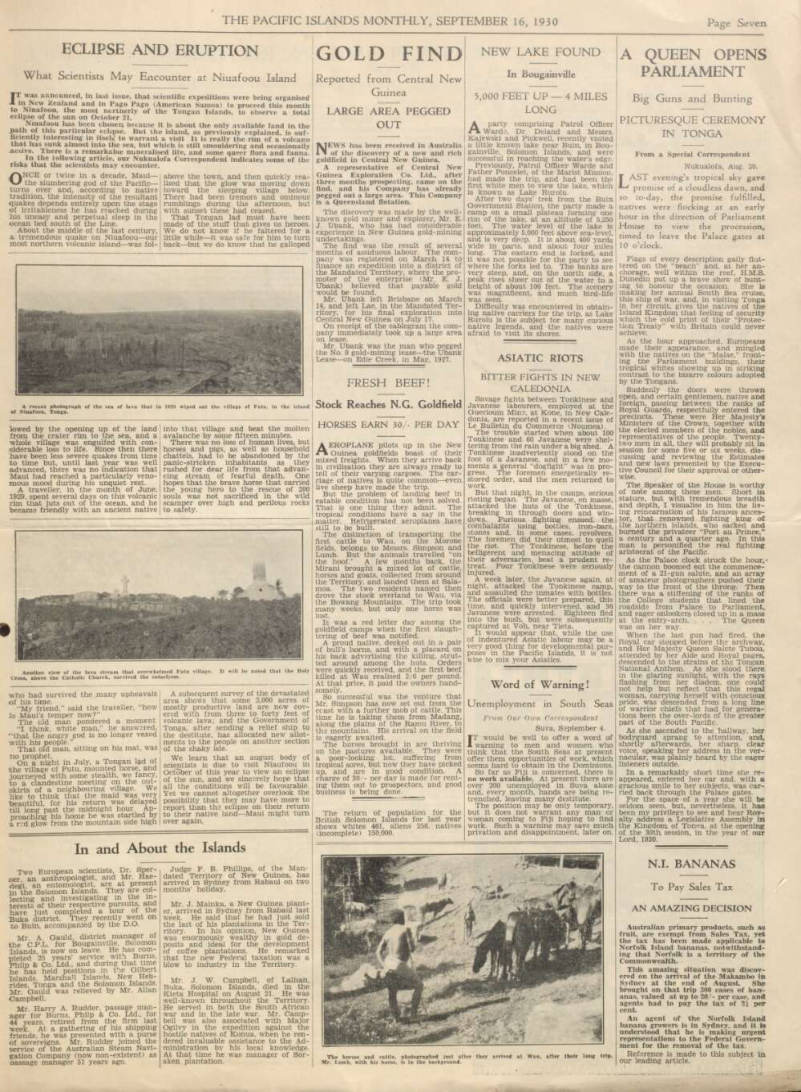
A recent photograph of the sea of lava that in 1929 wiped out the village of Futu, in the island of Niuafoou, Tonga.
Another view of the lava stream that overwhelmed Futu village. It will be noted that the Holy Cross, above the Catholic Church, survived the cataclysm.