"Despised”
Pacific Trade and Australia
Impressions Of A Fiji
Resident
FIJI’S trade goes where it is best served. Australia seemed to despise the Pacific as being a small place, and never made the most of her opportuni ties.
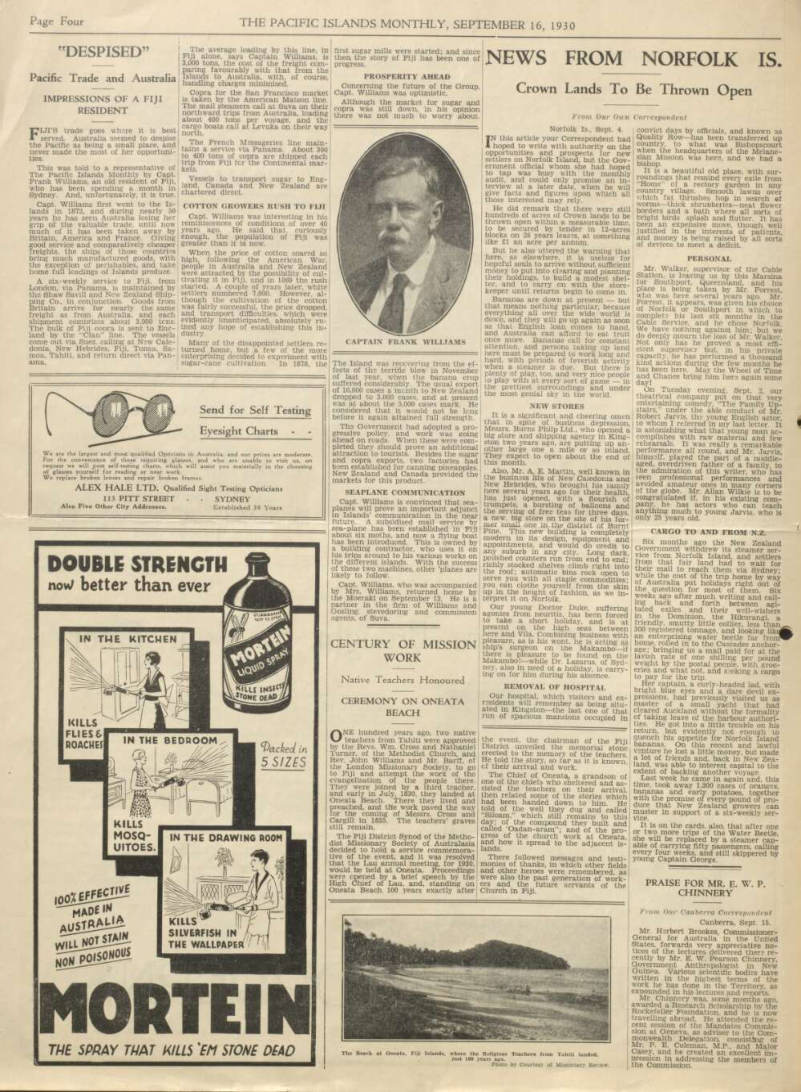
This was told to a representative of The Pacific Islands Monthly by Capt.
Frank Williams, an old resident of Fiji, who has been spending a month in Sydney. And, unfortunately, it is true.
Capt. Williams first went to the Is lands in 1872, and during nearly 50 years he has seen Australia losing her grip of the valuable trade, until now much of it has been taken away by Britain, America and France. Giving good service and comparatively cheaper freights, the ships of those countries bring much manufactured goods, with the exception of perishables, and take home full loadings of Islands produce.
A six-weekly service to Fiji, from London, via Panama, is maintained by the Shaw Savill and New Zealand Ship ping Co., in conjunction. Goods from Britain arrive for nearly the same freight as from Australia, and each shipment comnrises about 3,000 tens.
The bulk of Fiji copra is sent to England by the “Clan” line. The vessels come out via Suez, calling at New Cale donia, New Hebrides, Fiji, Tonga, Sa moa, Tahiti, and return direct via Pan ama.
The average loading by this line, in Fiji alone, says Captain Williams, is 3,000 tons, the cost of the freight com paring favourably with that from the Islands to Australia, with, of course, handling charges minimised.
Copra for the San Francisco market is taken by the American Matson line.
The mail steamers call at Suva on their northward trips from Australia, loading about 400 tons per voyage, and the cargo boats call at Levuka on their way north.
The French Messageries line main tains a service via Panama. About 300 to 400 tons of copra are shipped each trip from Fiji for the Continental mar kets.
Vessels to transport sugar to Eng land, Canada and New Zealand are chartered direct.
Cotton Growers Rush To Fiji
Capt. Williams was interesting in his reminiscences of conditions of over 40 years ago. He said that, curiously enough, the population of Fiji was greater than it is now.
When the price of cotton soared so high, following the American War, people in Australia and New Zealand were attracted by the possibility of cul tivating it in Fiji, and in 1869 the rush started. A couple of years later, white settlers numbered 7,000. However, al though the cultivation of the cotton was fairly successful, the price dropped, and transport difficulties, which were evidently unanticipated, absolutely ru ined any hope of establishing this in dustry.
Many of the disappointed settlers re turned home, but a few of the more enterprising decided to experiment with sugar-cane cultivation. In 1878, the
first sugar mills were started; and since then, the story of Fiji has been one of progress.
Prosperity Ahead
Concerning the future of the Group, Capt. Williams was optimistic.
Although the market for sugar and copra was still down, in his opinion there was not much to worry about.
The Island was recovering from the ef fects of the terrific blow in November of last year, when the banana crop suffered considerably. The usual export of 10,000 cases a mcnth to New Zealand dropped to 3,000 cases, and at present was at about the 5,000 cases mark. He considered that it would not be long before it again attained full strength.
The Government had adopted a pro gressive policy, and work was going ahead on roads. When these were com pleted they should prove an additional attraction to tourists. Besides the sugar and copra exports, two factories had been established for canning pineapples.
New' Zealand and Canada provided the markets for this product.
Seaplane Communication
Capt. Williams is convinced that sea planes will prove an important adjunct in Islands’ communication in the near future. A subsidised mail service by sea-plane has been established in Fiji about six moths, and now a flying boat has been introduced. This is owned by a building contractor, who uses it on his trips around to his various works on the different islands. With the success of these two machines, other ’planes are likely to follow.
Capt. Williams, who was accompanied by Mrs. Williams, returned home by the Moeraki on September 12. He is a partner in the firm of Williams and Gosling, stevedoring and commission agents, of Suva.