Opportunities In New Guinea
Chances For New Enterprise and New Capital
Bond-Selling Company Puts Faith In Coffee
Shrewd and experienced observers believe that a period of great development and expansion lies immediately ahead of New Guinea and Papua, where enterprise is being stimulated by gold production.
In this article, the potentialities of New Guinea are outlined.
In comparison with Australia, or any older country, the Territory of New Guinea has three things in its favour: (1) It has vast undeveloped resour ces, with amazing fertility and a heavy, regular rainfall. (2) It is free from the heavy taxa tion, and various other evils associated with over-government. (3) It has a large supply of cheap labour.
This Territory—which comprises one third of New Guinea (virtually a con tinent in itself), the huge, fertile island of New Britain (300 miles long by 30 broad), and the smaller but equally valuable islands of New Ireland and Bougainville offers opportunities for the investment of capital, and the en terprise of young men, such as are to be found in no other part of the world.
An hour ago, I talked about the Pacific Islands with a man who is clever and experienced, but tired —grey and bent under the weight of years.
He said “the Islands are finished,” and that New Guinea in particular is “wiped out.” He is interested in copra, and measures everything in terms of that commodity.
I think that, in these times of eco nomic stress, all the pessimistic old men should be rooted out of their executive chairs, and given a comfortable holi day somewhere, while the affairs of the immediate future are arranged by the younger men, to whom the future be longs. The world, certainly, is a little out of gear. But that only means it is a time for quick decisions, shrewd cal culation, confidence in the future. It is no time for croaking and pessimism, for the buttoning up of pockets and in sistence that everything is going to the “demnition bow-wows.”
Trade in the Islands is depressed.
The price offered for copra at present is sheer murder. There is no doubt that greedy, soul-less corporations are reaching their tentacles through the Pacific, taking advantage of financial conditions to gather in the plantations that have been built on the sweat and hopes of industrious men. There is no doubt, also, that other big corporations are carrying hundreds of men who, otherwise, would have been completely wiped out by this slump.
But to say that the “Islands are finished” and that “this is the end of the copra industry” is absurd and ri diculous. It would be just as logical to say that we are witnessing the end of the wool industry, and the metal-pro ducing industries, and the wheat growing industry, and all the other in dustries which give us raw material and foodstuffs.
The Islands are suffering the same economic sickness that is being more or less patiently endured by all the other countries in the world. It is being more generally felt here, because the Islands are dependent upon one main staple product—copra—whose price has fallen to unprecedented levels. But it can be taken as certain that when the world gets back to normal trading con ditions, as it will shortly, the Islands will return to normal trading, too.
There are going to be minor readjust ments of value. Substitutes have been found for copra, just as substitutes have been found for wool; but neither the cocoanut plantation nor the sheep-sta tion is going to be wiped out in a month, or a year, or a decade.
People are inclined to let the drifting clouds obscure their vision of the solid mountains behind. The world’s vast population is rapidly increasing. The average standard of living, everywhere,
is getting higher. The growth in the demand for every variety of tropical product during the past fifty years is nothing to the growth that we shall see in the, next half century. There may be spasms of over-production, with cor responding brief periods of depression— but it is as certain as the sunrise that the world will continue to want the rich oil of the cocoanut, the inimit able product of the rubber-trees, cocoa and coffee, pear and trochus shell.
Alternatives To Copra
For 20 years past, European effort in the Islands has been concentrated on the cultivation of the cocoanut palm.
It is difficult to get detailed figures, but it is certain that the increase in the production of copra has been enor mous. The same thing has been going i
on in Malaya, Ceylon and the Dutch East Indies. Possibly the time has ar rived when it is wise to suggest that further planting of cocoanut planta tions should be undertaken, at least, with caution. There are a very large number of new plantations in all parts come into full bearing.
Is this not a time when the other rich resources of the Islands should be considered? New Guinea provides vari ous typical alternatives to copra. Al thought the production of copra, no doubt, will remain the staple industry, this rich and fertile territory is capable of vast production in other directions.
There is, for instance, the production of cocoa. Already several cocoa plan tations have been established, and be fore long various planters in New Guinea will be producing on a fairly large scale. Cocoa flourishes in the rich volcanic soil —this has been amply demonstrated in Witu, off the north coast of New Britain, and also on the plantations in the Bainings, not far from Rabaul. There is a good world market for cocoa, and the Common wealth Government gives a bounty of £l3/10/- per ton.
What Of Coffee?
Then there is coffee. Investigation has shown that large areas of land on the various islands of the Mandate Ter ritory are eminently suitable to coffee growing, and there appears to be no reason why this region should not be come a notable producer of coffees of the finer Arabian types. The consump tion of coffee throughout the world is growing steadily.
A most interesting recent develop ment is the acquisition of a large area, on the Karavet River, in the Rabaul district, by a new company, entitled Islands Plantations Ltd., for the pur pose of establishing a coffee planta tion. It is a plan based on the bond selling system made familiar in re cent years by New Zealand timber growing and flax-planting enterprises, and there seems to be no reason why it should not become the forerunner of a rich and important New 1 Guinea in dustry. Three well-known New Guinea planters—Messrs. H, G. W. Hanson, V.
B. Pennefather and H. J. Washington— are the founders of the company, and details of the plan are given in an ad vertisement in this issue. The com pany proposes to proceed with its plant ing operations on sound lines and, if this pioneering work receives from the Administration and other large New Guinea interests the sympathy and co operation it seems to deserve, it may mark a new era in New Guinea de velopment.
There also is kapok. This is a pro duct for which there is a growing de mand throughout the world. Kapok seed from Java was introduced in 1926, and distributed among about 60 planters. Some have achieved success in its cultivation and, on present ap pearances it is likely that this will be come a large and profitable product of the Territory. The Commonwealth Government is seeking to stimulate kapok production with a bonus of 2d. per lb.
Cattle - Farming
The possibilities of cattle farming are not to be overlooked. There are now more than 14,000 cattle in the Ter ritory, and the numbers are steadily increasing. Rich pasture lands have been discovered in the Lower Sepik Valley, about 40 miles from the river mouth. Aeroplane flights have also disclosed excellent cattle country in the Markham Valley.
Up to the present, cattle have been pastured mostly in the cocoanut plantations, but there is now a tendency to open up country specially for cattle farming, and the possibilities in this connection appear to be unlimited, par
ticularly on the New Guinea main land. Of course, pasturage conditions are quite different to those in Aus tralia, but that is only a matter of ac climatisation.
Cattle farming is now an established industry in Fiji and Noumea, and to some extent in the Solomons; and there is no reason why it should not be de veloped in New Guinea —particularly in view of the increasing world shortage of beef.
What May Follow Gold Rush
We have said nothing about gold or the numerous other valuable minerals (tin, cooper, manganese, lead, magna tite, osmiridium, platinum, etc.),, which are found in such abundance throughout the territory. The story of New Guinea gold is told elsewhere. All of the other mineral deposits may be profitably worked.
The history of gold discovery throughout the world shows, almost without exception, that the huge im migration brought about by the gold fields rushes has been followed by tre mendously rapid development of the other natural resources of the country— particularly agricultural and pastoral.
This seems bound to happen in New Guinea. The wealth that is being dug out of the Morobe gorges will inevitably be reflected in the vast development of New Guinea’s other natural wealth.
Of course, there are serious prob lems for the Administration. One has to do with labour. It is doubtful whether native labour, sufficient now, will meet all future demands. There are already those who urge the estab lishment of a system of indentured Asiatic labour.
It seems likely that, sooner or later, the Administration will meet a serious challenge in regard to its native labour policy. The opinion is growing throughout the Territory that the sys tem of “pampering” the natives, and refusing to allow planters to maintain satisfactory discipline by imposing minor punishment, is leading to awk ward complications. The subject is closely linked with the whole question of labour supply.
But that is a minor matter. The thing that interests Australia to-day is the fact that, despite temporary de pression in the copra industry, New Guinea apparently is at the point of tremendous development and expansion, and is well worthy of the attention, not only of Australian investors, but of all Australian young men who are seeking a useful career under interesting and attractive conditions.
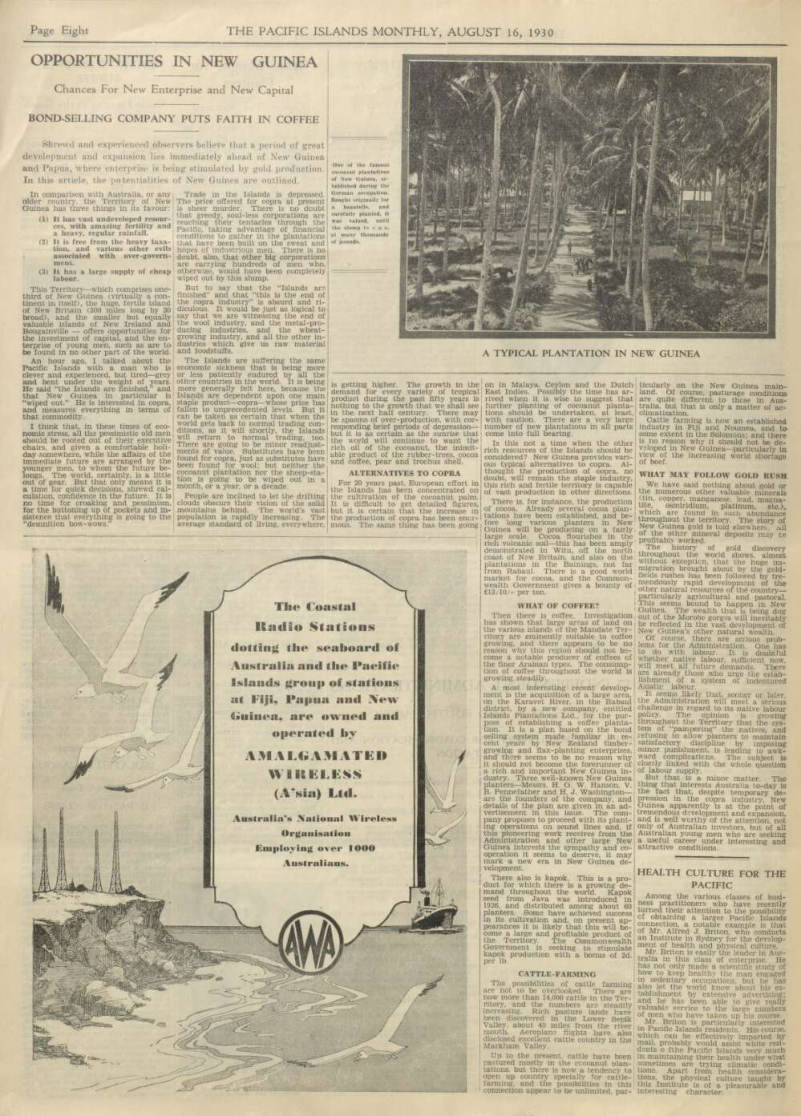
One of the famous cocoanut plantations of New Guinea, es tablished during the German occupation.
Bought originally for a bagatelle, and carefully planted, it was valued, until the slump in c.p.a, at many thousands of pounds.