Cattle-Farming in the South
Fiji Now Exports
Butter
Cattle-Farming in the South Seas
AN interesting feature of Pacific Islands development is that cattle-breeding has been com menced in several of the larger Islands, and that the dairying in dustry has been actually estab lished in Fiji.
Up until about 1922 Fiji imported annually butter of the value of about £12,000. Then it was found that the business of cattle-farming—introduced many years ago in order to provide
fresh meat and milk on the planta tions—might be extended to dairying, in the Australian sense of the word.
Three butter factories were established: at Korovou, at Waila (Rewa), and at Tamanua (Navua). By 1927 those fac tories had overtaken the whole of the local demand, and 484 cwt. were ex ported. The annual value of the fac tory butter produced now in Fiji is over £20,000, and there are over 70,000 cattle in the group.
In the Solomon Islands —the least civilised and developed of all the nearer groups—there are some 15,000 head of cattle. Introduced first to crop the grasses in the cocoanut plantations, and provide the planters with milk and fresh meat, they have flourished and multiplied. It is possible that as set tlement extends over these extensive territories cattle-farming will become an important industry. Even on un tamed Malaita, where settlement is re tarded owing to the ferocity of the natives, there are some 700 cattle.
There are 5,000 cattle in the eastern section of Papua, while in the man date territory of New Guinea, distrib uted through all divisions, there are over 14,000 head.
In the French territory of New Cale donia, which lies in the latitude of Rockhampton, only a few hundred miles from the Australian coast, cattle raising is carried on on an extensive scale, and there are several canning factories.
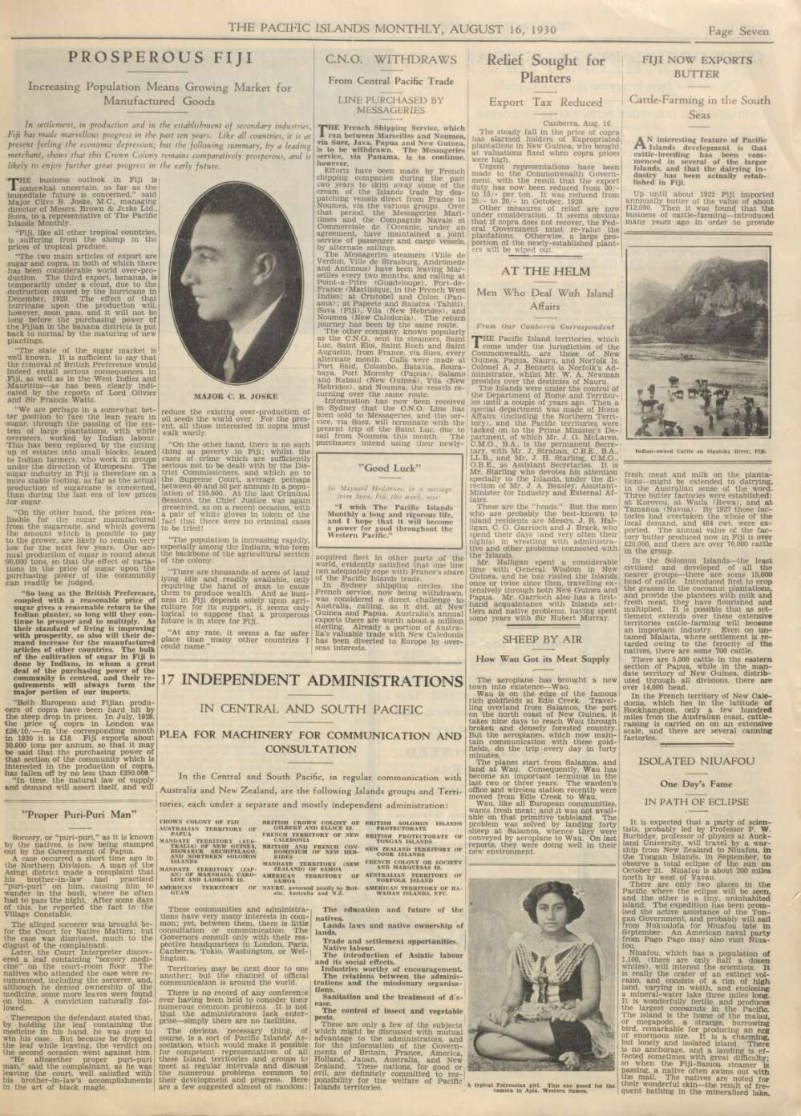
Indian-owned Cattle on Sigatcka River, Fiji.