Is Edie Creek Another
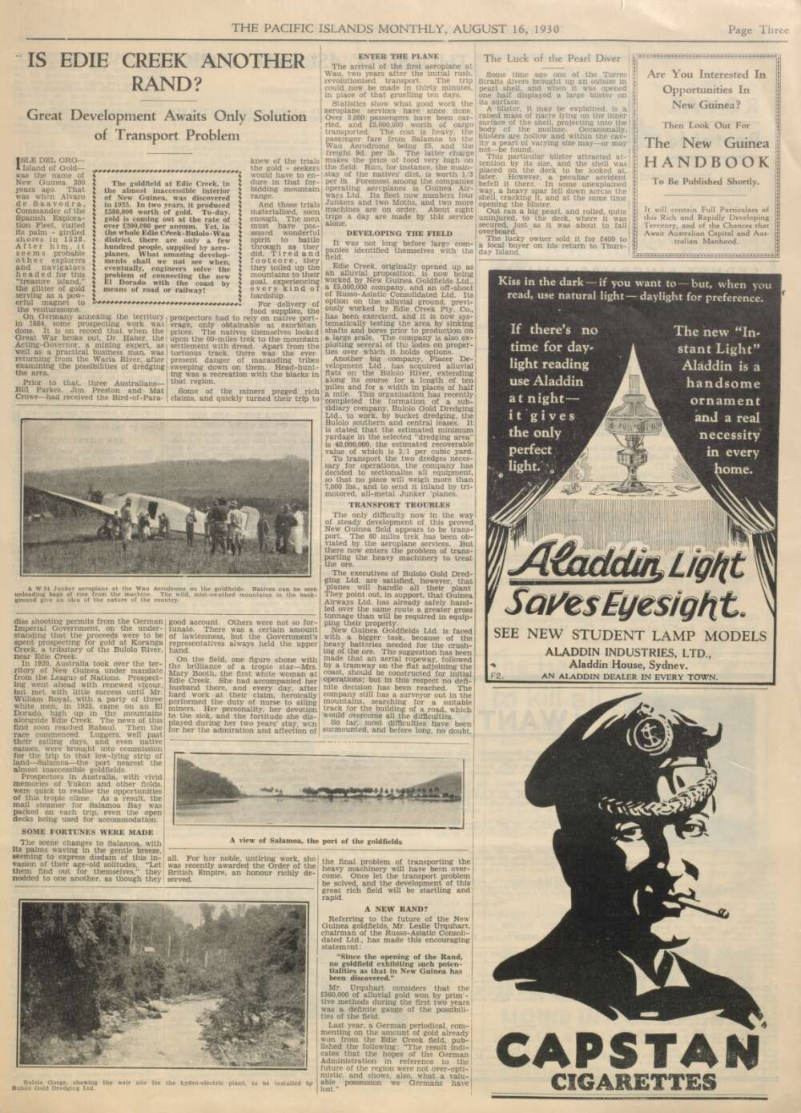
Rand?
Great Development Awaits Only Solution of Transport Problem
Isle Del Oro—
Island of Gold — was the name of New Guinea 300 years ago. That was when Alvaro de Saavedra, Commander of the Spanish Explora tion Fleet, visited its palm-girdled shores in 1528.
After him, it seems probable other explorers and navigators headed for this “treasure island,” the glitter of gold serving as a pow erful magnet to the venturesome.
On Germany annexing the territory in 1884, some prospecting work was done. It is on record that when the Great War broke out, Dr. Haber, the Acting-Governor, a mining expert, as well as a practical business man, was returning from the Waria River, after examining the possibilities of dredging the area.
Prior to that, three Australians— Bill Parkes, Jim Preston and Mat Crowe—had received the Bird-of-Para-
The goldfield at Edie Creek, in the almost inaccessible interior of New Guinea, was discovered in 1925. In two years, it produced £580,000 worth of gold. To-day, gold is coming out at the rate of over £200,000 per annum. Yet, in the whole Edie Creek-Bulolo-Wau district, there are only a few hundred people, supplied by aero planes. What amazing develop ments shall we not see when, eventually, engineers solve the problem of connecting the new El Dorado with the coast by means of road or railway!
knew of the trials the gold-seekers would have to en dure in that for bidding mountain range.
And those trials materialised, soon enough. The men must have pos sessed wonderful spirit to battle through as they did. Tired and footsore, they they toiled up the mountains to their goal, experiencing every kind of hardship.
For delivery of food supplies, the
prospectors had to rely on native port erage, only obtainable at exorbitant prices. The natives themselves looked upon the 60-miles trek to the mountain settlement with dread. Apart from the tortuous track, there was the ever present danger of marauding tribes sweeping down on them. Head-hunting was a recreation with the blacks in that region.
Some of the miners pegged rich claims, and quickly turned their trip to
dise shooting permits from the German Imperial Government, on the under standing that the proceeds were to be spent prospecting for gold at Koranga Creek, a tributary of the Bulolo River, near Edie Creek.
In 1920, Australia took over the ter ritory of New Guinea under mandate from the League of Nations. Prospect ing went ahead with renewed vigour, but met with little success until Mr.
William Royal, with a party of three white men, in 1925, came on an El Dorado, high up in the mountains alongside Edie Creek. The news of this find soon reached Rabaul. Then the race commenced. Luggers, well past their sailing days, and even native canoes, were brought into commission for the trip to that low-lying strip of land —Salamoa —the port nearest the almost inaccessible goldfields.
Prospectors in Australia, with vivid memories of Yukon and other fields, were quick to realise the opportunities of this tropic clime. As a result, the mail steamer for Salamoa Bay was packed on each trip, even the open decks being used for accommodation.
Some Fortunes Were Made
The scene changes to Salamoa, with its palms waving in the gentle breeze, seeming to express disdain of this in vasion of their age-old solitudes. “Let them find out for themselves,” they nodded to one another, as though they
good account. Others were not so for tunate. There was a certain amount of lawlessness, but the Government’s representatives always held the upper hand.
On the field, one figure shone with the brilliance of a tropic star —Mrs.
Mary Booth, the first white woman at Edie Creek. She had accompanied her husband there, and every day, after hard work at their claim, heroically performed the duty of nurse to ailing miners. Her personality, her devotion to the sick, and the fortitude she dis played during her two years’ stay, won for her the admiration and affection of
all. For her noble, untiring work, she was recently awarded the Order of the British Empire, an honour richly de served.
Enter The Plane
The arrival of the first aeroplane at Wau, two years after the initial rush, revolutionised transport. The trip could now be made in thirty minutes, in place of that gruelling ten days.
Statistics show what good work the aeroplane services have since done.
Over 3,000 passengers have been car ried, and £3,000,000 worth of cargo transported. The cost is heavy, the passenger fare from Salamoa to the Wau Aerodrome being £5, and the freight 9d. per lb. The latter charge makes the price of food very high on the field. Rice, for instance, the main stay of the natives’ diet, is worth 1/3 per lb. Foremost among the companies operating aeroplanes is Guinea Air ways Ltd. Its fleet now numbers four Junkers and two Moths, and two more machines are on order. About eight trips a day are made by this service alone.
Developing The Field
It was not long before large com panies identified themselves with the field.
Edie Creek, originally opened up as an alluvial proposition, is now being worked by New Guinea Goldfields Ltd., a £5,000,000 company, and an off-shoot of Russo-Asiatic Consolidated Ltd. Its option on the alluvial ground, previ ously worked by Edie Creek Pty. Co., has been exercised, and it is now sys tematically testing the area by sinking shafts and bores prior to produdppnbn a large scale. The company is also ex ploiting several of the lodes on proper ties over which it holds options.
Another big company, Placer De velopment Ltd., has acquired alluvial flats on the Bulolo River, extending along its course for a length of ten miles and for a width in places of half a mile. This organisation has recently completed the formation of a sub sidiary company, Bulolo Gold Dredging Ltd., to work, by bucket dredging, the Bulolo southern and central leases. It is stated that the estimated minimum yardage in the selected “dredging area” is 40,000,000, the estimated recoverable value of which is 2/1 per cubic yard.
To transport the two dredges neces sary for operations, the company has decided to sectionalise all equipment, so that no piece will weigh more than 7,000 lbs., and to send it inland by tri motored, all-metal Junker ’planes.
Transport Troubles
The only difficulty now in the way of steady development of this proved New Guinea field appears to be trans port. The 60 miles trek has been ob viated by the aeroplane services. But there now enters the problem of trans porting the heavy machinery to treat the ore.
The executives of Bulolo Gold Dred ging Ltd. are satisfied, however, that ’planes will handle all their plant They point out, in support, that Guinea Airways Ltd. has already safely hand led over the same route a greater gross tonnage than will be required in equip ping their property.
New Guinea Goldfields Ltd. is faced with a bigger task, because of the heavy batteries needed for the crush ing of the ore. The suggestion has been made that an aerial ropeway, followed by a tramway on the flat adjoining the coast, should be constructed for initial operations; but in this respect no defi nite decision has been reached. The company still has a surveyor out in the mountains, searching for a suitable track for the building of a road, which would overcome all the difficulties.
So far, most difficulties have been surmounted, and before long, no doubt,
the final problem of transporting the heavy machinery will have been over come. Once let the transport problem be solved, and the development of this great rich field will be startling and rapid.
A New Rand?
Referring to the future of the New Guinea goldfields, Mr. Leslie Urquhart, chairman of the Russo-Asiatic Consoli dated Ltd., has made this encouraging statement: “Since the opening of the Rand, no goldfield exhibiting such poten tialities as that in New Guinea has been discovered.”
Mr. Urquhart considers that the £580,000 of alluvial gold won by primtive methods during the first two years was a definite gauge of the possibilities of the field.
Last year, a German periodical, com menting on the amount of gold already won from the Edie Creek field, pub lished the following: “The result indi cates that the hopes of the German Administration in reference to the future of the region were not over-optimistic, and shows, also, what a valuable possession we Germans have lost.”
The Luck of the Pearl Diver
Some time ago one of the Torres Straits divers brought up an outsize in pearl shell, and when it was opened one half displayed a large blister on its surface.
A blister, it may be explained, is a raised mass of nacre lying on the inner surface of the shell, projecting into the body of the mollusc. Occasionally, blisters are hollow and within the cav ity a pearl of varying size may—or may not—be found.
This particular blister attracted at tention by its size, and the shell was placed on the deck to be looked at, later. However, a peculiar accident befell it there. In some unexplained way, a heavy spar fell down across the shell, cracking it, and at the same time opening the blister.
Out ran a big pearl, and rolled, quite uninjured, to the deck, where it was secured, just as it was about to fall overboard.
The lucky owner sold it for £400 to a local buyer on his return to Thurs day Island.
A W 34 Junker aeroplane at the Wau Aerodrome on the goldfields. Natives can be seen unloading bags of rice from the machine. The wild, mist-swathed mountains in the back ground give an idea of the nature of the country.
Bulolo Gorge, showing the weir site for the hydro-electric plant, to be installed by Bulolo Gold Dredging Ltd.
A view of Salamoa, the port of the goldfields