Radio Links The Pacific
pp. 1-2 · Read in the full issue
Life In The Islands Has Been Revolutionised By Wireless
Centres Of The Pacific Network
SUVA (to Sydney, Samoa, Tonga, New Caledonia, New Hebrides, Gilbert & Solomon Is., Hawaii, and San Francisco). 3 sub-stations in Fijian Islands.
RABAUL (to Sydney, Gilbert, Solomon, Caroline, and Marshall Is.). 7 Sub-stations in Mandated Territory.
Port Moresby (To Aus-
tralia) . 1 Sub-station in Samarai.
NOUMEA (to Sydney, Suva, Vila).
Sub-stations in Allied Is.
NUKUALOFA (to Suva, Apia). 1 Sub-station in Tonga.
APIA (to Suva, Wellington and Hawaii, Cook and Hervey Islands). 6 Sub-stations in Samoan Islands.
TULAGI (to Rabaul and Suva). 1 Sub-station in Solomon Islands.
OCEAN ISLAND (to Rabaul, Nauru and. Suva). 3 Sub-stations in Gilbert and Ellice Islands.
RAROTONGA (to Suva, and Wellington). 4 Sub-stations in Cook Is.
TAHITI (to Apia). 3 Sub-stations in Society and Marquesas Islands.
TRUK (to Japan & Rabaul).
Sub-stations in Marshall, Caroline and Marianne Islands.
PRACTICALLY all the Europeanised towns and settlements in the Pacific Island, and many plantations and trading stations, now have direct communication with the rest of the world.
The complete isolation of "the Islands,” which early in this century was at once their greatest charm and their most serious handicap, is a thing of the past. The economic importance of this development, and its effect on the future of the Pacific, cannot be exaggerated.
TWENTY years ago, a man who lived in Bougainville or Vanua Levu, or Aitutaki, was almost as inaccessible as if he were buried in Darkest Africa. A letter written in London, or Sydney, or New York, might reach him six months after it was posted. To-day, a resident of almost any of the Pacific Islands, unless he is very remotely situated, can send a message to Europe, or America, or Australia, and receive a reply within twelve hours. To-day, people who reside in Rabaul or Vila, Suva or Nukualofa or Rarotonga, are little, if any more isolated, in relation to world affairs, than if they lived in New Zealand, Natal, or Newfoundland.
The magic of radio has revolutionised life in The Islands. Europeans may make their homes in the South Seas, enjoy the benefits of climate, soil-fertility, cheap labour, and the charm of sunshine and colour, while suffering none of the disadvantages of complete separation from their friends or their business principals, which residence in the Pacific entailed for so many decades.
The coming of wireless, and the development of the internal combustion engine, have removed from Islands life whatever terrors previously existed by reason of isolation and loneliness, and have greatly reduced the element of risk in the operations of planters and merchants. Even residents on the outer islands of the groups need be no more isolated than an Australian inland squatter. Radio takes the place of the squatter’s long-distance telephone; and, instead of the grazier’s motor-car, the planter has a fast-travelling, petrol driven launch, which conveys him easily to the trading centre and the route of the mail-steamers.
Few people realise how completely the Islands are covered, now, by a network of wireless stations.
In the eastern and north-eastern Islands, nearest to Australia, there are three main wireless centres, which have direct communication with Australia, on the one hand, and, on the other with the smaller “feeder” stations in the Islands round about. Northwards, in the Marshalls and Carolines, and eastward in Samoa, the Cook Islands, Tahiti, etc., there are other similar radio organisations.
The history of what has happened in the nearer Islands provides an example of radio developments throughout the Pacific.
In 1914, when war broke out, Islands radio stations were just beginning to be commercially valuable. Already, a few had been established. It will be remembered that the first Australian casualties occurred when the Australian force was seizing the German
wireless station at Rabaul; and that
the Emden was trapped at Cocos Island, on November 9, 1914, because the radio operator got a message away to
H. M. A. S.
Sydney before the Germans could get ashore and destroy his apparatus.
There was a German wireless sta-
tion at Apia when the New Zealanders took possession of Samoa in September, 1914.
But it was not until after the War that the Governments of Britain, France, United States, Australia and New Zealand, as administrators of Islands territories, began to link up the fertile and beautiful lands of the South Pacific with a real network of wireless.
In 1922, while he was in England, Mr. E. T. Fisk, managing director of Amalgamated Wireless (Aust.) Ltd., interviewed the British authorities, and urged that, for purposes of efficient coordination and operation, the whole of the British radio stations in the South western Pacific should be controlled by A.W.A, It was pointed out that other nations were becoming active in the installation of wireless stations in their Pacific Islands possessions, and that,
SEE MAP WITH CONTINUATION OF THIS ARTICLE ON PAGE 2
Radio Station at Bita Paka, near Rabaul
The London Missionary Society’s new steamer “John Williams V.” will leave England in the middle of September for the Gilbert Islands, via Suva. The old John Williams, known these many years in every Islands port, will under go permanent retirement. ... ———
The Magic Of Wireless Communication
Continued From Page 1
by simply operating a number of isolated stations in the Pacific, Britain could not hope to meet this competition. Fortunately, Britain saw the force of the argument; Mr. Fisk’s suggestion was accepted; and to-day A.W.A.’s Australian coastal stations are closely operated in conjunction with the wireless networks in New Guinea, Papua, and Fiji, where three large and many small installations are in charge of A.W.A. men.
Suva—Rabaul—Pt. Moresby
The radio station at Suva is a very important one. Not only does it handle all traffic with the three Fijian substations (at Labasa, Savu Savu and Taveuni, which are places outside the Fijian telephone and telegraphic services), but it also maintains communication with the main radio stations in Samoa, Tongan Islands, Gilbert and Ellice Islands, New Caledonia and New Hebrides. None of the latter are under A.W.A. control, though working with A.W.A. in close co-operation and harmony.
The daily broadcast of weather reports from Suva has proved of inestimable value to shipping, and to residents throughout the Pacific, particularly in the hurricane season The second centre is at Bita Paka, near Rabaul, on the great island of New Britain, which is part of the New Guinea (mandate) administrative area.
This station not only handles all telegraphic traffic between Sydney and New Guinea (now a very considerable volume), but also maintains contact with its numerous sub-stations through out the territory—namely, Aitape and Madang, on the New Guinea mainland; Manus, in the Admiralty Islands, northwards of Rabaul; Kavieng, in the island of New Ireland; Kieta, in Bougainville, one of the Solomon Islands, which is included in, the mandate; Bulolo and Salamoa, on the goldfields, in the interior of New Guinea. Rabaul Radio also has regular contact with the stations at Tarawa, in the Gilberts; Ocean Island (headquarters of the Gilbert and Ellice administration); Vanikoro (in the Santa Cruz group, part of the Solomon slands administration); and Tulagi (headquarters of (the Solomons administration) .
The third important Islands radio centre controlled by A.W.A. is at Port Moresby, capital of Papua. This station communicates with Samarai, at the eastern end of Papua, and with Townsville, Thursday Island and other Australian coastal stations. It maintains contact with the private installations of the oil-boring companies when operating in Papuan Territory.
What A.W.A. Is Doing
The whole of this vast A.W.A. network, which 20 years ago would have seemed a fantastic dream, is being operated to-day with complete efficiency. The Islands residents are now in close contact with the rest of the world, sending and receiving messages in ever-increasing volume. They can receive at exceptionally low rates from Sydney a daily bulletin, summarising the news of the world.
It may fairly be claimed for Amalgamated Wireless, with its efficient plant, splendid personnel and ever widening sphere of operations, that it will rank in the future with great firms like Burns Philp & Co. Ltd., Morris Hedstrom Ltd., and others whose activities have profoundly influenced the development of these Southern Pacific lands. Radio is changing the Islands from a semi-legendary region of adventure and romance into a home for prosperous, healthy and happy Europeanised communities.
Other Radio Networks
Up north, in the Caroline and Marshall Islands, there is a wireless net-
work operated by Japan, which hold these groups under mandate. There are stations at Truk and Ponape, administrative centres in the Eastern Carolines; at Palau and Yap, administrative centres in the Western Carolines; and at Angaur. There is a station at Jaluit, the chief town of the Marshalls and at Saipan, administrative centre of the Marianne group (which is part of the Japanese mandate). Truk, Yap, Jaluit and Saipan maintain contact with Rabaul, but most of their traffic of course, is routed via Japan.
The administration at Nauru (where a considerable British, Asiatic and native population is working the phosphate deposits) maintains a wireless station, which communicates chiefly through Rabaul and Suva. Ocean Island (headquarters of the Gilbert and Ellice administration) has contact with three substations—Tarawa, in the Gilberts (operated by Burns Philp), Beru (mission station), and Ooma (British
Phosphate Commission).
Contact between the British Solomon Islands Protectorate and the outer world is maintained via the wireless station at Tulagi, the administrative centre. There are also two privately owned stations in the Solomons—one at Roviana, in Gizo, owned by the Methodist Mission; and one at Vanikoro, in the Santa Cruz group, owned by the Vanikoro Kauri Timber Company.
Communication with the large and flourishing French Colony of New Caledonia is maintained through the wireless station at Noumea. This magnificent island is equipped with 900 miles of telegraphs and 750 miles of telephone wires, so there is no need for radio sub-stations; but in the populous dependencies included by France in the New Caledonia administration— Isle of Pines. Wallis Islands, Loyalty Islands, Fatuna—there is plenty of use for radio sub-stations.
The station at Vila, the administrative headquarters of New Hebrides Condominium, is worked by a British and a French operator. The bulk of the traffic is with Noumea, but there is also daily communication with Suva.
Radio communication is fully availed of in the wealthy British protectorate of Tonga. The main station at Nukualofa, maintained by the Tongan Government, communicates with Suva and Apia. The sub-station at Vavau has been in existence for some years, communicating only with Nukualofa; and last year the Government ordered the installation of three more sub-stations.
What New Zealand Is Doing
There is a fine, modern station at Apia, headquarters of New Zealand’s administration of Western Samoa.
There are sub-stations at three other centres on Upolu and Savaii, and at Fakaofa, chief town of the Tokelau islands, now governed by New Zealand from Apia. A most interesting fact is that the operators of all these substations are educated natives. Apia and sub-stations, in 1929, handled messages containing over 570,000 words.
In Eastern Samoa (American) there is a high-powered station in Tutuila, and sub-stations on the islands of Tau and Ofu.
New Zealand also makes full use of wireless in her administration of the Cook Islands and Nuie. The station at Rarotonga communicates with Apia; and sub-stations in the islands of Aitutaki, Atiu, Mangaia communicate with Rarotonga. The large island of Nuie, with its separate administration, maintains a station in direct communication with Apia.
Still further east, France maintains a radio network by which the outlying islands of the Society, Paumotu and Marquesas groups are kept in contact with the administrative headquarters at Papeete, chief town of Tahiti. ... ———
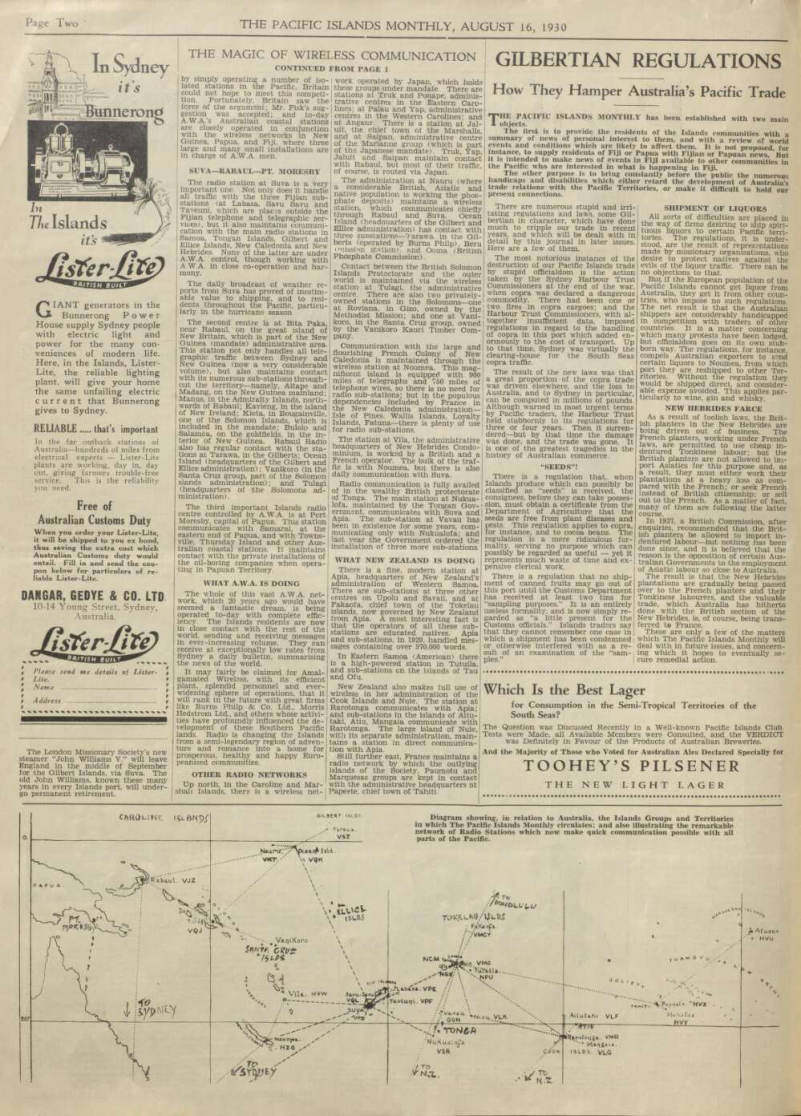
Diagram showing, in relation to Australia, the Islands Groups and Territories in which The Pacific Islands Monthly circulates; and also illustrating the remarkable network of Radio Stations which now make quick communication possible with all parts of the Pacific.