successful Euro tour
pp. 52-53 · Read in the full issue
Te Vaka returns after third successful Euro tour
By Gift Johnson
MOST of the European audi ences that have thronged to hear Polynesian contempo rary music group Te Vaka on tom over the past three years had previ ously never heard of the remote South Pacific Tokelau Islands where the music stems from.
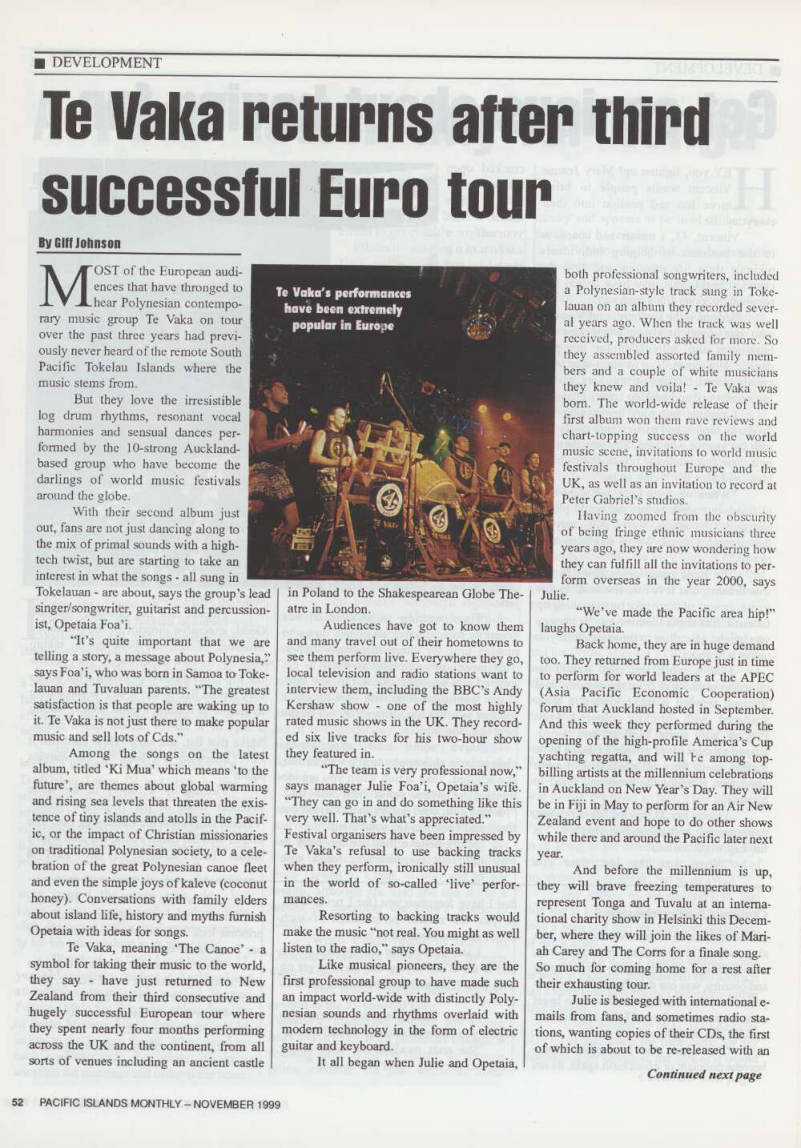
But they love the irresistible log drum rhythms, resonant vocal harmonies and sensual dances per formed by the 10-strong Auckland based group who have become the darlings of world music festivals around the globe.
With their second album just out, fans are not just dancing along to the mix of primal sounds with a high tech twist, but are starting to take an interest in what the songs - all sung in
Tokelauan - are about, says the group’s lead singer/songwriter, guitarist and percussion ist, Opetaia Foa’i.
“It’s quite important that we are telling a story, a message about Polynesia,” says Foa’i, who was born in Samoa ta Toke lauan and Tuvaluan parents. “The greatest satisfaction is that people are waking up to it. Te Vaka is not just there to make popular music and sell lots of Cds.”
Among the songs on the latest album, titled ‘Ki Mua’ which means ‘to the future’, are themes about global warming and rising sea levels that threaten the exis tence of tiny islands and atolls in the Pacif ic, or the impact of Christian missionaries on traditional Polynesian society, to a cele bration of the great Polynesian canoe fleet and even the simple joys of kaleve (coconut honey). Conversations with family elders about island life, history and myths furnish Opetaia with ideas for songs.
Te Vaka, meaning ‘The Canoe’ - a symbol for taking their music to the world, they say - have just returned to New Zealand from their third consecutive and hugely successful European tour where they spent nearly four months performing across the UK and the continent, from all sorts of venues including an ancient castle
Audiences have got to know them and many travel out of their hometowns to see them perform live. Everywhere they go, local television and radio stations want to interview them, including the BBC’s Andy Kershaw show - one of the most highly rated music shows in the UK. They record ed six live tracks for his two-hour show they featured in.
“The team is very professional now,” says manager Julie Foa’i, Opetaia’s wife.
“They can go in and do something like this very well. That’s what’s appreciated.”
Festival organisers have been impressed by Te Vaka’s refusal to use backing tracks when they perform, ironically still unusual in the world of so-called ‘live’ perfor mances.
Resorting to backing tracks would make the music “not real. You might as well listen to the radio,” says Opetaia.
Like musical pioneers, they are the first professional group to have made such an impact world-wide with distinctly Poly nesian sounds and rhythms overlaid with modem technology in the form of electric guitar and keyboard.
It all began when Julie and Opetaia,
both professional songwriters, included a Polynesian-style track sung in Toke lauan on an album they recorded sever al years ago. When the track was well received, producers asked for more. So they assembled assorted family mem bers and a couple of white musicians they knew and voila! - Te Vaka was born. The world-wide release of their first album won them rave reviews and chart-topping success on the world music scene, invitations to world music festivals throughout Europe and the UK, as well as an invitation to record at Peter Gabriel’s studios.
Having zoomed from the obscurity of being fringe ethnic musicians three years ago, they are now wondering how they can fulfill all the invitations to per form overseas in the year 2000, says
Julie.
“We’ve made the Pacific area hip!” laughs Opetaia.
Back home, they are in huge demand too. They returned from Europe just in time to perform for world leaders at the APEC (Asia Pacific Economic Cooperation) forum that Auckland hosted in September.
And this week they performed during the opening of the high-profile America’s Cup yachting regatta, and will be among top billing artists at the millennium celebrations in Auckland on New Year’s Day. They will be in Fiji in May to perform for an Air New Zealand event and hope to do other shows while there and around the Pacific later next year.
And before the millennium is up, they will brave freezing temperatures to represent Tonga and Tuvalu at an interna tional charity show in Helsinki this Decem ber, where they will join the likes of Mari ah Carey and The Corrs for a finale song.
So much for coming home for a rest after their exhausting tour.
Julie is besieged with international e mails from fans, and sometimes radio sta tions, wanting copies of their CDs, the first of which is about to be re-released with an
Continued next page
in Poland to the Shakespearean Globe The atre in London.
Te Vaka's performances have been extremely popular in Europe
Continued from previous page
additional new song. Or university students from the USA and Austria who are studying their music.
She also organises their tours and finalises contracts for gigs which means not just the ever-increasing fees they are offered but the finer points of ensuring they get food they like - raw fish, fresh meat and plenty of water - to sustain them during hec tic tour schedules.
Meanwhile, Opetaia locks himself away in his homegrown recording studio with the latest sound equipment, walls bedecked with tapa cloth, in their rustic home among the native bush in west Auck land.
Making music is very much a family affair, with both parents at the helm and all four children involved.
Alana, 17, sings and dances and is the gorgeous young woman on the cover of the second album, while Manase, 15, plays the pate liki (rhythm drums) and pate toa (double log drums). Matatia, 9, and Olivia, 4, sell CDs, T-shirts, flax baskets, posters during shows and occassionally get up on stage to dance.
Three other members of the group are from the Foa’i extended family, including lead female vocalist Sulata Foa’i who has recent ly taken time out to take care of her second child. Andrew Dukeson, on drum kit and log drums, and Neil Forrest (on percussion, electric guitar, rhythm and double log
drums) are both Pakeha (white) New Zealanders with a flair for Polynesian music.
Surprisingly, tensions remain at bay despite the pressures of being ‘on the road’ for long periods. This year they drove from gig to gig between England, Scotland, Germany, Holland and Poland, in two vans they have bought.
Severe flu’ when they first arrived, and numerous mechanical problems that led to hilarious encounters with German mechan ics whose verdict on their problem was ‘kaput!’ didn’t dampen their spirits. On the contrary.
“The only thing I can accuse them of is laughing too much,” quips Opetaia. ■