A 'read' letter day for Tonga
pp. 50-51 · Read in the full issue
By Michael Reid
IT was one of those sad, ill-fated affairs of the heart few are blessed or cursed with, doomed to fail and inevitably leaving
deep, slow healing scars.
She was a princess, he was a cop and a commoner. They met in 1985 in an Auck land hotel and the rest ... well it was their affair and no business for the rest of the world.
Except High Royal Highness Salote
Mafile’o Pilolevu, 48, only daughter of King Taufa’ahau Tupou IV and sixth in line of succession, is involved in a fierce power struggle in the Kingdom of Tonga. She is vulnerable to attack for that alone; she makes it harder for herself by preaching to her sub jects on morality, God and service.
And then there is, too, the strange story behind the other man, one Josh Liava’a, now manager of a Sydney night club, renowned within the Tongan communi ty for his relationships with the royals.
Way back in 1969 Liava’a met a 21year-old university student in Auckland and after a short romance, they married. She was Princess Mele Siu’ilikutapu, eldest daughter of Prime Minister Prince Tu’ipelehake, 13th in line to the Tongan throne. When word got back to Nuku’alofa, her uncle, the king, annulled the marriage and ordered her home.
By some accounts Liava’a deter mined to get even the royals.
Pilolevu married a noble, Tuita, and together they produced three daughters. During the 1980 s he was Tonga’s Fligh Commis sioner to London.
Liava’a went on to marry again and have a family. Then Liava’a and Pilolevu met and had what was essentially a private romance which lasted until 1996. Many people will say today that they knew of it then, but nothing was said at the time. A couple of things happened to change the
picture.
Pilolevu became immensely rich, more or less overnight, when she took the controlling stake in Tongasat, the ‘government-owned but now Hong Kong-based satel lite slot leasing company.
Although the operation was based on Tonga’s sovereign rights to
geostationary satellite orbiting slots, Pilole vu had no apparent reservations about turn ing it into personal wealth.
The US-based Fortune magazine esti mated four years ago that she was worth US$25 million. She has been careful more recently not to disclose what she is worth, but it is considerably more now. This has
prompted questions in Tonga’s Legislative
Assembly for proper accounting of what she
is doing.
Meantime she has won the battle with her brother, Crown Prince Tupuoto’a, for vir tual control over her ageing father. It was her and her’private satellite interests that got Tonga to switch from diplomatic recognition from Taiwan to China. It will add to her wealth, although she said she did it “as a means of spreading the Lord’s words to China.”
“When China opens its doors to
Christian evangelists, Tonga should be right
there by the door.”
There is also a deeper battle over suc cession to the 81-year-old king.
Tupuoto’a, unmarried, without any known heirs and irritable in his premature old age, is resisting calls from his father to become prime minister. He just wants to make
money and appears to be tired of the royal family and its religion.
Pilolevu, by default, has become the grey eminence of Tonga.
Liava’a, who had gone on to become the first Tongan sergeant in the New Zealand police force and then became bankrupt, moved to Australia. His marriage broke up.
And then, seemingly in the battle over Ton gasat and power, a 10-page letter from Pilolevu to Liava’a entered circulation in Tonga. Every member of parliament received a copy. They seemed to pass it on to their 10 favourite constituents and onwards.
Every top civil servant had a copy; even the local media had it. They did not publish it mainly because, as one senior journalist put it, “we do not know how to publish it.”
For a couple of months, stories about the letter floated to NZ, although not many had seen a copy. It was apparent it was caus ing turmoil within the very highest ranks of Tongan society. The Royal Family knew that everybody else now knew what had hap
pened.
Several sources finally leaked the let ter. Written questions to the Royal Palace and the Prime Minister’s Office over it went unanswered. It is virtually impossible to ver ify it now, although Liava’a had admitted it was to him and he clearly believes it came from her.
Beginning “My Darling Josh” the let ter has a sad, forbidden, failed love tone to it.
Without much doubt the author - identified only as “P” - was smitten by this man. She was giving her heart to him; even though it could not, would not work.
“ Josh, I tried so hard to forget you; even going to the extent of flirting with two chaps in a win bar, anything to get you out of my system, so to speak, but to no avail!”
She speaks of astonishment to find that she is a normal human being who “can love a man and feel the hurt and desolation
of being apart.”
Some of it, in a Tongan setting, could be seen as explicit; but between two adults it has a naturalness that brings sympathy rather than distaste.
“I was bought up NOT TO FALL IN LOVE, so that when the time came for my marriage to be arranged, the idea of it would
Continued next page
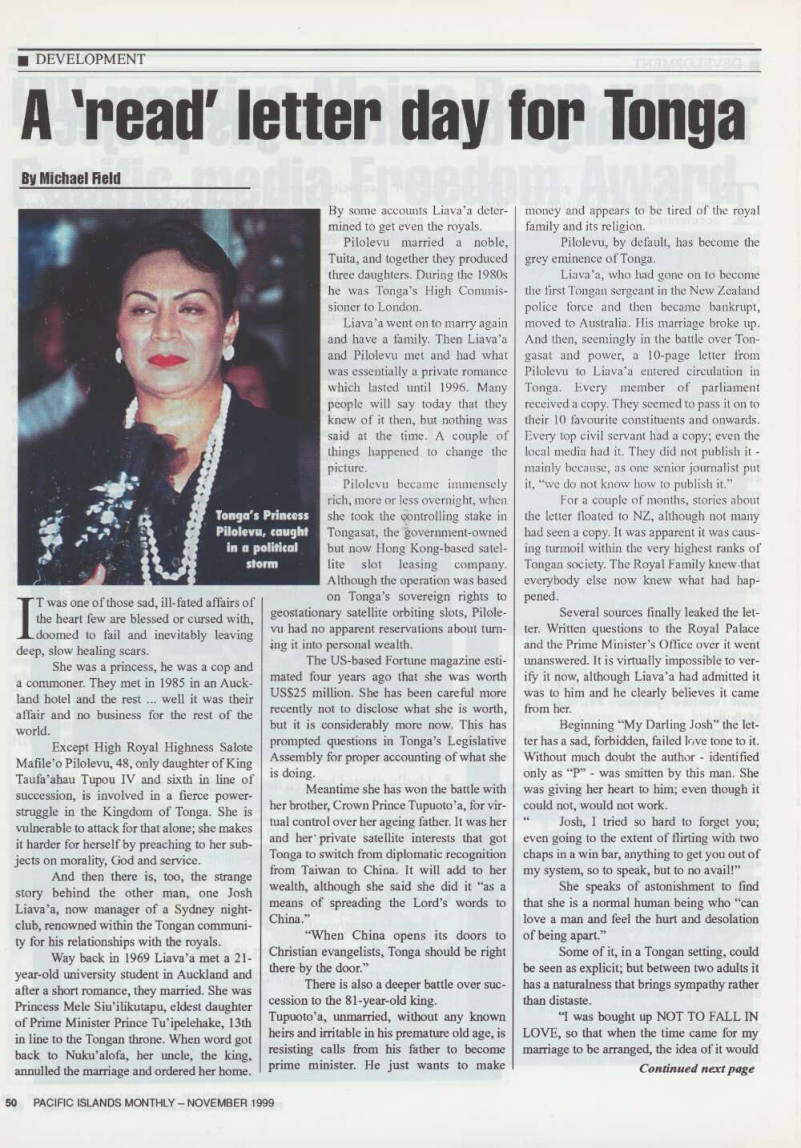
Tonga's Princess Pilolevu, caught in a political storm
Continued from previous page
not be distasteful to me. My husband was also raised in a similar fashion. Duty,
responsibility, and loyalty to king, family
and country, was our daily bread. So the pur pose of such a marriage as mine, is to beget a son to ensure the line of Tuita. I have as yet to fulfil this obligation.
“So, when you hear that I have become pregnant or given birth again, its not
that I have forgotten you (for I never will), its just the normal performance of such duties that are expected of me.”
Later in the letter she appeals for an end to the affair, saying they have to get on with their lives and they both have children to love.
“Even though we are lovers also regard you as a valuable and trusted friend.”
She ends recalling the blues singer Sade and her song “Your love is king.”
Liava’a told the Sunday Telegraph that the letter was in circulation to make the princess look bad. People were resentful of her Tongasat revenue.
“They all thought it was a big joke until it started making a lot of money. Now everybody wants to get into it,” he said.
“I have deliberately kept quiet all
these years out of respect.
“I am going to speak up, and I am going to take this up with the government.” ■