Forum makes minor recovery from irrelevance
pp. 10-11 · Read in the full issue
By Michael Held
IT could have been just another day in paradise - but it was better than that.
The depleted ranks of the leaders of the Pacific were gathering on a dockside in Palau. Only seven of the 16 had been to a forum before as a leader. The chemistry was all wrong. New Zealand Prime Minis ter Jenny Shipley, dressed in blue silk, seemed puzzled at the little man in shorts and stripped tee-shirt. He was Nauruan President Rene Harris. Australian deputy prime minister John Anderson looked and
sounded like a school boy on his first boat trip while Solomon Prime Minister Bartholomew Ulufa’alu kept
his perpetual
scowl in place.
This was the beginning of the 30th annual South Pacific Forum, an organ isation in trouble.
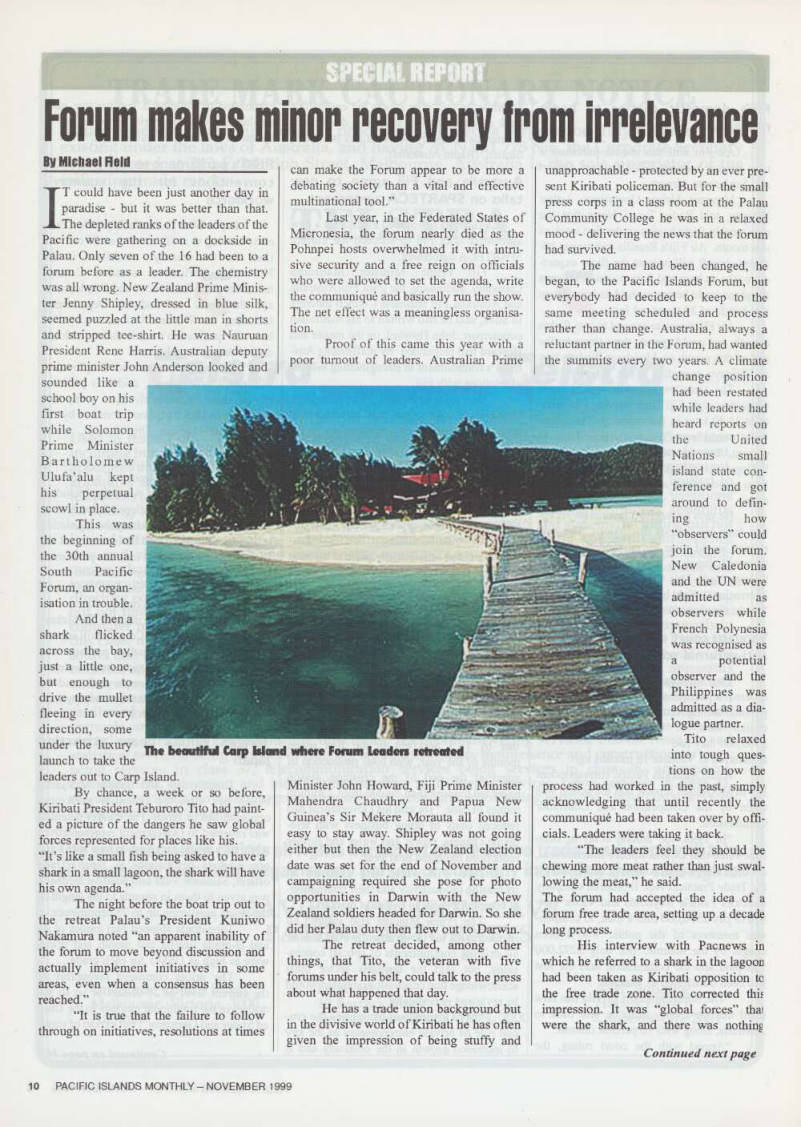
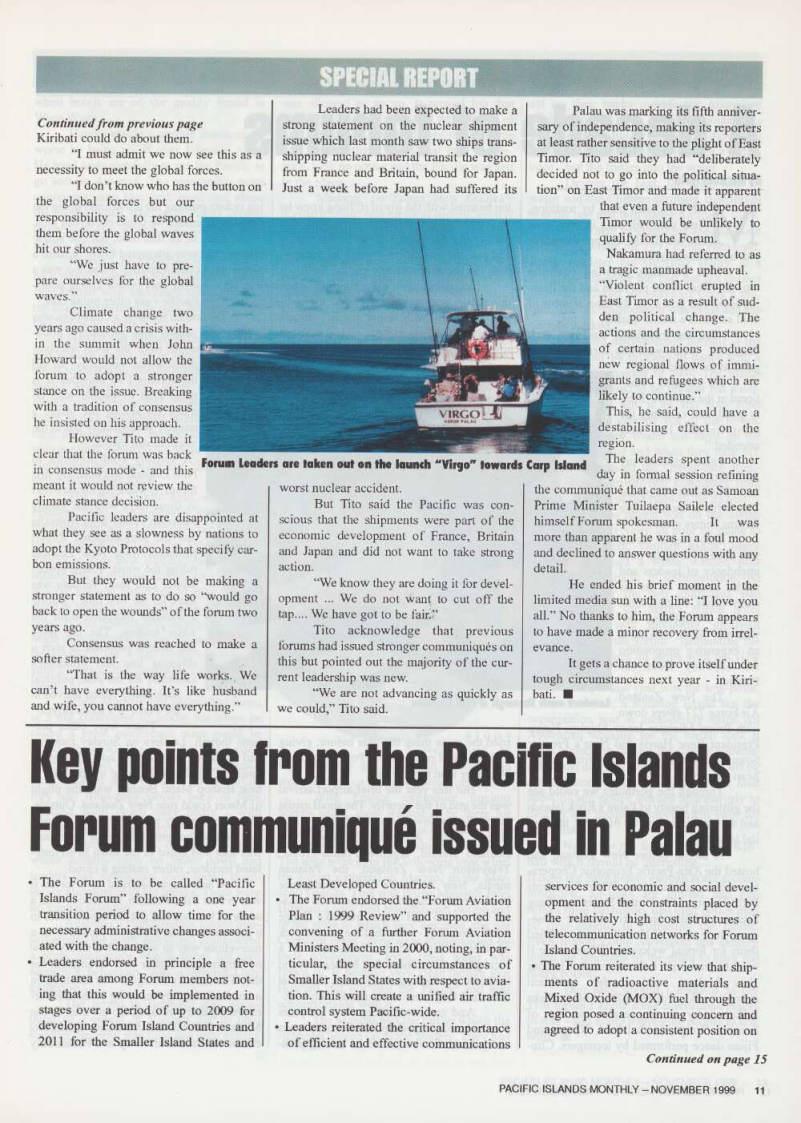
And then a shark flicked across the bay, just a little one, but enough to drive the mullet fleeing in every direction, some under the luxury launch to take the
leaders out to Carp Island.
By chance, a week or so before, Kiribati President Teburoro Tito had paint ed a picture of the dangers he saw global forces represented for places like his.
“It’s like a small fish being asked to have a shark in a small lagoon, the shark will have his own agenda.”
The night before the boat trip out to the retreat Palau’s President Kuniwo Nakamura noted “an apparent inability of the forum to move beyond discussion and actually implement initiatives in some areas, even when a consensus has been reached.”
“It is true that the failure to follow through on initiatives, resolutions at times
can make the Forum appear to be more a debating society than a vital and effective multinational tool.”
Last year, in the Federated States of Micronesia, the forum nearly died as the Pohnpei hosts overwhelmed it with intru sive security and a free reign on officials who were allowed to set the agenda, write the communique and basically run the show.
The net effect was a meaningless organisa tion.
Proof of this came this year with a poor turnout of leaders. Australian Prime
Minister John Howard, Fiji Prime Minister Mahendra Chaudhry and Papua New Guinea’s Sir Mekere Morauta all found it easy to stay away. Shipley was not going either but then the New Zealand election date was set for the end of November and campaigning required she pose for photo opportunities in Darwin with the New Zealand soldiers headed for Darwin. So she did her Palau duty then flew out to Darwin.
The retreat decided, among other things, that Tito, the veteran with five forums under his belt, could talk to the press about what happened that day.
He has a trade union background but in the divisive world of Kiribati he has often given the impression of being stuffy and
unapproachable - protected by an ever pre sent Kiribati policeman. But for the small press corps in a class room at the Palau Community College he was in a relaxed mood - delivering the news that the forum had survived.
The name had been changed, he began, to the Pacific Islands Forum, but everybody had decided to keep to the same meeting scheduled and process rather than change. Australia, always a reluctant partner in the Forum, had wanted the summits every two years. A climate
change position had been restated while leaders had heard reports on the United Nations small island state con ference and got around to defin
ing how
“observers” could join the forum.
New Caledonia and the UN were admitted as observers while
French Polynesia
was recognised as a potential observer and the
Philippines was
admitted as a dia logue partner.
Tito relaxed into tough ques tions on how the
process had worked in the past, simply acknowledging that until recently the communique had been taken over by offi cials. Leaders were taking it back.
“The leaders feel they should be chewing more meat rather than just swal lowing the meat,” he said.
The forum had accepted the idea of a forum free trade area, setting up a decade long process.
His interview with Pacnews in which he referred to a shark in the lagoon had been taken as Kiribati opposition to the free trade zone. Tito corrected this impression. It was “global forces” that were the shark, and there was nothing
Continued next page
The beautiful Carp Island where Forum leaders retreated
Continued from previous page
Kiribati could do about them.
“I must admit we now see this as a necessity to meet the global forces.
“I don’t know who has the button on the global forces but our
responsibility is to respond them before the global waves hit our shores.
“We just have to pre pare ourselves for the global waves.”
Climate change two years ago caused a crisis with in the summit when John Howard would not allow the forum to adopt a stronger stance on the issue. Breaking with a tradition of consensus he insisted on his approach.
However Tito made it clear that the forum was back in consensus mode - and this meant it would not review the climate stance decision.
Pacific leaders are disappointed at what they see as a slowness by nations to adopt the Kyoto Protocols that specify car bon emissions.
But they would not be making a stronger statement as to do so “would go back to open the wounds” of the forum two years ago.
Consensus was reached to make a softer statement.
“That is the way life works. We can’t have everything. It’s like husband and wife, you cannot have everything.”
Leaders had been expected to make a strong statement on the nuclear shipment issue which last month saw two ships trans shipping nuclear material transit the region from France and Britain, bound for Japan.
Just a week before Japan had suffered its
worst nuclear accident.
But Tito said the Pacific was con scious that the shipments were part of the economic development of France, Britain and Japan and did not want to take strong action.
“We know they are doing it for devel opment ... We do not want to cut off the tap... We have got to be fair.”
Tito acknowledge that previous
forums had issued stronger communiques on this but pointed out the majority of the cur rent leadership was new.
“We are not advancing as quickly as we could,” Tito said.
Palau was marking its fifth anniver sary of independence, making its reporters at least rather sensitive to the plight of East Timor. Tito said they had “deliberately decided not to go into the political situa tion” on East Timor and made it apparent
that even a future independent Timor would be unlikely to qualify for the Forum.
Nakamura had referred to as a tragic manmade upheaval.
“Violent conflict erupted in East Timor as a result of sud den political change. The actions and the circumstances of certain nations produced new regional flows of immi grants and refugees which are likely to continue.”
This, he said, could have a destabilising effect on the region.
The leaders spent another day in formal session refining
the communique that came out as Samoan Prime Minister Tuilaepa Sailele elected himself Forum spokesman. It was more than apparent he was in a foul mood and declined to answer questions with any detail.
He ended his brief moment in the limited media sun with a line: “I love you all.” No thanks to him, the Forum appears to have made a minor recovery from irrel evance.
It gets a chance to prove itself under tough circumstances next year - in Kiri bati. ■
Forum Leaders are taken out on the launch "Virgo" towards Carp Island