to Bougainville island
pp. 48-49 · Read in the full issue
Peace brings new crisis to Bougainville island
Story and picture* by Ui Thompson
NOW the crisis in Bougainville is offi cially over, or at least a Cease-fire is being maintained, we hear little of it.
But now there is another crisis fac ing Bougainville and it involves the re integration of the Bougainville Revo lutionary Army (BRA) and the Papua New Guinea government-backed Resistance Fighters into the communi ty-
It also involves those who have lost loved ones during the decade long war and ways in which they will cope with their grief and the legacy of suffering the crisis has left behind.
Those who fought as part of the BRA and Resistance talk about the personal difficulties they are experi encing now the fighting is finished.
Nathaniel, an ex-BRA soldier, tells me how during the crisis he “felt like a giant”, that with a gun he felt powerful and everybody should listen to him.
When his father told him not to kill people, he hit him over the head with a
rifle butt. “The influence of the gun,” he says in retrospect, “destroyed our minds.”
Nathaniel is one of a number of ex- BRA soldiers who have turned to the church since the fighting stopped; he is now a pastor and regularly attends Mass. Jesus, he says, showed him the
light.
Before arriving at this conclusion he turned to alcohol to help him through. Nathaniel like many others consumed large quantities of home
brew. Moonshining, an increasingly
common activity, involves the illegal
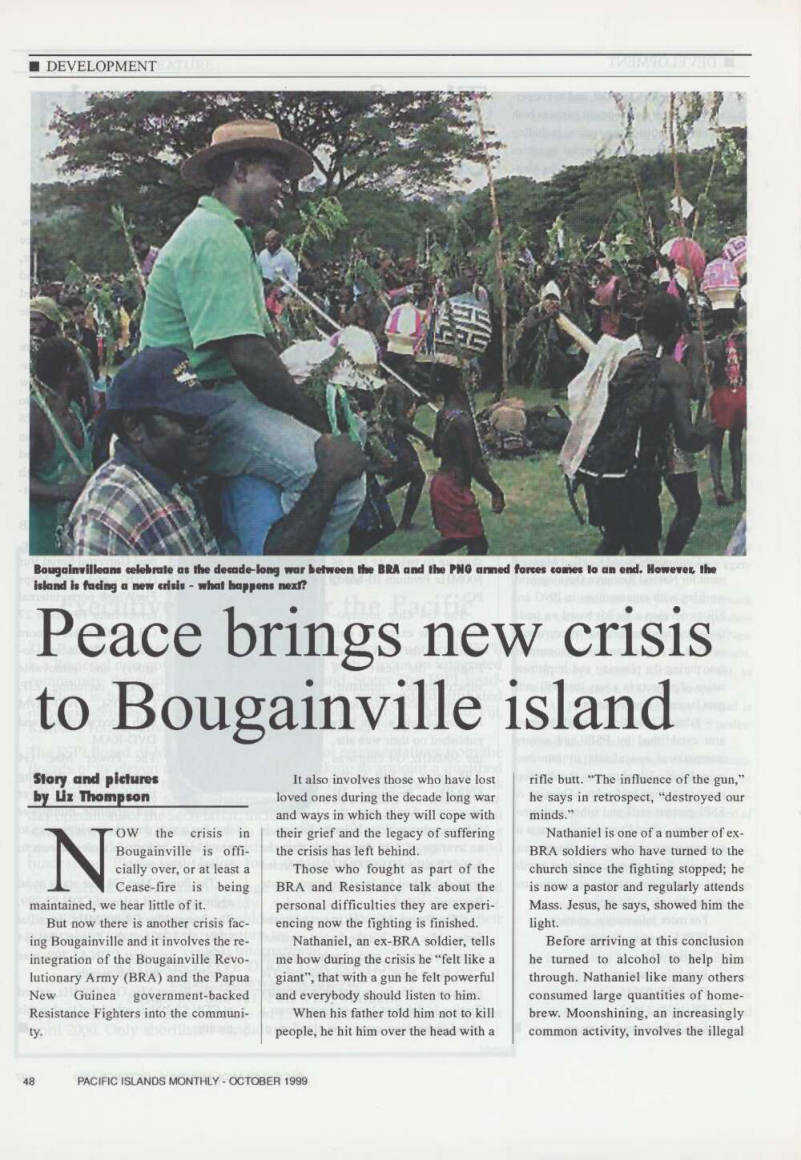
Bougainvilleans celebrate as the decade-long war between the BRA and the PNG aimed forces conies to an end. However the island is facing a new crisis - what happens next?
brewing of alcohol in large gas cylin ders. Bananas, pineapples, paw paws and watermelons are boiled with sugar and yeast to create an alcohol that is almost 98 per cent proof - 100 per cent when reboiled. It takes
effect quickly and dramatically.
Francis, also an ex-BRA soldier, tells of how he drank to forget what he had done, that others drink because “they saw too much blood, too many dead, they killed too many
people.”
“Sometimes I want to drink to cover up myself and what I have done,” says Nathaniel. “By drinking I have power. I am a giant.”
According to Helen Hakena, director of the Leitana Nehan Women’s Development Agency, alcohol and its influence is one of the most pressing problems facing
Bougainville society today.
There has, she tells me, been a dramatic increase in the incidence of rape since the crisis and it often occurs under the influence of alcohol by young men who are still armed.
Many men, even now still only in their early twenties, have grown up in a climate of war, knowing only the culture of war.
Their sense of identity is intrinsi cally bound up with their idea of themselves as fighters.
The call to lay down arms, says Francis, has been ignored by many, “Some still carry weapons, they are afraid if they give them up they will be nobody, they don’t want to give away guns or they give away their
strength.”
“When we had a gun,” he goes on, “we felt superior, we felt we had power, we were the boss.”
“The gun,” says Nathaniel, “was our armour. No one will speak against us.”
In this climate, traditional respect for the authority and guidance of the elders quickly broke down and with it the traditional laws and protocol that had done much to manage the
society. Even so, in the face of the cur rent problems of violence and rape, tra ditional law is no longer enough.
“Traditional Law is no longer ade quate,” says Hakena. Many ex-soldiers now struggling to come to terms with
“When we had a gun, we felt
superior,
we felt we had power, we were the boss.”
“The gun,” says Nathaniel, “was our armour.
No one will speak against us”
their sense of displacement and dislo cation are turning to organizations like Hakena’s for help.
Hakena and others who work at her organization, several of whom have participated in Trauma counseling workshops at the Fiji Women’s Crisis Center, regularly travel out to work in villages on request of the chiefs.
Hakena believes they are having a significant impact although they need to conduct more rehabilitation pro grams but are restricted in their capa bilities through limited funding.
Francis talks glowingly of how trau ma counseling through the Leitana Nehan Women’s Development Agency helped him stop the drinking binges he went on and made it easier for him to deal with his anger.
“After the crisis I felt I was still somebody, I didn’t care about any body,” he says, but counseling he insists, helped in the process of re-inte
grating into the community.
In the efforts being made towards
re-integration and healing, reconcilia
tion is receiving considerable empha sis.
Albert Joe Noro, who works at the Bougainville Trauma Institute in Buka, was held captive for many months. He was blindfolded and beaten regularly before he was finally released.
In 1993 one of the men who held him came forward to ask pardon and both he and Noro participated in a number of ceremonies.
These ceremonies were based on traditional reconciliation ceremonies and involved, amongst other things, chewing of betel nut, exchanging of traditional wealth and the breaking of bows and arrows, a traditional symbol of peace.
Noro believes this sort of reconcili ation was an important part of his heal ing process and, he suggests, is a nec essary part of the spiritual rehabilita tion of Bougainville society.
“Normalising” in terms of develop ing an infrastructure is all very well but, he insists, “we must start from within.
Perpetrators and victims have an opportunity to come together, to under stand and develop trust.”
Noro now acts as a bridge between certain parties facilitating in this process.
Of course many are not ready to face those who killed their loved ones or destroyed their homes and villages.
A reconciliation ceremony was due to take place between Hakena’s village and those who burnt it down but the elders decided it was too soon and the ceremony was postponed.
When those involved do feel ready to come forward, this kind of reconcil iation can only be a positive step for ward for a community fractured by a decade of war. * Anyone wishing to assist the Lei tana Nehan Women's Development Agency in their work can send dona tions to: Helen Hakena @ PO Box 86, Buka,
Bougainville Province,
Papua New Guinea ■