history with innovative
pp. 24-25 · Read in the full issue
New Britain could make history with innovative shell money bank
Story and pictures by Liz Thompson
WHEN the volcano erupted in Rabaul in Sep tember 1994 people were ready for it. The town was geared for such an emergency but despite all precautions the radio
announced a transi tion from stage 2 to stage 4 in a matter of minutes.
Fortunately most of the locals had seen the Guinea Fowl leave their home in the warm ash on the volcano’s side. The fact the ash was too hot for them was a sign there was not long to go and almost everybody left.
Whilst the volcano itself killed no one, it did destroy Rabaul - a once thriving town with a colourful mar ket. Streets filled with people, hotels and small business now stand smothered in a coat of compressed ash that is metres deep.
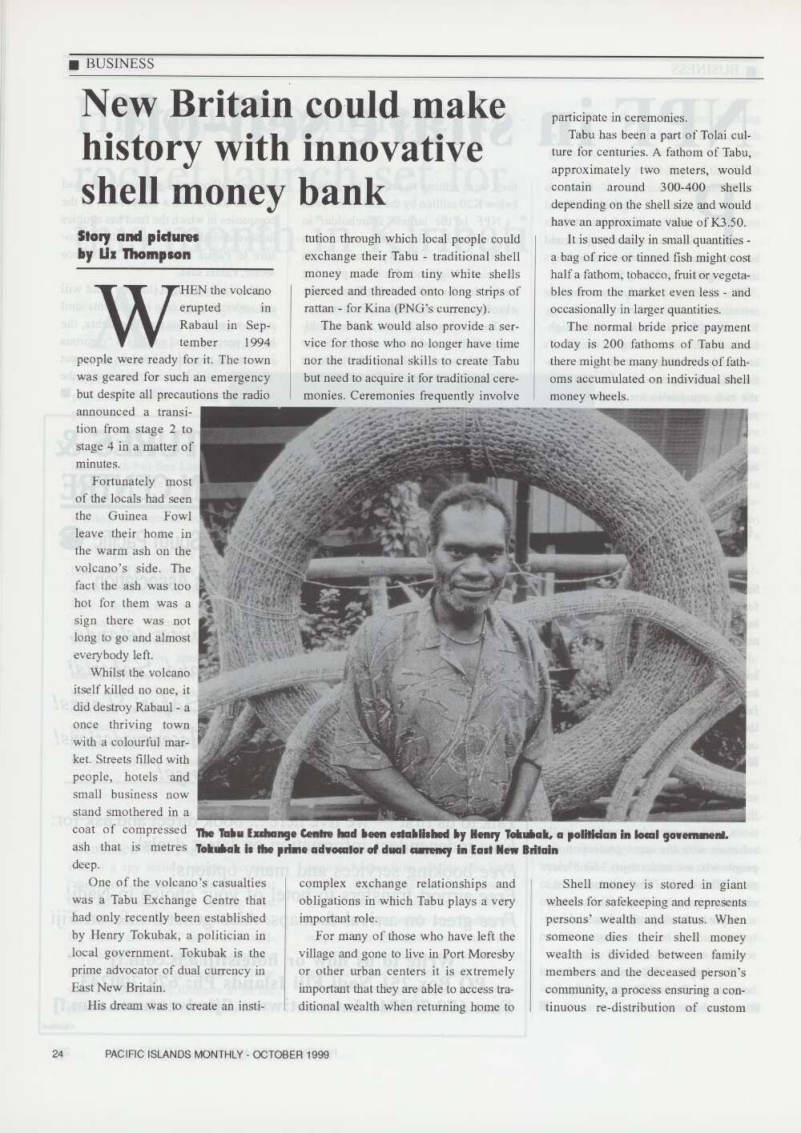
One of the volcano’s casualties was a Tabu Exchange Centre that had only recently been established by Henry Tokubak, a politician in local government. Tokubak is the prime advocator of dual currency in East New Britain.
His dream was to create an insti
tution through which local people could exchange their Tabu - traditional shell money made from tiny white shells pierced and threaded onto long strips of rattan - for Kina (PNG’s currency).
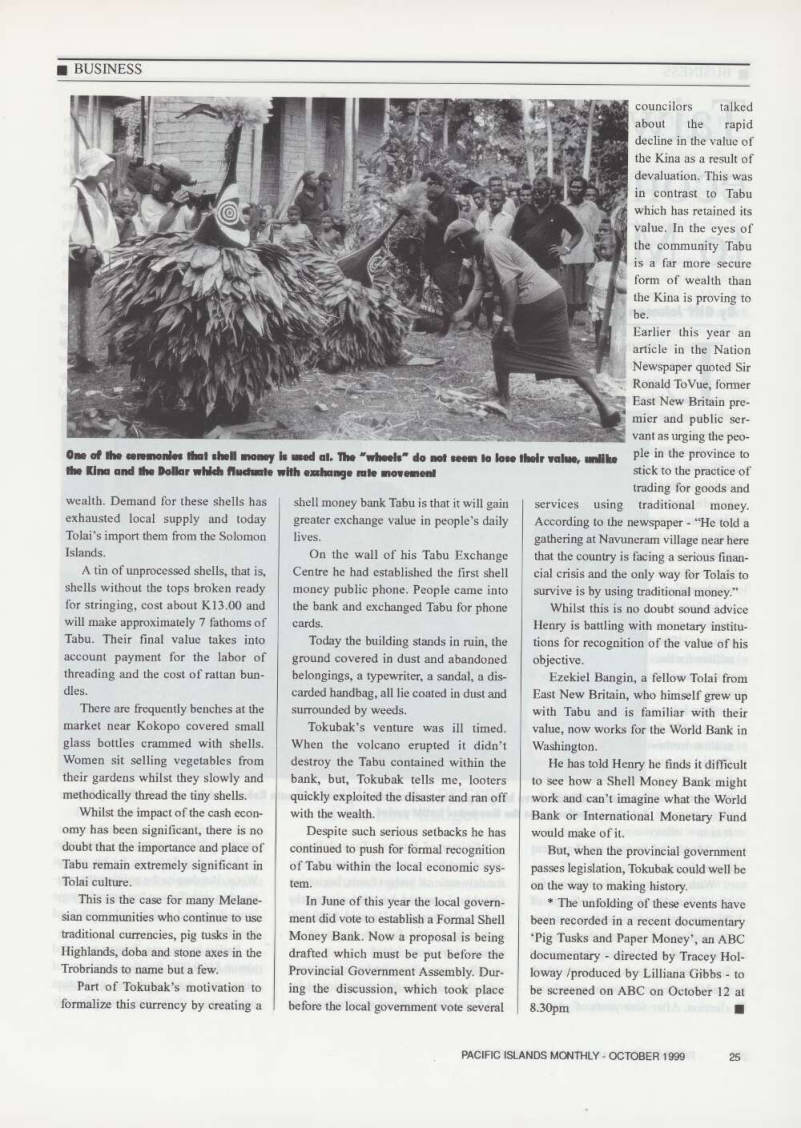
The bank would also provide a ser vice for those who no longer have time nor the traditional skills to create Tabu but need to acquire it for traditional cere monies. Ceremonies frequently involve
complex exchange relationships and obligations in which Tabu plays a very
important role.
For many of those who have left the village and gone to live in Port Moresby or other urban centers it is extremely important that they are able to access tra ditional wealth when returning home to
participate in ceremonies.
Tabu has been a part of Tolai cul ture for centuries. A fathom of Tabu, approximately two meters, would contain around 300-400 shells depending on the shell size and would have an approximate value of K 3.50.
It is used daily in small quantities a bag of rice or tinned fish might cost half a fathom, tobacco, fruit or vegeta bles from the market even less - and
occasionally in larger quantities.
The normal bride price payment today is 200 fathoms of Tabu and there might be many hundreds of fath oms accumulated on individual shell money wheels.
Shell money is stored in giant wheels for safekeeping and represents persons’ wealth and status. When someone dies their shell money wealth is divided between family members and the deceased person’s community, a process ensuring a con tinuous re-distribution of custom
The Tabu Exchange Centre had been established by Henry Tobubak, a politician in local government.
Tokubak is the prime advocator of dual currnecy in East New Britain
wealth. Demand for these shells has exhausted local supply and today Tolai’s import them from the Solomon Islands.
A tin of unprocessed shells, that is, shells without the tops broken ready for stringing, cost about K 13.00 and will make approximately 7 fathoms of Tabu. Their final value takes into account payment for the labor of threading and the cost of rattan bun dles.
There are frequently benches at the market near Kokopo covered small glass bottles crammed with shells.
Women sit selling vegetables from their gardens whilst they slowly and methodically thread the tiny shells.
Whilst the impact of the cash econ omy has been significant, there is no doubt that the importance and place of Tabu remain extremely significant in Tolai culture.
This is the case for many Melane sian communities who continue to use traditional currencies, pig tusks in the Highlands, doba and stone axes in the Trobriands to name but a few.
Part of Tokubak’s motivation to formalize this currency by creating a
shell money bank Tabu is that it will gain
greater exchange value in people’s daily
lives.
On the wall of his Tabu Exchange Centre he had established the first shell money public phone. People came into the bank and exchanged Tabu for phone cards.
Today the building stands in ruin, the ground covered in dust and abandoned belongings, a typewriter, a sandal, a dis carded handbag, all lie coated in dust and surrounded by weeds.
Tokubak’s venture was ill timed.
When the volcano erupted it didn’t destroy the Tabu contained within the bank, but, Tokubak tells me, looters quickly exploited the disaster and ran off with the wealth.
Despite such serious setbacks he has continued to push for formal recognition of Tabu within the local economic sys tem.
In June of this year the local govern ment did vote to establish a Formal Shell Money Bank. Now a proposal is being drafted which must be put before the Provincial Government Assembly. Dur
ing the discussion, which took place
before the local government vote several
councilors talked about the rapid decline in the value of the Kina as a result of devaluation. This was in contrast to Tabu which has retained its value. In the eyes of the community Tabu is a far more secure form of wealth than the Kina is proving to be.
Earlier this year an article in the Nation Newspaper quoted Sir Ronald To Vue, former East New Britain pre mier and public ser vant as urging the peo ple in the province to stick to the practice of trading for goods and
services using traditional money.
According to the newspaper - “He told a gathering at Navuneram village near here that the country is facing a serious finan cial crisis and the only way for Tolais to survive is by using traditional money.”
Whilst this is no doubt sound advice Henry is battling with monetary institu tions for recognition of the value of his
objective.
Ezekiel Bangin, a fellow Tolai from East New Britain, who himself grew up with Tabu and is familiar with their value, now works for the World Bank in
Washington.
He has told Henry he finds it difficult to see how a Shell Money Bank might work and can’t imagine what the World Bank or International Monetary Fund would make of it.
But, when the provincial government passes legislation, Tokubak could well be on the way to making history. * The unfolding of these events have been recorded in a recent documentary ‘Pig Tusks and Paper Money’, an ABC documentary - directed by Tracey Hol loway /produced by Lilliana Gibbs - to be screened on ABC on October 12 at 8.30 pm ■
One of the ceremonies that shell money is used at. The "wheels” do not seem to lose their value, unlike the Kina and the Dollar which fluctuate with exchange rale movement