capacity in the region
pp. 18-19 · Read in the full issue
Business
Southern Cross cable to increase telecommunication capacity in the region
By Sophie Foster Hildebrand
WORK on the much-needed Southern Cross cable, which will provide up to 120 times more
cable transmission capac ity for the region, is on track.
The Auckland-Hawaii segment of the Southern Cross cable, which is designed to remove the bandwidth bottleneck between Australasia and the United, is now being laid.
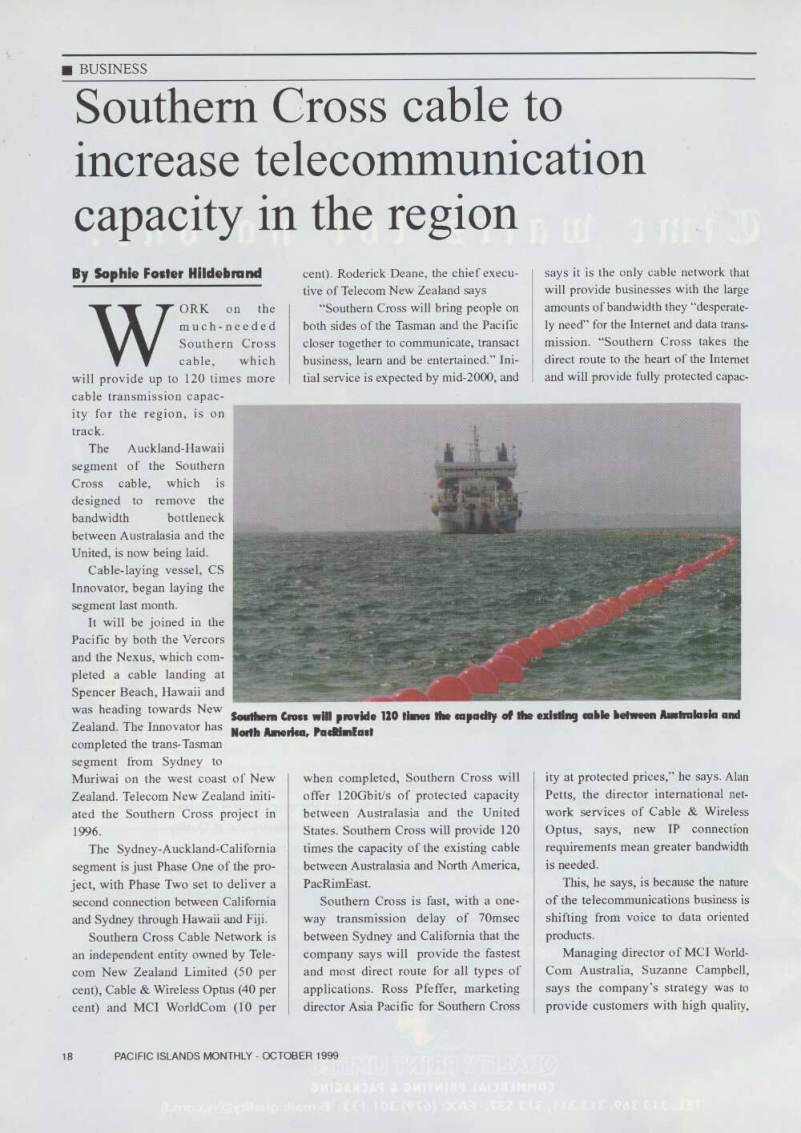
Cable-laying vessel, CS Innovator, began laying the segment last month.
It will be joined in the Pacific by both the Vercors and the Nexus, which com pleted a cable landing at Spencer Beach, Hawaii and was heading towards New Zealand. The Innovator has completed the trans-Tasman segment from Sydney to
Muriwai on the west coast of New Zealand. Telecom New Zealand initi ated the Southern Cross project in 1996.
The Sydney-Auckland-California
segment is just Phase One of the pro ject, with Phase Two set to deliver a second connection between California and Sydney through Hawaii and Fiji.
Southern Cross Cable Network is an independent entity owned by Tele com New Zealand Limited (50 per cent), Cable & Wireless Optus (40 per cent) and MCI World Com (10 per
cent). Roderick Deane, the chief execu tive of Telecom New Zealand says “Southern Cross will bring people on both sides of the Tasman and the Pacific closer together to communicate, transact business, learn and be entertained.” Ini tial service is expected by mid-2000, and
when completed. Southern Cross will offer 120Gbit/s of protected capacity between Australasia and the United States. Southern Cross will provide 120 times the capacity of the existing cable between Australasia and North America, PacßimEast.
Southern Cross is fast, with a one way transmission delay of 70msec between Sydney and California that the company says will provide the fastest and most direct route for all types of
applications. Ross Pfeffer, marketing
director Asia Pacific for Southern Cross
says it is the only cable network that will provide businesses with the large amounts of bandwidth they “desperate ly need” for the Internet and data trans mission. “Southern Cross takes the direct route to the heart of the Internet and will provide fully protected capac
ity at protected prices,” he says. Alan Petts, the director international net work services of Cable & Wireless Optus, says, new IP connection requirements mean greater bandwidth is needed.
This, he says, is because the nature of the telecommunications business is shifting from voice to data oriented
products.
Managing director of MCI World- Com Australia, Suzanne Campbell, says the company’s strategy was to
provide customers with high quality.
Southern Cross will provide 120 times the capacity of the existing cable between Australasia and North America, PacRimEast
innovative voice, data and Internet ser vices over an end-to-end managed net work.
The Southern Cross Cable Net work, she says, was an important com ponent of this strategy. The submarine fibre optic cable network is being man ufactured and laid by a consortium of Alcatel Submarine Networks and
Fujitsu.
“Southern Cross is one of the most advanced and longest submarine cable systems that Alcatel has provided,” says Mark Giles, general manager for Alcatel in New Zealand. He says most of the company’s research and devel opment in recent years was focused on
Internet-related equipment and services.
New Zealand telecommunications manager for Fujitsu, Stan Baker, says that the company was pleased that its submarine systems technology and skills would contribute to the realisation of the Southern Cross project and the new busi ness opportunities that its implementa tion would create.
Opportunities include the fact that high quality real-time video images could be used to increase access to med ical specialists where, for example, a neurosurgeon in the United States could watch and assist in a specialist operation in Australia without leaving her US hos
pital. ■
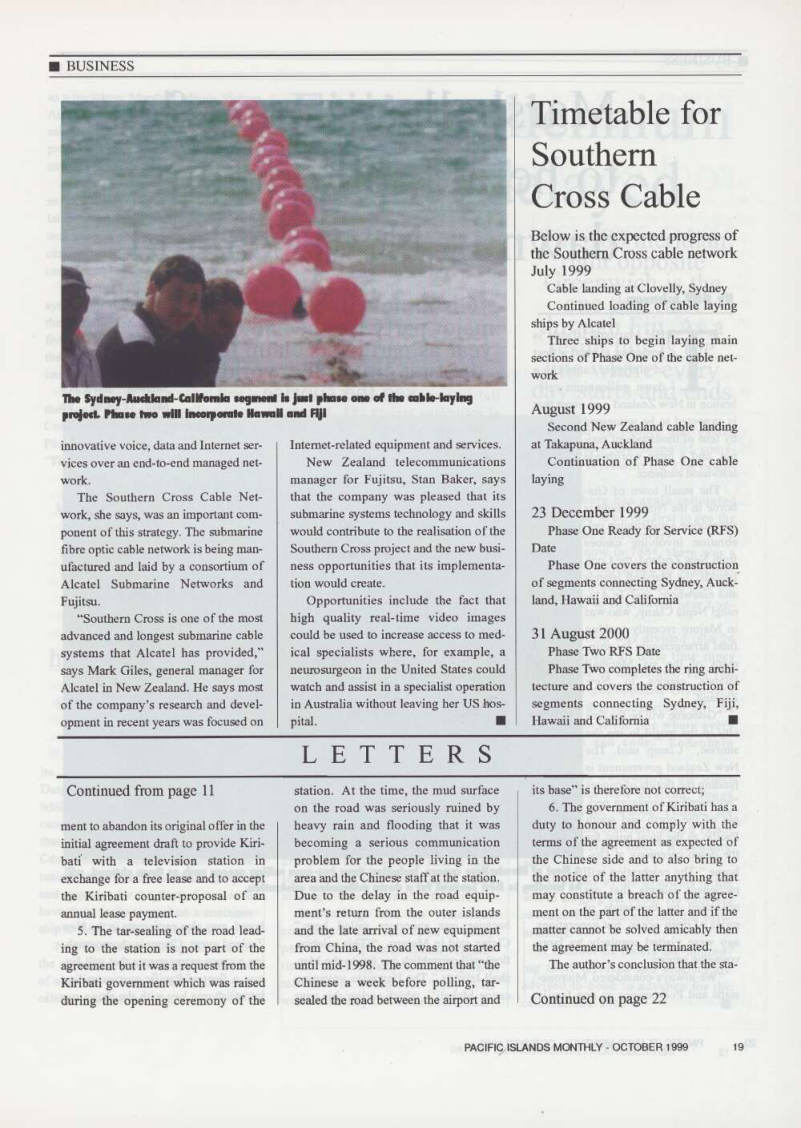
Hie Sydney-Auckland-Califomia segment is Just phase one of the cable-laying project. Phase two will incorparale Hawaii and Fiji