next West Papua
pp. 14-16 · Read in the full issue
Special Report
Now East Timor, next West Papua
By Otto Ondawame
EAST Timorese’s unanimous vote for independence is the beginning of the road to freedom for Indonesia’s “colonies”.
The events of August 30, 1999 will
undoubtedly inspire others
struggling to disentangle
themselves from the Indone
sian regime, in particular
West Papua (the western hall of the island of New Guinea that the Indonesians call Irian Jay a).
There are some who would prefer to call West Papua a “territory” rather than a “colony”, but, whatev er the semantics, one thing is obvious - Indonesia’s annexa tion of West Papua in 1962 will increasingly be scruti nised by the international
community in the near future. It is also conspicuous that regardless of what Jakarta and the international commu nity says, the balkanisation of the Indonesian archipelago seems inevitable. The reasons are obvious.
In many ways the nation-state of Indonesia is an artificial construction of the post world war era.
Secondly, because of the oppres sion, exploitation and genocide propa gated by a Javanese-dominated cen tralised power structure, civil society is bound to react. In a way, in the last fifty years, the Indonesian state has been digging its own grave.
On the issue of independence, despite the indifference of the interna tional community, West Papua has always resisted Indonesian rule.
But the struggle has been long ignored by the rest of the world perhaps because it serves their political, strate gic and economic interest to do so.
Indeed the people of West Papua seem to be victims of international political conspiracy dictated by the cold war era.
Australia, the USA and their Western allies denied West Papuans’ right of self-determination and independence because of their attempts to prevent the spread of communism through Indone sia and to Australia and the Pacific Islands. Consequently, West Papuans had to pay the price for the interests of Western countries.
The underlying interests of these countries were exposed in sbs’s Date Line programme on August 26, 1999.
Because of pressures from Western countries (especially Australia and the USA) and with the knowledge of the United Nations, the Dutch government the former colonial power in West Papua - was forced to transfer West Papua to Indonesia.
This was made official by the New
York Agreement of 15 August 1962, signed by the Dutch and the Indone sians and blessed by the USA and the UN.
Six years later, West Papua's annexation was completed by the administration of the Act of Free Choice of 1969 - musyawarah (con sultation) as it is referred to by the Indonesians.
For West Papuans this was an act “free of choice” and a mockery of internationally accepted norms. Only 1,025 Indonesian-appointed “repre sentatives” voted on behalf of a pop
ulation of more than 800,000 Papuans.
Administered under gun point, the participants in the act of free choice voted to be a part of Indonesia.
Through this process West Papuans were denied their right to have one-person one-vote as accepted by international practices. In effect, there was never a proper referendum to allow |West Papuans to choose their political status.
But, although the interna tional community knew
that musyawarah - a Javanese village tradition for consultation, not a refer endum - was unlawful and violated the people’s right to have one-person one vote, they endorsed it because it served their political interests.
Hence, the people of West Papua were never given the opportunity to vote for independence. Instead they were merely “consulted” about their integration with Indonesia.
Some say that this means that the international community contributed to West Papua’s forceful integration with Indonesia.
This, for West Papuans, was the beginning of a new era of colonial ism.
In today’s world, colonialism, as a political tool, is out of place. East
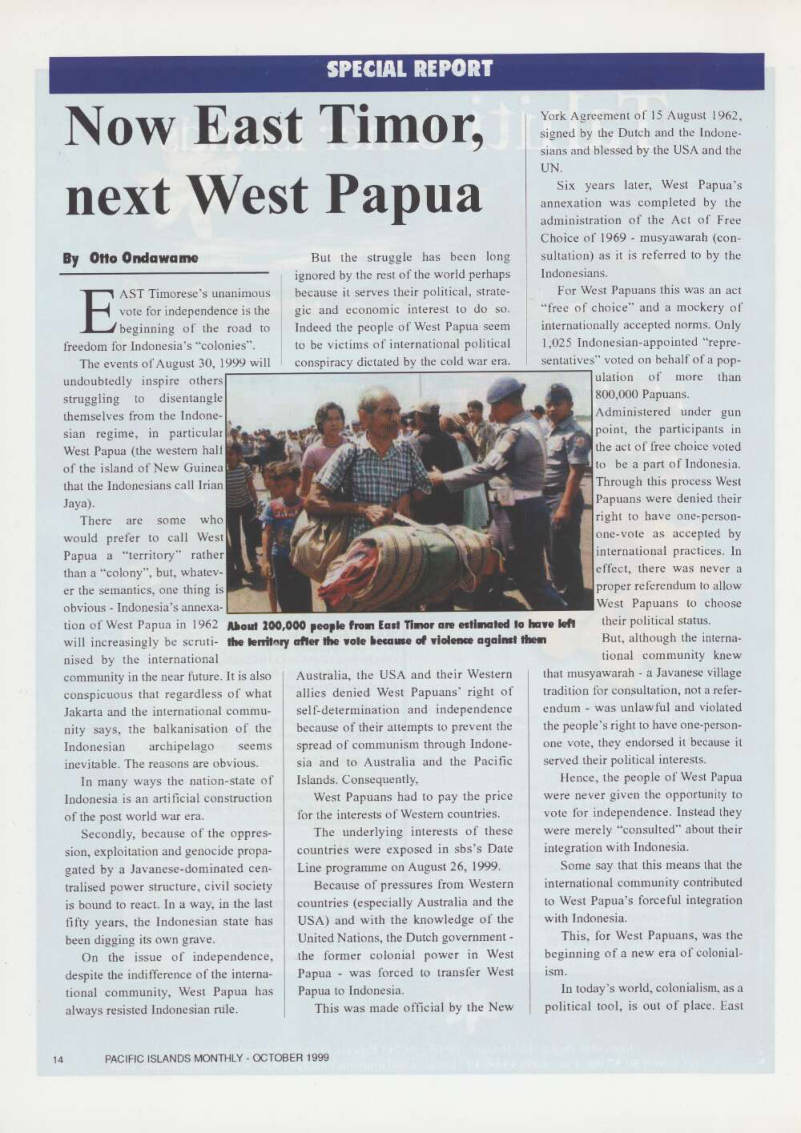
About 200,000 people from East Timor are estimated to have left the territory after the vote because of violence against them
Timor has proven that, in spite of Jakarta and the global community’s propaganda, the struggle against Indonesian colonialism will end in victory for the colonised.
East Timor’s independence brings to an end one of the most painful,
oppressive and exploitative colonial
legacies of our region. Jakarta is defeated by the people at the ballot box. East Timorese in voting for independence have confirmed what the world has always known, but cho sen to deny.
Now that East Timor has gone through the ballot box, the people of West Papua want the same opportuni ty to determine their political status a right they say was denied to them in the 19605.
“We want to be a people free from Indonesia’s colonial grasp and enjoy peace, democracy, freedom and social progress. Our questions have to be answered: What can the inter national community, especially west
ern countries, do to set right the wrongs done dur ing the cold war era? Has the political and strategic interests of the cold war now overtaken by eco nomic interests manifest ed in western multination al companies’ exploitation of our natural resources?
Are we, as a people, of less importance to you than our minerals and forests? Is there any morality in today’s glob alised world? Are the lives of black Papuans of less value than that of white
Europeans?”
Answers to these questions are indeed not
simple. The simple truth,
however, is that the governments of Australia, the USA, Holland, and the UN have a moral responsibility to end the colonial subjugation of West
Papua.
“They owe that to us. It is an issue they cannot continue to side step, ignore and pretend they did not have anything to do with it. We have been victims of a political pawn by the international com munity in the 19605.
“That same international community has a responsibility to assist us. Canber ra and its allies must apologise to the people of West Papua for the past mis takes and take moral accountability for their future,” he says.
Australia’s commitment to bring peace and order to East Timor is a good beginning.
There is more to come.
As a powerful member of the region, and torn between the South Pacific and Southeast Asia, Australia will not escape the obligations to bring peace to
the region.
It is in Australia’s interest to do so.
Dotted along its strategic buffer line are the issues of Guadalcanal in the Solomon islands, Bougainville in PNG,
West Papua and East Timor.
West Papua is equally important and
will soon become a thorn on Australia’s side if it is not addressed quickly. It is
an issue Canberra cannot afford to ignore.
As Michelle Gratin wrote in the Sydney Morning Herald of Septem ber 14, 1999, “Australia may be faced in a few years with questions of what attitude it should adopt to an East Timor situation in Irian Jaya” (refers to West Papua).
Canberra has a moral obligation to help end Indonesian colonialism in West Papua. Today its East Timor, tomorrow it will be West Papua.
If the West Papuan cause and that of other colonised peoples in Indone sia are ignored, there will be serious
strategic, political and economic
problems for Australia in the near future.
Australia and international com munity must recognise that the pres ence of Indonesia and the role of its armed forces in the region will be a cause for instability. It is therefore pertinent that the international com munity finds a mechanism to end
Indonesian colo nialism.
“We, the people of West Papua, will not sit and watch.
We will continue to
fight against
Indonesian colo nialism.
“We will continue to struggle for our rights to determine our future and to be respected. For the best interest of all of us, Australia must respond now.
Not tomorrow. We do not want to repeat in West Papua what occurred in East
Timor in the post referendum peri od,” a West Papuan academic said.
Continued on page 16
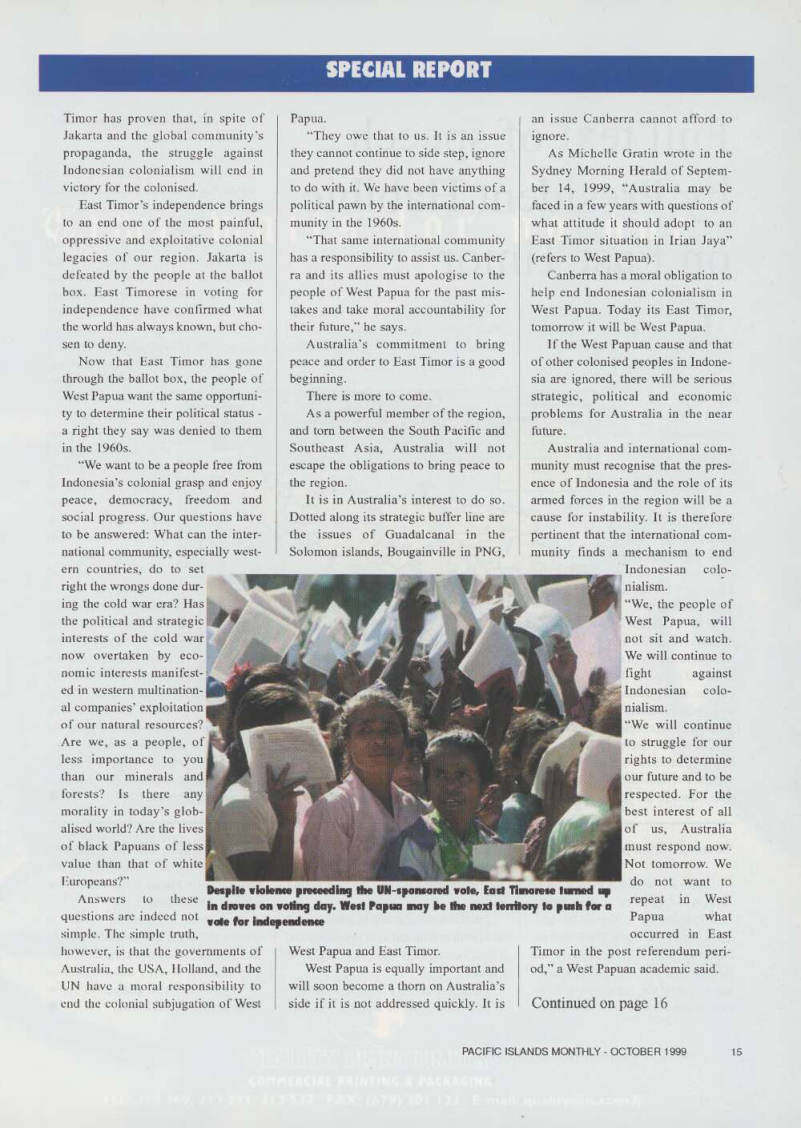
Despite violence proceeding the UN-sponsored vole. East Timorese turned up in droves on voting day. West Papua may be the next territory to push for a vale for independence.
Continued from page 15
Concerned with the escalation of conflict and violence in West Papua, West Papuans are calling on the gov ernments of Australia, the USA, the Dutch and the UN to pressure the Habibie government into starting a
peaceful dialogue, organising referen
dum on special autonomy or indepen
dence for West Papua under the supervi sion of the UN. Such a process must use a formula that satisfies the conflicting
parties.
Jakarta must also allow international independent humanitarian organisations, journalists and UN observers into West Papua.
Trade and military ties and assistance to Indonesia must be stopped. Indone
sian troops must also be withdrawn from West Papua. Members of the South Pacific Forum must address the issue of West Papua.
And, most importantly, initiate to reopen the legal and political discus sions on the act of free choice of 1969.
The stability, security and progress of the region cannot be guaranteed unless these issues are dealt with. ■