Globalisation is not a spectator sport
Editorial
ANYONE who has seen the Disney cartoon, Lion King, will know what the motto “Hakuna matata” means. But for those who haven’t, and who don’t, it means “no worries” - very much a Pacific, laid-back, take-each-day-as it-comes sort of attitude.
But with the advent of globalisation and all the challenges that it presents.
Pacific Islanders can no longer afford to be so nonchalant about certain aspects of life.
One of these aspects is economic lib eralisation.
If there was ever a need to change their tune, it is now.
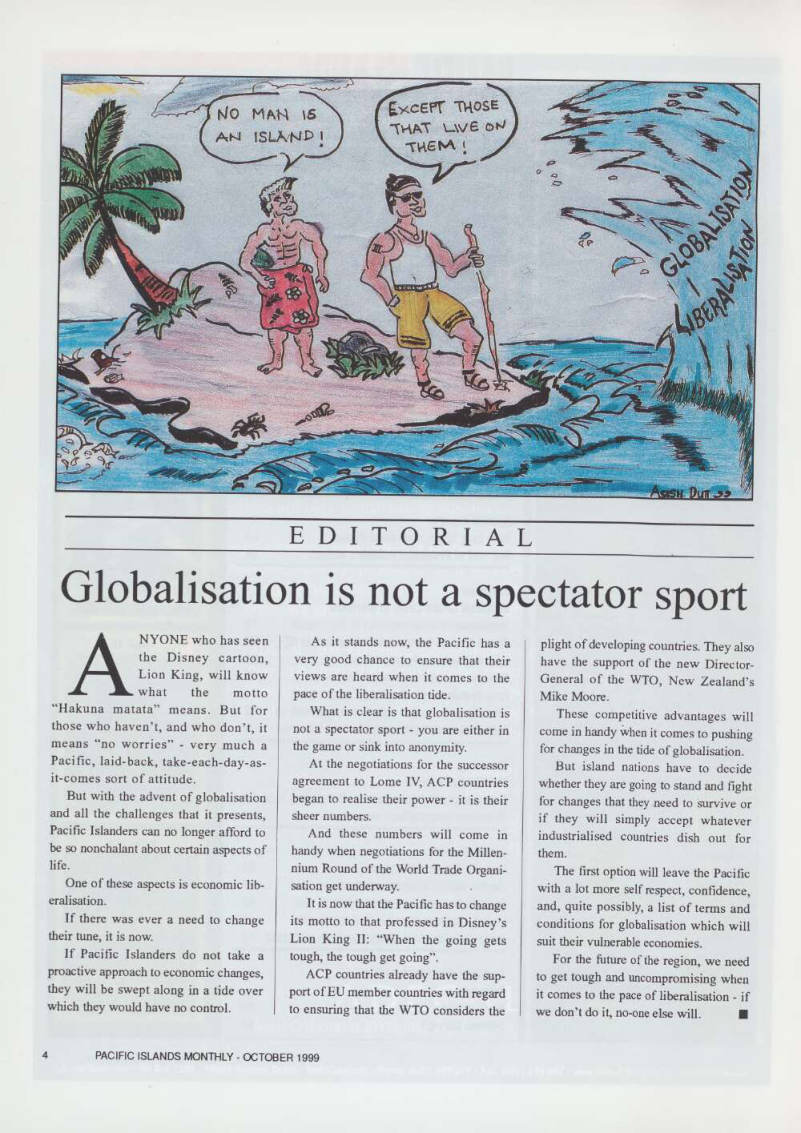
If Pacific Islanders do not take a proactive approach to economic changes, they will be swept along in a tide over which they would have no control.
As it stands now, the Pacific has a very good chance to ensure that their views are heard when it comes to the pace of the liberalisation tide.
What is clear is that globalisation is not a spectator sport - you are either in the game or sink into anonymity.
At the negotiations for the successor agreement to Lome IV, AGP countries began to realise their power - it is their sheer numbers.
And these numbers will come in handy when negotiations for the Millen nium Round of the World Trade Organi sation get underway.
It is now that the Pacific has to change its motto to that professed in Disney’s Lion King II: “When the going gets tough, the tough get going”.
AGP countries already have the sup port of EU member countries with regard to ensuring that the WTO considers the
plight of developing countries. They also have the support of the new Director- General of the WTO, New Zealand’s Mike Moore.
These competitive advantages will come in handy when it comes to pushing for changes in the tide of globalisation.
But island nations have to decide whether they are going to stand and fight for changes that they need to survive or if they will simply accept whatever industrialised countries dish out for them.
The first option will leave the Pacific with a lot more self respect, confidence, and, quite possibly, a list of terms and conditions for globalisation which will suit their vulnerable economies.
For the future of the region, we need to get tough and uncompromising when it comes to the pace of liberalisation - if we don’t do it, no-one else will. ■