TONGA Broad
p. 48 · Read in the full issue
TV Polynèsie helps Tonga set up television
casting Commis sion (TBC) news and current affairs controller, Laumanu Petelo, is currently training to become a TV news presen ter in French Polynesia under a PINA-coordinated coopera tion programme with the French station.
The two-week training is designed to help the Tonga Broadcasting Commission launch the kingdom’s national TV service later this year. Petelo joined a team of RFO journalists from French Polynesia, New Caledonia and Wallis & Futuna.
Last February, a similar action
took place in Noumea (New Caledonia), where a team of one camera man and one journalist from Fiji Television joined a workshop within RFO-New Cale donia, directed by Paris-based French trainer Bernard Vaillot.
The aim then was to help Fiji Television set up its own weekly current affairs mag azine, which was created a few weeks later.
On both occasions, RFO (French Over seas Territories Television and Radio sta tion) has opened its doors to trainees from outside the station and typically from regional Pacific island countries. The workshops are coordinated by PINA with help from the French government.
In Papeete, Petelo was trained by 35year-old Patrice Romedenne, a senior international reporter with France 2 (one of France’s main national televisions) who presented TV news bulletins until recently, and Catherine Sorzana, an actress.
They form a team and have already worked together before, Romedenne spe
cialising in writing and presenting tech
niques, while Sorzana focuses on the ges tures, control and breathing exercises.
Since the training started, participants have analysed professional TV news bul letins, but also made their debut on the screen: every day, they record a “dummy”
news bulletin. Straight after this, every day too, comes the painful exercise of another critical viewing where defects, mistakes or good points are discussed.
The exercise increased in difficulty as days went by, with accessories featuring regularly in a TV news bulletin, such as guests, commentary on pictures.
Petelo, although she has never been to French Polynesia before, thoroughly enjoyed the challenge. And because the RFO trainers also speak English, she felt well-looked after.
“The main feature of behaviour on the screen are basically the same, English or French language. We’re all working on flu ency in the speech, there is a common expe rience on the professional ground, we’re all doing the same job, we’re giving news and we have to capture the viewer’s attention,”
Patrice Romedenne explains.
“This training proves that such a bilin gual training can take place, this is what is happening here naturally. And naturally too, there is also the human relation side of things, the discovery between people of dif ferent languages and cultures.”
Petelo found this out very quickly, after she met RFO-Wallis & Futuna colleague Anna Vakalepu. The Wallisian language
was incredibly close to
the Tong an language.
“This is all very new for me, I’ve been a radio journalist for twenty years in Tonga. Of course, I have the writ ing skills, but all the pre senting side and the image management is something else. I think I’m progressing every day,” Laumanu Petelo
explained.
“Yes, this is a new envi ronment for me, people don’t speak my lan guage. But language is not an obstacle, we’re working on very practi cal things and on this
point, I think we understand each other very well. Everyone of us here has this feeling of sharing the same profession, and also of being all part of Pacific country.
Every day, we discover common points among ourselves. I feel accepted here.”
This new kind of cooperation between
English-speaking and French-speaking
media in the Pacific is a direct result of PINA’s last annual convention, which took place last December in the very same
place: Papeete.
It was then decided that exchanges of training and news should be promoted between PINA members, whatever lan guage they speak.
Petelo’s participation is sponsored by the French Polynesia territorial govern ment, the French embassy in Suva, and RFO, and coordinated through the PINA Pacific Journalism Development Centre. It has strong personal support from the presi dent of French Polynesia, Gaston Flosse, and the French ambassador in Suva, Michel Jolivet.
Petelo will use the knowledge and skills gained in French Polynesia to provide on the-job training for her TV staff back in Tonga as well as her own work. (PINA Nius Online) •
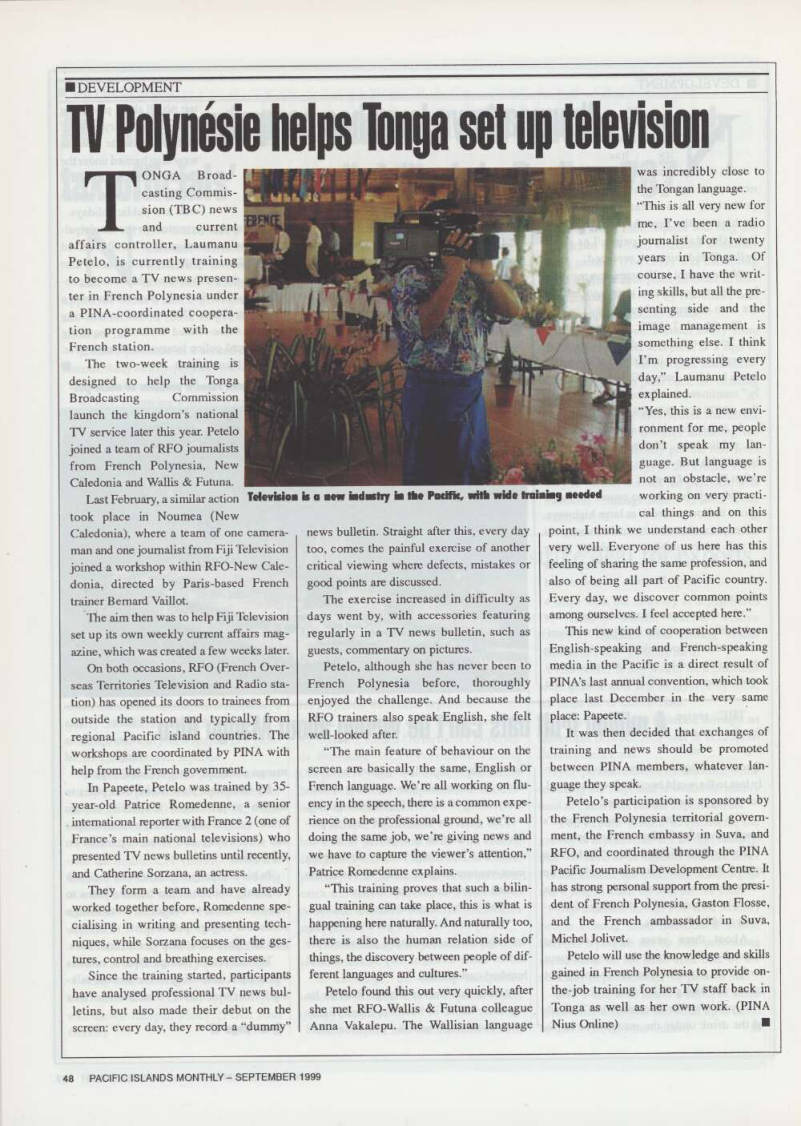
Television is a new industry in the Pacific, with wide training needed