Weeds threaten mighty PNG
pp. 40-41 · Read in the full issue
river - WWF report
ONE of the world’s few great river systems to remain in a near pris tine state, Papua New Guinea’s Sepik River, is under threat from introduced weeds, according to a new report.
“The Sepik River: A Natural History” was published mid-August by the South Pacific programme of the World Wide Fund (WWF) for Nature.
The report calls the Sepik, with more than 1,500 lakes and dozens of major trib utaries and landforms, one of the world’s most significant river systems. Its catch ment extends for more than 77,700 square kilometres and is navigable for about 500 kilometres from its mouth on the northern coast of PNG.
Biologically, it is among the most
diverse and least described ecosystems on earth.
“There are no laige mining projects, no industrial plants and no large timber extrac tion projects operating within the region, and compared to other areas of New guinea, much of the area has a low rate of popula
tion growth,” it said.
“The Sepik has yet to suffer the blows that accompany rapid development.”
However, water weeds, mostly from South America, are one of its biggest threats.
“Aquatic weeds in the Sepik River sys tem deserve special attention because of the serious effects they have had on the people and ecology of the region, as well as then potential to cause similar consequences in the future,” the report said. Salvinia moles ta, a weed capable of doubling its size every
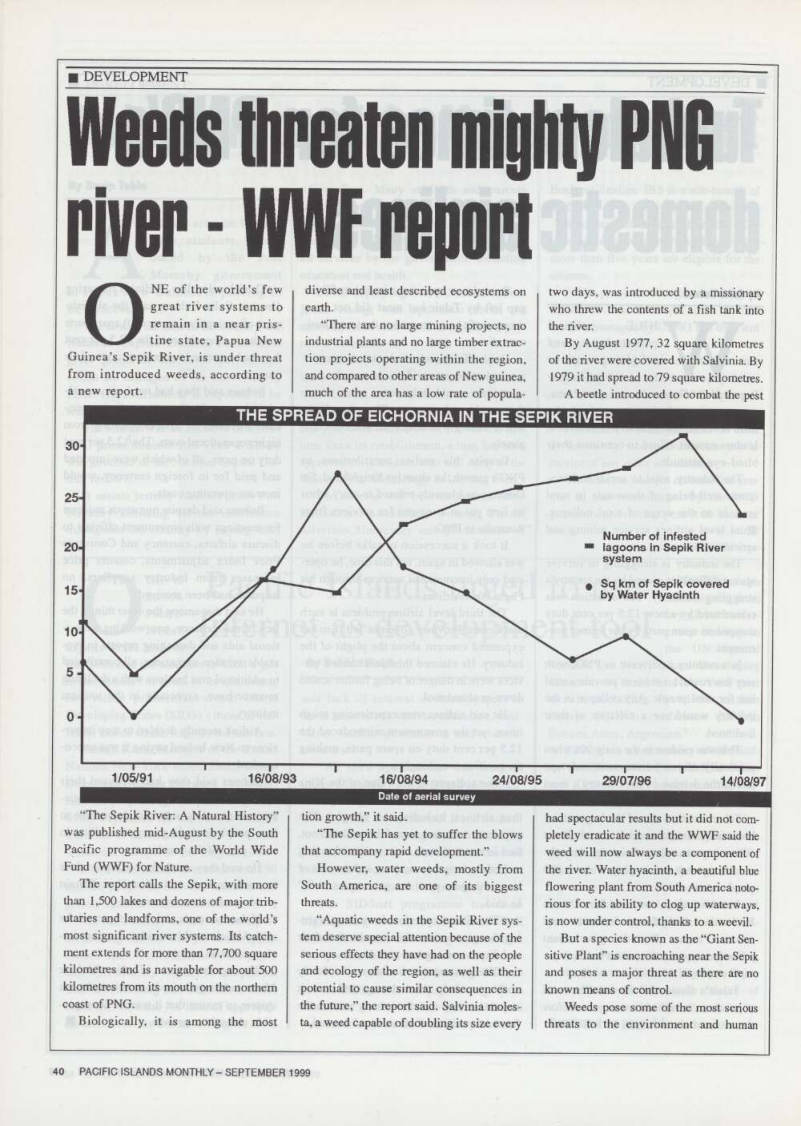
two days, was introduced by a missionary who threw the contents of a fish tank into the river.
By August 1977, 32 square kilometres of the river were covered with Salvinia. By 1979 it had spread to 79 square kilometres.
A beetle introduced to combat the pest
had spectacular results but it did not com pletely eradicate it and the WWF said the weed will now always be a component of the river. Water hyacinth, a beautiful blue flowering plant from South America noto rious for its ability to clog up waterways, is now under control, thanks to a weevil.
But a species known as the “Giant Sen sitive Plant” is encroaching near the Sepik and poses a major threat as there are no known means of control.
Weeds pose some of the most serious threats to the environment and human
inhabitants in the Sepik catchment. Sever al species that are already in PNG have the potential to invade large areas of the Sepik flood plains where their effect would be catastrophic,” the report said.
The prevention of new weeds entering the Sepik must be of high priority.”
A whole host of mammals and birds face a growing threat. The recent intro duction of arboreal primates into Irian Jaya should be regarded as an extremely serious threat to the ecology of the entire island.
Already there are reports of local extinction of some Bird of Paradise species as a result of primate predation of eggs.”
Various species of tree kangaroo are under threat, WWF said, and Australian introduced water buffalo, which cause mas sive damage to wetlands, should be eradi cated. Mining in the spectacularly beautiful region is currently on a small scale, but is unlikely to stay that way.
“The mining of economically important minerals in the Sepik catchment is likely to
be a major issue in the next decade in rela tion to development opportunities for local communities and the environmental impact,” WWF said.
One of the tributaries, the Frieda River, is targeted already by the American firm Cyprus Amax which is planning a copper and gold mine with a 2002 start-up date.
“If this mine is operated in the same way as all the other large mining projects, it probably will have major impacts on the region,” the report warned. (AFP) ■
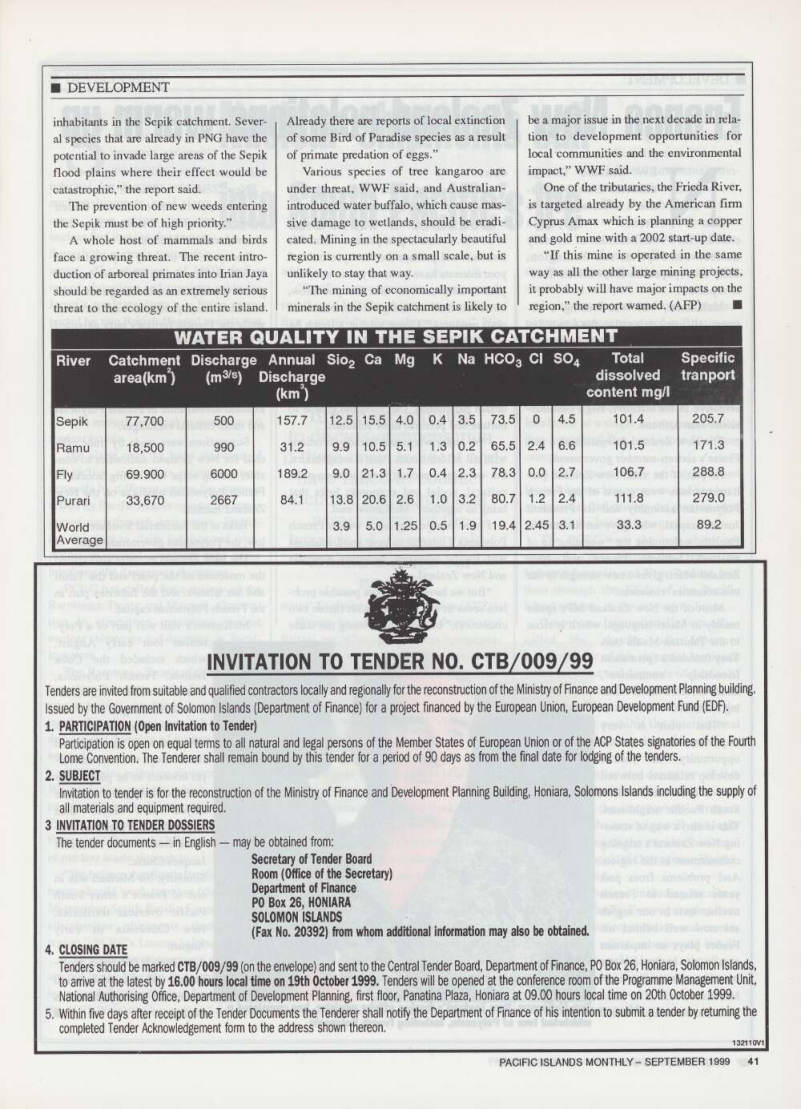
Water Quality In The Sepik Catchment
River Catchment
area (km 2 )
Discharge Annual
(m 3/s ) Discharge
(km 3 ) CM O W Ca Mg K Na O O X Cl so 4 Total dissolved
content mg/l
Specific
tranport
Sepik 77,700 500 157.7 12.5 15.5 4.0 0.4 3.5 73.5 B 4.5 101.4 205.7 Ramu 18,500 990 31.2 9.9 10.5 5.1 1.3 0.2 65.5 rS 6.6 101.5 171.3 Fly 69.900 6000 189.2 9.0 21.3 1.7 0.4 2.3 78.3 0.0 2.7 106.7 288.8 Purari World Average 33,670 2667 84.1 13.8 3.9 20.6 5.0 2.6 1.25 1.0 0.5 3.2 1.9 80.7 19.4 1.2 2.45 2.4 3.1 111.8 33.3 279.0 89.2