Murder, intrigue and death penalty
pp. 30-33 · Read in the full issue
Cover Story
Murder, intrigue and death penalty Samoan politics takes a new turn
By Michael Field
FOR a decade or more life
had been pleasantly prof
itable for Leafa Vitale.
He had successfully ripped off the Samoan government, its taxpayers and aid donors. As Minister of Works he treated the public purse as his own proper ty - and if anybody got in the way he told them he would kill them.
Everybody knew the truth about Leafa but he had strong patrons in the late Prime Minister Tofilau Eti Alesana and Finance Minister Tuila’epa Sailele. Tuila’epa was the public spokesman who, for years, sav agely attacked anybody who questioned the truth of what was going on.
Leafa had a mate too; Telecommunica tions Minister Toi Aukuso and the two even had a personal competition about how much they could get away with.
This year, after 20 years of worsening corruption, Tuila’epa privately launched a clean-up; publicly he could not because that would have been an admission of what had happened while he had been
deputy.
Besides, the ruling Human Rights Pro tection Party (HRPP) were in the process of deifying Tofilau who died early this year. Tuila’epa, who took over, took Pub lic Works from Leafa who was given the spurious post of Minister of Women’s Affairs.
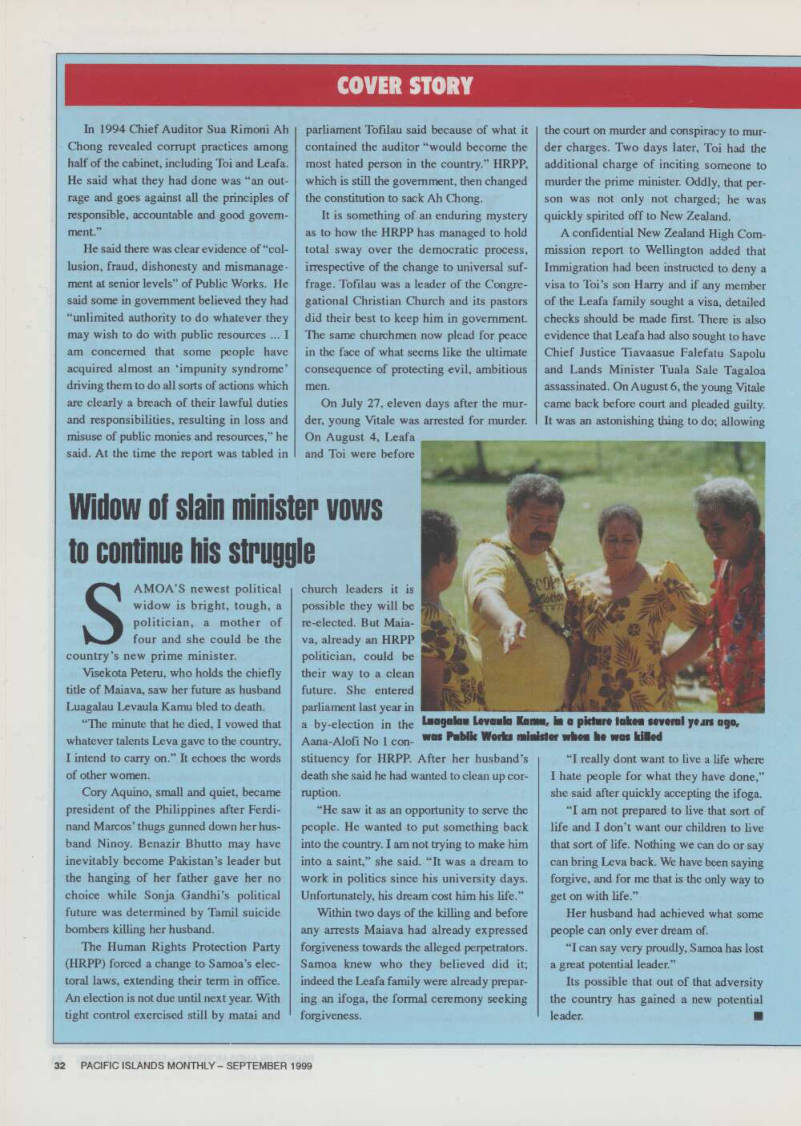
The potentially lucrative job of Public Works went to Luagalau Levaula Kamu, an ebullient, over-weight lawyer who was married to Visakota Peteru, a bright New Zealand-bom pastor’s daughter who hailed too from Auckland University law school and more recently an MR Lua galau’s early moves were against the illic it empire built by Leafa and Toi and par ticularly corruption in the government
owned Electric Power Corporation (EPC) although it is by no means clear whether criminal charges would follow.
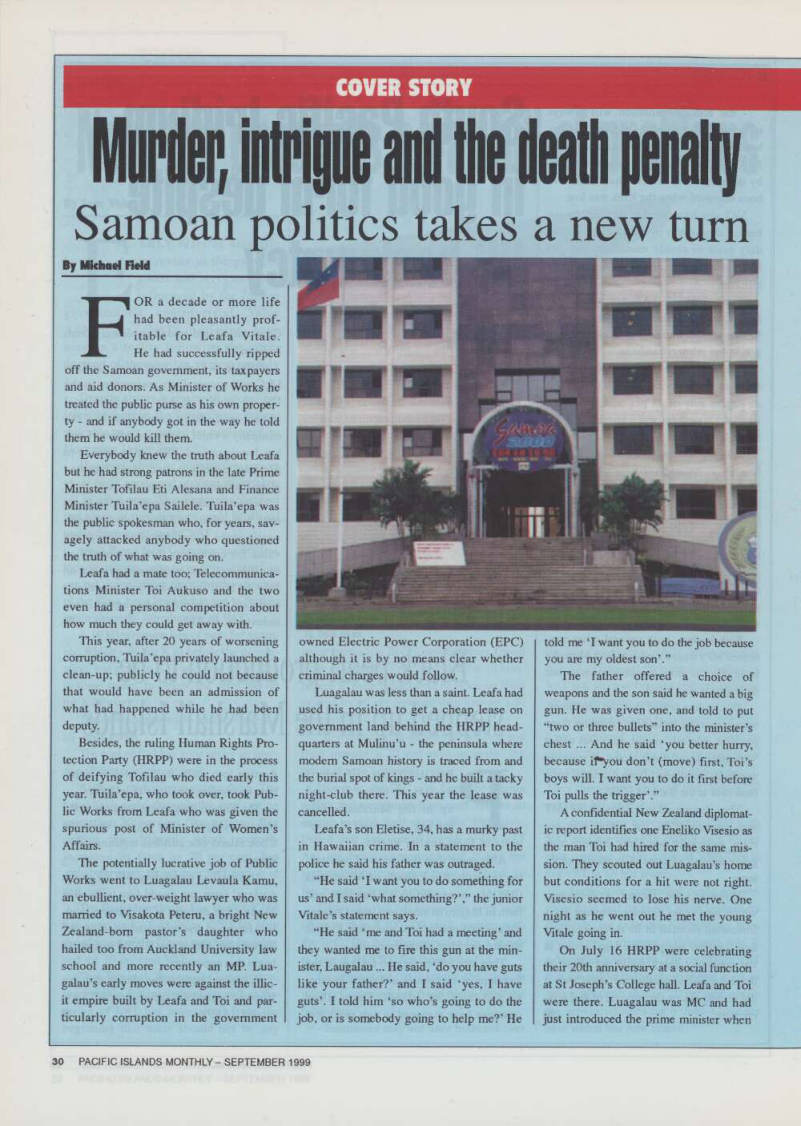
Luagalau was less than a saint. Leafa had used his position to get a cheap lease on government land behind the HRPP head quarters at Mulinu’u - the peninsula where modem Samoan history is traced from and the burial spot of kings - and he built a tacky night-club there. This year the lease was cancelled.
Leafa’s son Eletise, 34, has a murky past in Hawaiian crime. In a statement to the police he said his father was outraged.
“He said T want you to do something for us’ and I said ‘what something?’,” the junior Vitale’s statement says.
“He said ‘me and Toi had a meeting’ and they wanted me to fire this gun at the min ister, Laugalau ... He said, ‘do you have guts like your father?’ and I said ‘yes, I have guts’. I told him ‘so who’s going to do the job, or is somebody going to help me?’ He
told me ‘I want you to do the job because you are my oldest son’.”
The father offered a choice of weapons and the son said he wanted a big gun. He was given one, and told to put “two or three bullets” into the minister’s chest ... And he said ‘you better hurry, because if"you don’t (move) first, Toi’s boys will. I want you to do it first before
Toi pulls the trigger’.”
A confidential New Zealand diplomat ic report identifies one Eneliko Visesio as the man Toi had hired for the same mis sion. They scouted out Luagalau’s home but conditions for a hit were not right.
Visesio seemed to lose his nerve. One night as he went out he met the young Vitale going in.
On July 16 HRPP were celebrating their 20th anniversary at a social function at St Joseph’s College hall. Leafa and Toi were there. Luagalau was MC and had just introduced the prime minister when
his cell phone rang. He walked off the stage to take it. Through the brick lattice the junior Vitale cocked his .223 rifle and switched off the safety.
“I seen him talking on the cell phone.
Leva talking on the cell phone, he was standing there,” he said in his confession.
“I put the gun mouth, the barrel between the bricks, and just pulled the trigger. The gun was pointed at Leva’s left-side. There was a loud bang, it was really loud, a big fire came out the front, then I pulled the gun and started running straight to the front.”
Luagalau, mortally wounded, but alive, is said to have cried out: “masofa, masofa” (broken) or “masofasofa” (to die).
His wife had been in the audience and thought the bang was an electrical malfunc tion. Then she saw them carrying her hus band to the pick-up truck which took him to hospital. Doctors struggled for 20 min utes. “From their faces I could tell things were bad,” she said. “I touched him and he was cold; the loss of blood was too great.
Then they started doing CPR and I realised we were losing him.”
The young Vitale, meanwhile, did not know if he had hit the minister, only find ing out when he met his father later that night. “I told him ‘is Leva died?’ and he said ‘yes, you got him on the right spot’.
My father was so happy. His pleasure was released from his body.”
This most political of murders was quickly de-politicised. A New Zealand For eign Affairs official slammed reports which termed it an assassination while Tuila’epa went into the same kind of curious denial.
“To me it was probably a personal grudge against the minister, or it is proba bly the work of a nut,” he said. There were “wild speculations” on the motives but he doubted it was political. “To me it is one of these incidents which the police are investi gating. It could happen to anybody. In a country like Samoa that killing could hap pen to anybody, any one of us. We don’t have security with us, this is a free country,
we walk everywhere unguarded.”
If it was political Luagalau could have been shot at a “much safer place where no one is present. His home is one such place, and there are hundreds and hundreds of
places when he could have been killed.”
In a surprising move he called in New Zealand police experts. It was ironic - the last political killing in Samoa had been those carried out by New Zealand Police in 1929 when they killed an unarmed Tupua Tamasese Lealofi 111 and members of the Mau Movement.
What was intriguing about this case was that in the 11 days between the killing and the first arrest, rumours quickly figured Leafa and Toi - for obvious reason. In 1992 Fatu Tielu was EPC financial controller when he refused to write out a cheque to Leafa’s personal company. The minister phoned him and told him he would shoot him. It went to court but the New Zealand magistrate. Bill Dillon, ruled there was no evidence Leafa was going to act on his threat. Leafa’s lawyer was Luagalau.
Last year the editor of the Weekly Samoa Post, Molesi Taumaoe, claimed Leafa had threatened him, saying: “I am the kind of guy who can always hire a hitman if I cannot do it myself.”
None of this is news in Samoa. It was well known but Leafa and Toi were protect ed by the way in which Samoa had effec tively become a one party state. And the HRPP was no stranger to corruption; its very first prime minister, Va’ai Kolone, had to step down when he was found guilty of corrupt practices over his own election.
Tofilau too had made a strange effort to conceal the fact that once he had been found guilty of cattle stealing. And yet, in the end, the circumstances were hardly pro found or important and were tied up in a chiefly battle not of his making. But the attempt at cover up was all his own work.
The local newspaper editor, Sano Mali fa of the Observer, ran a series of articles outlining various charges. Tupua Tamasese was vilified for bringing up the subject while the Observer was had its printing operation destroyed in a mystery arson attack - now being linked by police to Leafa. Destroyed in the fire were copies of Malifa’s novel which painted a barely fic tional picture of corrupt Samoa.
In 1994 Chief Auditor Sua Rimoni Ah Chong revealed corrupt practices among half of the cabinet, including Toi and Leafa.
He said what they had done was “an out rage and goes against all the principles of responsible, accountable and good govern ment.”
He said there was clear evidence of “col lusion, fraud, dishonesty and mismanage ment at senior levels” of Public Works. He said some in government believed they had “unlimited authority to do whatever they may wish to do with public resources ... I am concerned that some people have acquired almost an ‘impunity syndrome’ driving them to do all sorts of actions which are clearly a breach of their lawful duties and responsibilities, resulting in loss and misuse of public monies and resources,” he said. At the time the report was tabled in
parliament Tofllau said because of what it contained the auditor “would become the most hated person in the country.” HRPP, which is still the government, then changed the constitution to sack Ah Chong.
It is something of an enduring mystery as to how the HRPP has managed to hold total sway over the democratic process, irrespective of the change to universal suf frage. Tofllau was a leader of the Congre gational Christian Church and its pastors did their best to keep him in government.
The same churchmen now plead for peace in the face of what seems like the ultimate consequence of protecting evil, ambitious men.
On July 27, eleven days after the mur der, young Vitale was arrested for murder.
On August 4, Leafa and Toi were before
the court on murder and conspiracy to mur der charges. Two days later, Toi had the additional charge of inciting someone to murder the prime minister. Oddly, that per son was not only not charged; he was quickly spirited off to New Zealand.
A confidential New Zealand High Com mission report to Wellington added that Immigration had been instructed to deny a visa to Toi’s son Harry and if any member of the Leafa family sought a visa, detailed checks should be made first. There is also evidence that Leafa had also sought to have Chief Justice Tiavaasue Falefatu Sapolu and Lands Minister Tuala Sale Tagaloa assassinated. On August 6, the young Vitale came back before court and pleaded guilty.
It was an astonishing thing to do; allowing
no room for any appeal at all. He was sen tenced to death by hanging. It was hardly a plea-bargain worth having but he turned state’s evidence against his father. He was moved to jail on Savai’i for his protection, and his family sent to New Zealand. As this article was going to publication. New Zealand Foreign Minister Don McKinnon was in Samoa where a confidential report written by New Zealand High Commission er Mac Price was leaked.
It was his theory that the events had not been part of a coup attempt. “Rather it is that of a thug running amok. To suggest that he was trying to take over the government ascribes in our view far too much system, reason and structure to his actions.
“What we see is a man increasingly out of control as his empire of corruption in the public sector headed for extinction, and he resorted with growing desperation to what
he was been threatening to do to a large number of people for a long time - killing those who stood in his way.”
Opposition Leader Tupua Tamasese Efi, who for years had been a Jeremiah on the consequences of corruption now notes that Ah Chong had also exposed irregularities and corruption in the Inland Revenue, Cus toms and Treasury, for which departments Tuila’epa had ministerial responsibility.
“If we do not address constructively the cultural, political, economic and spiritual environment which spawned violence, we are condemned to repeat violence in a worse form.” * PIM correspondent Michael Field worked for former prime minister Tupuola Efi in the late 1970 s and was present for the creation of the Human Rights Protection Party. Tupuola is now Tupua Tamasese Efi, leader of the Samoan Opposition. ■