New technology uses industrial waste
pp. 22-23 · Read in the full issue
to create clean-burning gas
THERE have been many people who wished that rubbish would be put to good use, and not just dumped to create health and environ mental timebombs.
Now an Australian company is push ing product that it claims uses munici pal and industrial rubbish to create energy.
After many years of development the first commercial-size PCE Process unit was demonstrated at Toups Tech nology Licensing’s Environmental Solutions Division R & D centre head quarters in Tampa Bay, Florida, USA on July 27th, 1999.
The proprietary process is said to turn hydrocarbon-based solid and liquid waste, from household or industrial, into a clean-burning fuel and carbon black.
Now this technology is to be intro duced throughout Asia-Pacific, Africa, the Middle East and the Indian sub-con tinent through Touts Technology Licensing (Australia) Pty Ltd.
Third world countries, islands, small towns, large municipalities and manu facturing plants, are seen as prime can didates for full utilisation of this tech nology.
Hydrocarbon-based garbage repre sents approximately 86 per cent of our
waste stream. Most finds its way into landfills, while the balance is inciner ated.
This traditional method of disposal presents two serious environmental problems: landfills produce leachate, or ‘garbage juice’ a toxic runoff that can contaminate groundwater; incin erators have toxic emissions, includ ing ‘fly ash,’ which often escapes into
the atmosphere.
TTL’s unique PCE Process, on the other hand, treats hydrocarbon-based waste in a closed system without releasing harmful emissions, fluids or solids to the environment. The non burning system transforms approxi
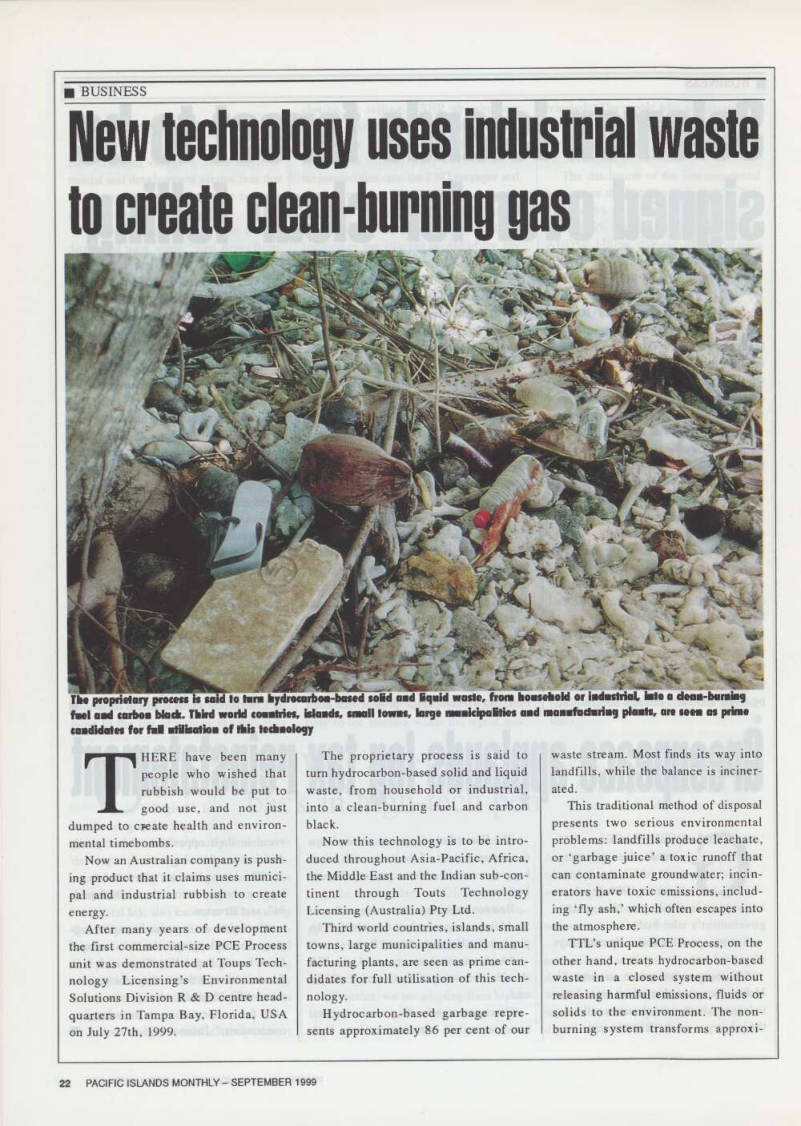
The proprielary process is said lo turn hydrocarbon-based solid aad liquid waste, from household or industrial, into a dean-burning fuel and carbon black. Third world countries, islands, small towns, large municipalities and manufacturing plants, are seen as prime candidates for full utilisation of this technology
mately 40 per cent of the waste into car bon black, which can be used for a vari ety of purposes.
The rest becomes a clean-burning gas that contains mostly hydrogen and methane.
The gas, given the lab name Phoenix 777, demonstrates exhaust and combus tion properties superior to natural gas.
Phoenix 777 combustion emits less than half of the carbon dioxide emis sions of natural gas and virtually no carbon monoxide or hydrocarbons.
It also contains seven to nine per cent oxygen and water vapour.
It is lighter than air and it has a nat ural odour - both important safety fea tures.
Phoenix 777 can be used to generate electricity on a commercial scale.
It can provide an estimated one megawatt per 20 tons of waste, a rate approximately 23 times more efficient than some of the best existing waste-to energy (incineration) technologies.
For example, 20 tons solid and liquid waste creates 300,000 cubic feet of Phoenix 777 gas.
This 300,000 cubic feet Phoenix 777 gas creates one megawatt of electricity.
One megawatt of electricity creates energy for approximately 500 - 2,000 homes.
The PCE Process is highly economi cal and its positive environmental attributes are enhanced, since the unit uses approximately 20 per cent of the clean-burning gas (Phoenix 777) creat ed by the waste treatment process to fuel itself.
“The PCE Process a wholly-owned TTL technology addresses both the
increasingly overflowing problem of
solid and liquid waste disposal and the increasing need for clean-burning alter native fuels,” said Leon Toups, TTL’s President and CEO.
Toups Technology Licensing, Inc., a
diversified company are at the forefront of new technological advances concen trating in the energy, environment, healthcare and natural resource mar kets. “Environmental problems caused by highly pollutant fuels are, by far, the
largest problems of contemporary soci eties.
Following personal eye-witnessing and inspection of the PCE Process, ren ders it as one of the most, if not the most advanced waste to energy type
technologies available.
The availability of a new, cheap, and readily producible fuel, such as Phoenix 777 produced by the PCE Process should be taken seriously by all,” said Ray Russell, CEO Toups Technology Licensing (Australia) Pty Ltd.
Toups Technology Licensing (Aus tralia) Pty Ltd., is a privately funded Australian company who have recog nised that the scientific world has made great advances in the latter years of this century combating pollution of the planet, while at the same time develop ing products which co-exist with the natural ecological balance. ■