ACP nations told to include
pp. 46-47 · Read in the full issue
gender in new Lome pact
By Debbie Singh & Niccolo' Sarno
THE 71 African, Caribbean and Pacific (AGP) governments and the European Union (EU) have been challenged to stop treating women as passive members of society and begin to focus trade and development policies on women, youth and the poor to ensure that development and growth head
in a common direc tion.
“The rules of the game of trade still do not include gender.
The fact that 70 per cent of the world’s women are poor is not new. And the rhetoric will not change ... but what more must be done in order to make
partnership become
operational?” asked Pat Made, Director of Inter Press Service, Africa.
The issue of gen der, in the context of a successor agreement to Lome IV, the huge trade and aid pact between the EU and the AGP states was
among issues addressed at a hearing on civil society held in Brussels July 8-10.
The current Lome convention expires on February 1, 2000 and it is envisaged that the successor pact will include a chapter on civil society and its role in the implementation of the follow-up agree ment.
The successor agreement between the EU and the AGP will be based on the overarching objective of poverty eradica tion.
The EU negotiating directives set out three guiding principles “for systematic application in all areas of cooperation”,
including “gender mainstreaming and gen
der equality”.
Both the EU and the AGP also recognise that “social and economic development cannot be secured in a sustainable way without the participation of women. Nego tiators continue to speak the language and
progress continues to seem far away. We are constantly treating the symptoms and not being reactive.”
Made said there was a need to main stream and stop compartmentalisation of issues. She said there was a need for har monisation of policies which had emanated from major United Nations international fora such as the human rights, environ ment, population, women’s and social development conferences to ensure consis tency and progress.
Jagjit Plahe of Kenya stressed the need for existing human rights agree ments to be used as a threshold when dis cussing trade agreements in terms of determining whether trade is assisting with the eradication of poverty.
“Let us not romanticise about words like poverty eradication and good gover nance. There have been claims that half the world’s poverty will be eliminated by the year 2015. But which half are we talking about?” asks Plahe.
“The EU and other international organisations need to invest in awareness raising to build capacity and inform poor people about Lome to enable them to make informed choices,” she added.
Kena’e Ka’au of the South Pacific based Melanesian Solidarity for an Inde-
I pendent and Nuclear Free Pacific supports the inclusion of gender as a development con cern in the successor Lome pact but says the meaning of gender is still not widely under stood in the Pacific.
“Many in the Pacific think that gender is about women but it is a much broader issue,”
Ka’au says.
“In the Papua New Guinea and Melanesian context the issue of gen der balance or equality from the EU level is important. At this level, it must be equality and not just a notion of equality. If this is not done, women will be
left out.”
Ka’au said an additional challenge for the Pacific concerned how the whole concept of gender in the successor Lome pact would be translated and made effec tive on the ground.
Ka’au suggested the need for aware ness raising before the gender issue could become any part of the successor agree ment but also pointed out that this would need to be done in the context of nation al capacity and availability of resources.
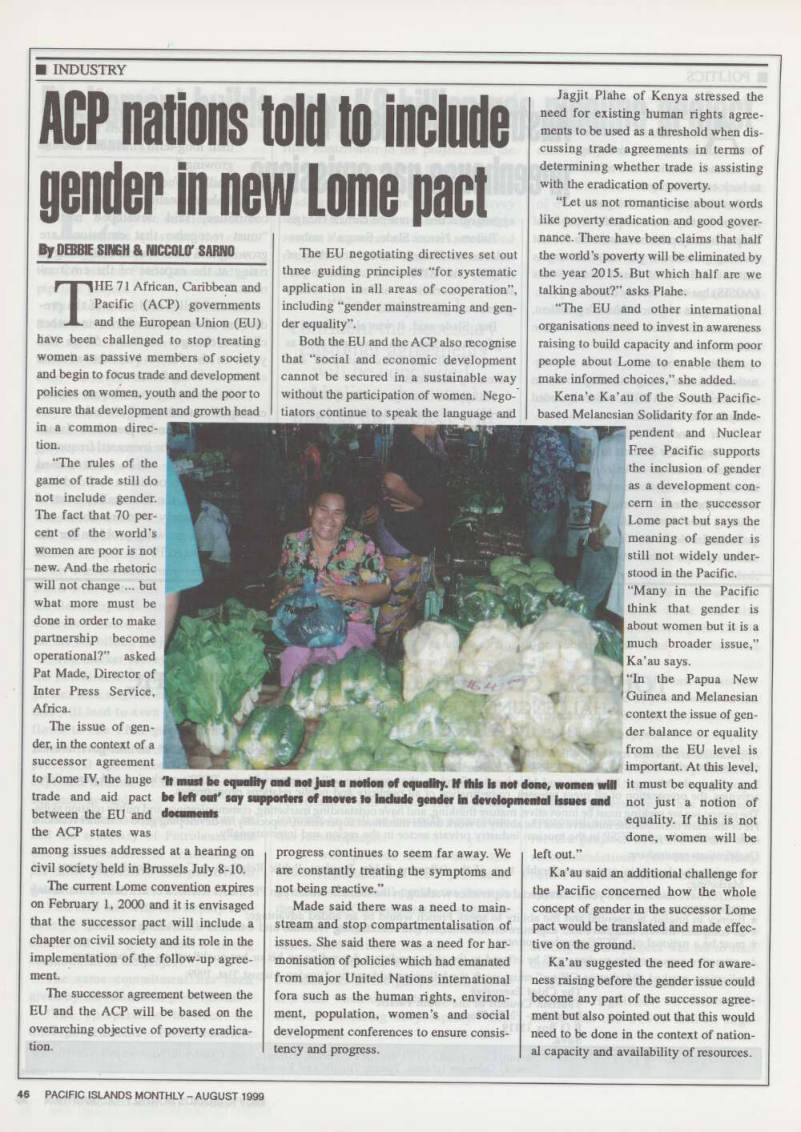
'It must be equality and not just a notion of equality. If this is not done, women will be left out' say supporters of moves to include gender in developmental issues and documents
“The first time I heard about Lome was in April this year but some work has begun on awareness raising in PNG (Papua New Guinea) through the Pacific Concerns Resource Centre and a few European NGOs,” Ka’au said.
“To be honest, we need to look at home first before looking elsewhere,” he said, adding that in the Pacific there exist ed a need also to consider governments that were not responding to people’s needs. “How can we get the EU to assist us to bring about good governance using our own definitions of development?”
Ramesh Jaura, Chair of the Global Cooperation Council in Bonn, Germany said there is a need to look beyond the successor Lome pact in terms of the democratisation of international relations.
He said there is a need for treaties and mechanisms for monitoring these treaties, and said it is civil society’s role to demand more transparent measures of democratisation in terms of trade, aid and investment.
Brita Bastogi, of the Brussels-based Eurostep Network of European NGOs said: ‘“They (negotiators) have said gen der is a cross-cutting issue.’”
“But there are no mechanisms in the ACP mandate (for negotiations) to imple ment measures related to gender.”
Calls for the engendering of develop ment policies from their evolutionary stages have also been heard in Brussels but Hellen Felter, Vice-President of the European Women’s Lobby agreed with Ka’au in that, even among negotiators: “People don’t know what gender is.”
The ACP negotiating directive brings together gender and youth issues under the same chapter.
Felter said that out of 20 appointe ments on July 9 as European Commis sioners at the executive branch of the European Union, the European Commis sion, only five were women.
“And gender has to do also with changing the structure that has been put up by men,” she said, pointing out that at the conference “there was not one female chair. And that is Europe,” she added, suggesting that the situation is worse in most ACP nations. ■