Fragile peace for Solomons
pp. 38-39 · Read in the full issue
Politics
By Michael Field
THE night a peace deal was signed in the Solomon Islands the pipe-smoking Prime Minis ter Bartholomew Ulufa’alu was home packing his bags.
It seemed a joke but was off to the Melanesian Spearhead Summit in Vanuatu next morning.
Melanesian solidarity as his country fragmented into Melanesian tribal groups; the victorious Guadalcanal Islanders were driving out the settlers and Ulufa’alu’s fel low Malaitans were surrendering. It was all stitched together in Peace Accord (see sep arate summary) negotiated in Honiara over two days by Commonwealth mediator Sitiveni Rabuka, who until two months ago was Fiji’s prime minister.
A day later and 40 minutes to the East, in militant territory, the guerrillas, rejoic ing in a variety of names, signed onto the deal on the condition it be acknowledged that it was the Malaitans who started it all.
Even now it is not clear whether Malai tans really accept their fate and Common wealth deputy director Ade Adefuye of Nigeria called it all a “fragile peace”.
With the help of the United Nations and the International Committee of the Red Cross tens of thousands of them, many who had been bom on Guadalcanal, were shipped off to Malaita with little thought given to the fate of the Solomon Islands itself in the face of fierce racism and ter rorism. One time bank clerk George Grey, now promoted to the secretary of the Isa tabu Freedom Fighters (also known as the Isiantabu, or the Guadalcanal Liberation
Army or Guadalcanal Revolutionary Army
and by shorthand “the militants”), who summed up the nobility of the cause.
“Do you know what we call Malaitans,” he said, smiling, behind his sunglasses and dreadlocks made of bamboo curtain rings,
“dog’s sperm.”
A short time later he shook Rabuka’s hand and told him there was peace in the
Guadalcanal coun tryside because the Malaitans had gone.
“They are all in town. They are liv ing behind a fence.
It is very easy to wipe them out,” he said, saying it would only take three hours.
“We are fighting a holy war. The trees are fighting, the stones are fighting, and women and the children are fight ing.”
The militants were an untested power. They had hundreds of men under a variety of arms.
While people
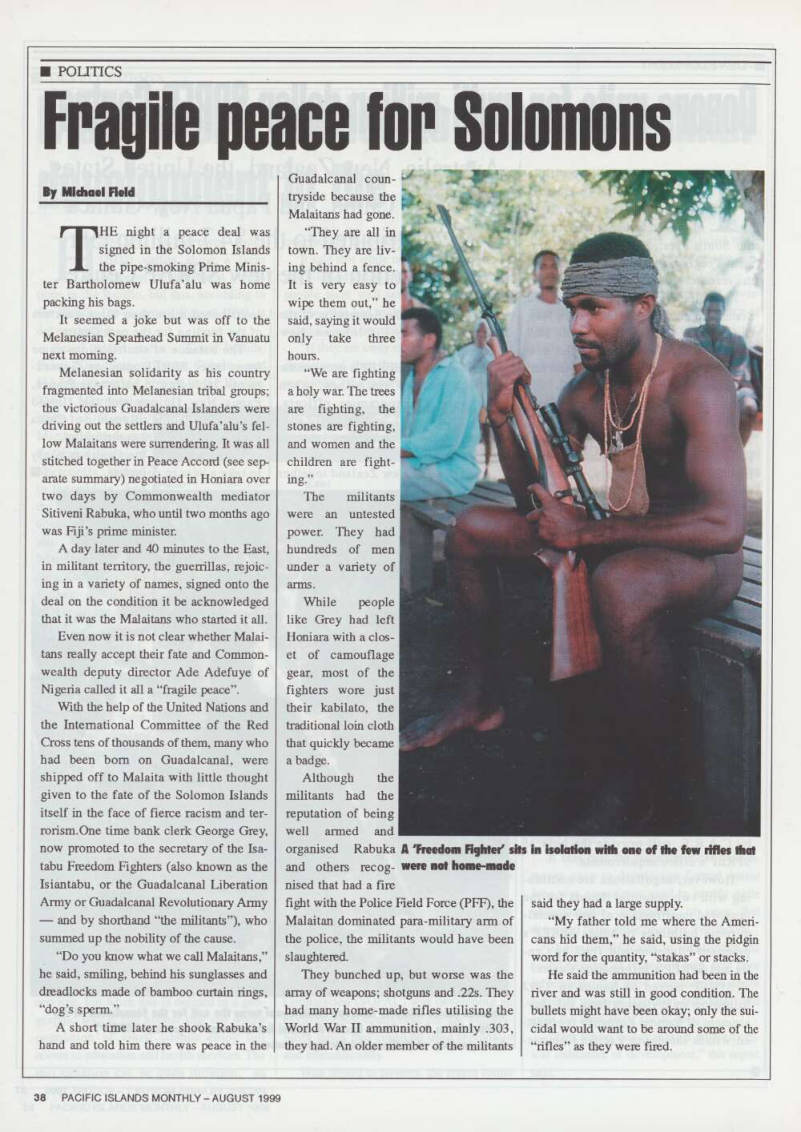
like Grey had left Honiara with a clos et of camouflage gear, most of the fighters wore just their kabilato, the traditional loin cloth that quickly became a badge.
Although the militants had the reputation of being well armed and I
organised Rabuka
and others recog nised that had a fire
fight with the Police Field Force (PFF), the Malaitan dominated para-military arm of the police, the militants would have been slaughtered.
They bunched up, but worse was the array of weapons; shotguns and ,225. They had many home-made rifles utilising the World War II ammunition, mainly .303, they had. An older member of the militants
said they had a large supply.
“My father told me where the Ameri cans hid them,” he said, using the pidgin word for the quantity, “stakas” or stacks.
He said the ammunition had been in the river and was still in good condition. The bullets might have been okay; only the sui cidal would want to be around some of the “rifles” as they were fined.
A 'Freedom Fighter' sits in isolation with one of the few rifles that were not home-made
Grey claimed they had a magic formula to protect them from PFF bullets; one sus pected he read too many Wilbur Smith nov els in the bank.
Rabuka had a more professional eye.
“The weapons they have are shotguns, they are short-range weapons.
If there was to be a teal hammer and pin type of operation they would have to sur render.
“But that is not the solution; you might be able to kill a few of them, but you will not be able to kill the ideology that they have.”
The peace accord is little more than a surrender.
Malaitan Premier David Oeta signed on after a lamentation in which he used the word “victim” many times.
“Malaita province becomes a victim between national government and Malaita province,” he said.
“Our people will always abide by the laws of this country. As you will witness there has been no retaliation.”
Guadalcanal Premier Ezekiel Alebua said he had never contemplated having his signature on a peace accord.
His people did not want the conflict and desired to return to their villages.
“It is sad that many of our friends, many of our people and many of our leaders, regard the people of Guadalcanal as crimi nals.
“I appeal to you all to understand that my people are not criminals, that it is most unfortunate that what has happened has
happened.”
So now the Solomons has a kind of peace, but is in economic min.
Warning travel advisories from Welling ton, Canberra and Washington have put an end to tourism.
During the worst of the troubles the gov
emment published For Sale notices on its shares in Solomon Islands Plantations Lim ited that had been closed.
The British Commonwealth Develop ment Corporation owns 68 per cent of the shares, the government 30 percent and landowners two percent. It operated on 6300 hectares of Guadalcanal property, employing 1800 workers in oil palm pro cessing.
They are now mostly in Malaita, or in Honiara refugee camps.
The militants also want to close down Australia’s Gold Ridge Mining Ltd that has only just begun production.
A Japanese investor last month visited the area before a planned'commitment to a 35 million dollar mining investment. They pulled out given the tensions.
Bigotry, personal ambition and politics
have all served to deliver a savage blow to the Solomons. ■