development in the region
p. 36 · Read in the full issue
More work needed to improve human development in the region
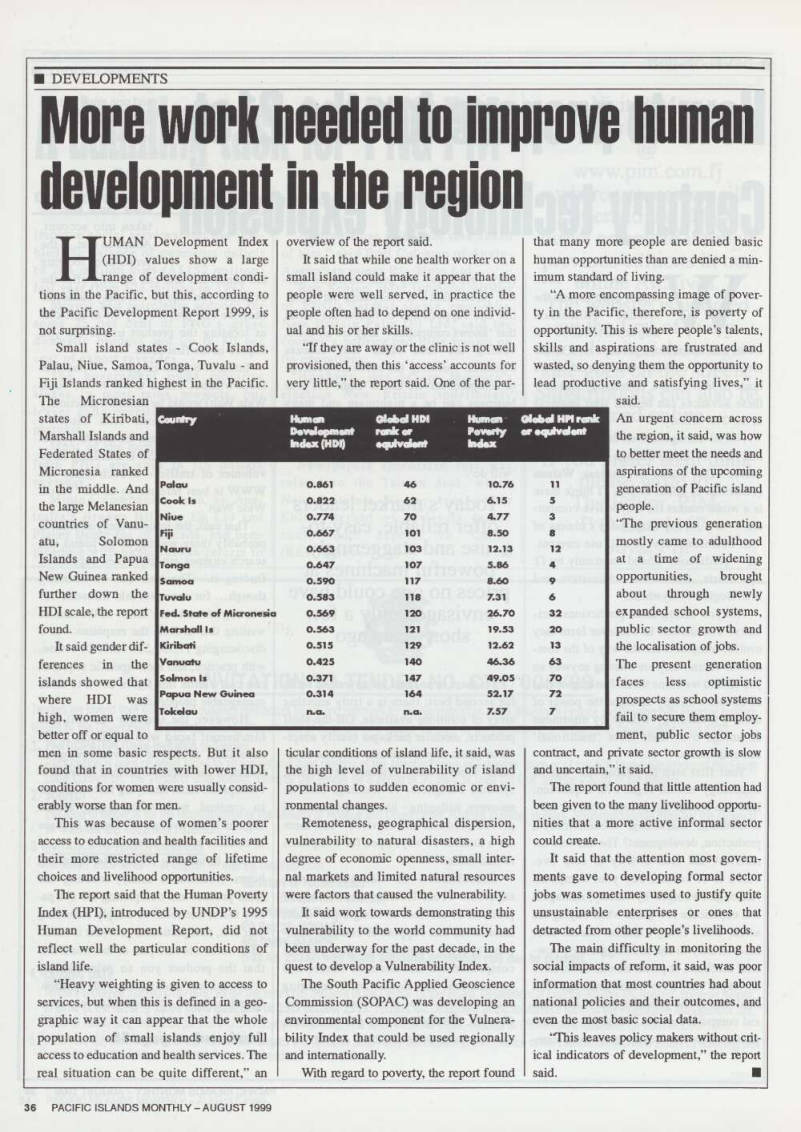
HUMAN Development Index (HDI) values show a large range of development condi tions in the Pacific, but this, according to the Pacific Development Report 1999, is not surprising.
Small island states - Cook Islands, Palau, Niue, Samoa, Tonga, Tuvalu - and Fiji Islands ranked highest in the Pacific.
The Micronesian
states of Kiribati, Marshall Islands and Federated States of Micronesia ranked in the middle. And the large Melanesian countries of Vanu atu, Solomon Islands and Papua New Guinea ranked further down the HDI scale, the report found.
It said gender dif ferences in the islands showed that where HDI was high, women were better off or equal to
men in some basic respects. But it also found that in countries with lower HDI, conditions for women were usually consid erably worse than for men.
This was because of women’s poorer access to education and health facilities and their more restricted range of lifetime choices and livelihood opportunities.
The report said that the Human Poverty Index (HPI), introduced by UNDP’s 1995 Human Development Report, did not reflect well the particular conditions of island life.
“Heavy weighting is given to access to services, but when this is defined in a geo graphic way it can appear that the whole population of small islands enjoy full access to education and health services. The real situation can be quite different,” an
overview of the report said.
It said that while one health worker on a small island could make it appear that the people were well served, in practice the people often had to depend on one individ ual and his or her skills.
“If they are away or the clinic is not well provisioned, then this ‘access’ accounts for very little,” the report said. One of the par-
ticular conditions of island life, it said, was the high level of vulnerability of island populations to sudden economic or envi ronmental changes.
Remoteness, geographical dispersion, vulnerability to natural disasters, a high degree of economic openness, small inter nal markets and limited natural resources were factors that caused the vulnerability.
It said work towards demonstrating this vulnerability to the world community had been underway for the past decade, in the quest to develop a Vulnerability Index.
The South Pacific Applied Geoscience Commission (SOPAC) was developing an environmental component for the Vulnera bility Index that could be used regionally and internationally.
With regard to poverty, the report found
that many more people are denied basic human opportunities than are denied a min imum standard of living.
“A more encompassing image of pover ty in the Pacific, therefore, is poverty of opportunity. This is where people’s talents, skills and aspirations are frustrated and wasted, so denying them the opportunity to lead productive and satisfying lives,” it
said.
An urgent concern across the region, it said, was how to better meet the needs and aspirations of the upcoming generation of Pacific island people.
“The previous generation mostly came to adulthood at a time of widening opportunities, brought about through newly expanded school systems, public sector growth and the localisation of jobs.
The present generation faces less optimistic prospects as school systems fail to secure them employ ment, public sector jobs
contract, and private sector growth is slow and uncertain,” it said.
The report found that little attention had been given to the many livelihood opportu nities that a more active informal sector could create.
It said that the attention most govern ments gave to developing formal sector jobs was sometimes used to justify quite unsustainable enterprises or ones that detracted from other people’s livelihoods.
The main difficulty in monitoring the social impacts of reform, it said, was poor information that most countries had about national policies and their outcomes, and even the most basic social data.
“This leaves policy makers without crit ical indicators of development,” the report said. ■
Country
liimai
Development
bidex (HDI)
Olobd HDI renker
equivalent
Humtsi
Poverty
hdtx
OlobdHPIra*
or equlvdent
Palau 0.861 46 10.76 11 Cook Is 0.822 62 6.15 5 Niue 0./74 70 4.77 3
Fiji
0.667 101 8.50 8 Nauru 0.663 103 12.13 12
Tonga
0.647 107 5.86 4 Samoa 0.590 117 8.60 9 Tuvalu 0.583 118 7.31 6 Fed. State of Micronesia 0.569 120 26.70 32 Marshall Is 0.563 121 19,53 20 Kiribati 0.515 129 12.62 13 Vanuatu 0.425 140 46.36 63 Salmon Is 0.371 147 49.05 70 Papua New Guinea 0.314 164 52.17 72 Tokelau n.a. n.a. 7.57 7