Catastrophe Insurance
pp. 26-29 · Read in the full issue
Cover Story
Catastrophe Insurance A World Bank proposal to take on natural disasters
By Sow Foster Hildebrand
IF you never thought you’d see the day the World Bank helped lower your insurance premi ums for disaster coverage, think again. That day may not be too far off, if a recent proposal for a Small
States Regional Catastrophe Insur
ance Programme goes ahead.
“DISASTERS do happen,” the advertisements say, “Are you prepared?”. For peo
pie in the South Pacific, this message is relayed often just before the cyclone
season of Novem ber to April, but no matter how much preparation is conducted, these small island economies contin ue to be vulnera ble to natural cata strophes.
Now, the World
Bank has decided to step in to even the odds for such countries with its proposal on a Small States Regional Cat astrophe Insurance Pro gramme.
Investigations by the World Bank found that natural disasters of a cata strophic nature were a “significant source of economic instability” for countries such as those of the Pacific.
A paper summarising the World Bank proposal, for a scheme that pro vides coverage for catastrophe insur ance, was put before the Forum Eco
nomic Ministers Meeting (FEMM) in Apia, Samoa last month. ‘Catastrophe Insurance: A Proposal’ said that further investigation by the World Bank “revealed that the high cost of re-establishing infrastructure further hindered economic performance after a nat-
ural dis aster, while a pattern of sharp increases in insurance premiums after catastroph ic disasters limited the ability of the private sector to maintain commercial insurance cover.”
FEMM decided that an analysis of
the proposal would be worthwhile and has called for appropriate strate gies to be developed in that area fol lowing the Caribbean example.
The incentives for setting up such a scheme, the paper says, is that there will be benefits all round. For insur ers, it would mean an expanded mar ket and stable reinsurance costs. For government, there would be wider
coverage of property at risk that should be offset by arrange ments to cover non-insurable risk to low income house holds and small business.
The World Bank estab lished a pilot pro gramme in the Caribbean, with repre sentatives from gov ernments, insurance companies and the private sector. Their work in progress was reported to the Con ference on Small States, held in St Lucia in February this year, where Forum represen tatives and the World
Bank agreed that work should begin on developing a similar scheme for the Pacific.
The initial strategy was to get
some idea of the situation first including the nature and magnitude of natural catastrophes in the Caribbean, the insurance market and its short
comings in dealing with catastrophes.
Since then, the Caribbean scheme has gone to explore how the risk can be dealt with through a regional
underwriting pool. This, they say, can
be financed through catastrophic bonds sold in capital markets, low interest borrowing from the World Bank and a World Bank stop-loss underwriting on multi-million dollar amounts.
The World Bank proposes that the scheme operate through the normal insurance market, with insurers using the pool for reinsurance rather than commercial markets.
“The pool would initially be the responsibility of regional govern ments, though it could be privatised once it became financially self-suffi cient and sustainable. The advantage of such a structure is that extreme risk would be,readily insurable at a stable and lower cost,” the paper says.
Studies in the Caribbean have shown that where there isn’t suffi cient risk transfer and insurance mechanisms, there is a severe limita tion on financing for reconstruction after a disaster.
“Disasters not only result in eco nomic volatility, with severe declines in growth rates being associated with natural disasters, but also in financial volatility in terms of: increased pre miums for, or withdrawal of, insur
ance cover; the additional borrowing requirement by governments to re establish infrastructure and support private sector recovery,” the paper says.
Research found that although the Caribbean has higher than average exposure to catastrophes, including hurricanes, earthquakes, floods and volcanic eruptions, penetration of the insurance industry is estimated at only eight per cent of Gross National Prod uct. This, the paper said, was low com pared to developed countries, though higher than in many Least Developed Countries.
The estimates showed that some 30 per cent of homes in the Caribbean region were not covered by property insurance, compared with less than five per cent in the United States and Europe.
“This,” the paper says, “reflects low incomes in the region, despite the need to insure where mortgage finance is used to finance construction.”
It added that while insurance was available, there was an underlying fear that it could be withdrawn following a series of major losses.
For Fiji, this rang true for business owners in the Nadi town area where
insurance companies have refused to cover property in the flood-prone Nadi streets. Lying on the banks of the Nadi river, these businesses have been subject to flooding over a period of years and thus their premiums have rocketed, and in some cases, they can get no coverage.
For the Caribbean, studies showed that the property insurance system was volatile. Over the first eight years of the 19905, the cost of prop erty insurance was said to have var ied from 0.4 per cent to 1.3 per cent of the value insured. This, it said, reflected periods of tight supply and high prices alternating with periods of easy availability and lower prices.
One of the problems faced is that property insurance in that region was under-capitalised therefore heavily dependent on foreign reinsurers.
Eighty per cent of premium income, the studies found, was ceded to rein surers in the United States and Europe. Because of the system, the primary insurers in the region bore little underwriting risk. This, in turn, leads to little incentive to engage in disaster mitigation and hazard analy sis.
As a consequence, the paper said,
there was minimal activity in crit- j ical areas such as hazards map-| ping, implementation of building! codes and standards and
rectofitting of existing structures
to mitigate loss.
Catastrophic risk, and a num ber of other financial instruments had emerged in recent years to manage risk, the paper said. It said such instruments could be used within a wider strategy to better protect economies at risk, reducing economic volatility in countries subject to natural disas ter risks.
It could also improve the effi ciency and operation of insurance markets, provide liquidity for more rapid reconstruction after disasters, and reduce vulnerabili ty to disaster through the improvement and enforcement of
building code standards and land use/construction planning.
The paper says the strategies drew on catastrophic risk transfer schemes developed over recent years in Flori da, California, Tokyo and New Zealand.
The World Bank’s role in all this, the paper says, is to support the cred
it quality of any scheme, and organising or financing appropriate technical assistance.
Ultimately, it says, there are two possible schemes - the Liquidi ty/Credit Enhancement Facility, and the Securi tisation of Catastrophe Risk scheme.
The first scheme would see commercial catastrophic risk cover age transferred to a cen tral pool sponsored by government and the insurance industry.
Multilateral financial institutions, such as the
World Bank, provide contingent cov erage above the upper limit of the pool, which will be repaid over a long term if used.
This scheme assumes that because of the lower premiums, it would be feasible to have cover made compul sory for higher income households and larger businesses.
The objectives of scheme one are “to increase the capacity of insurers to absorb and spread risk, to augment coverage for property and business losses, and to reduce the volatility impact of changes in international reinsurance pricing.”
Under the second scheme, multi lateral financial institutions and the
insurance industry sponsor the issuing of catastrophic bonds.
These would pay a higher than average yield, but would drop significantly if there is a catastrophe.
The extent of the drop would depend on the “trigger conditions” which gauge the intensity of the cata strophe.
The sponsorship of the bonds would be through guarantees in association with gov ernment. Under this second scheme, the
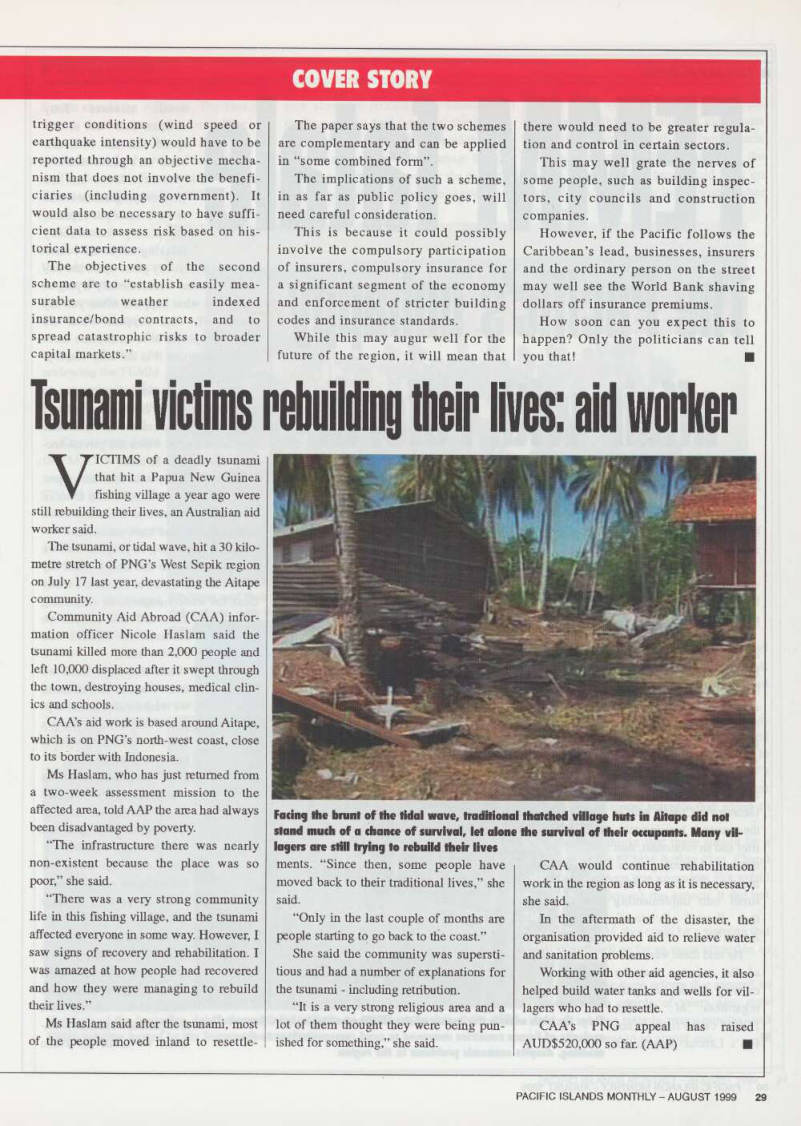
A villager in the Aitape area overcome with grief after the loss of lives and property, following a freak tidal wave, one year ago, last month
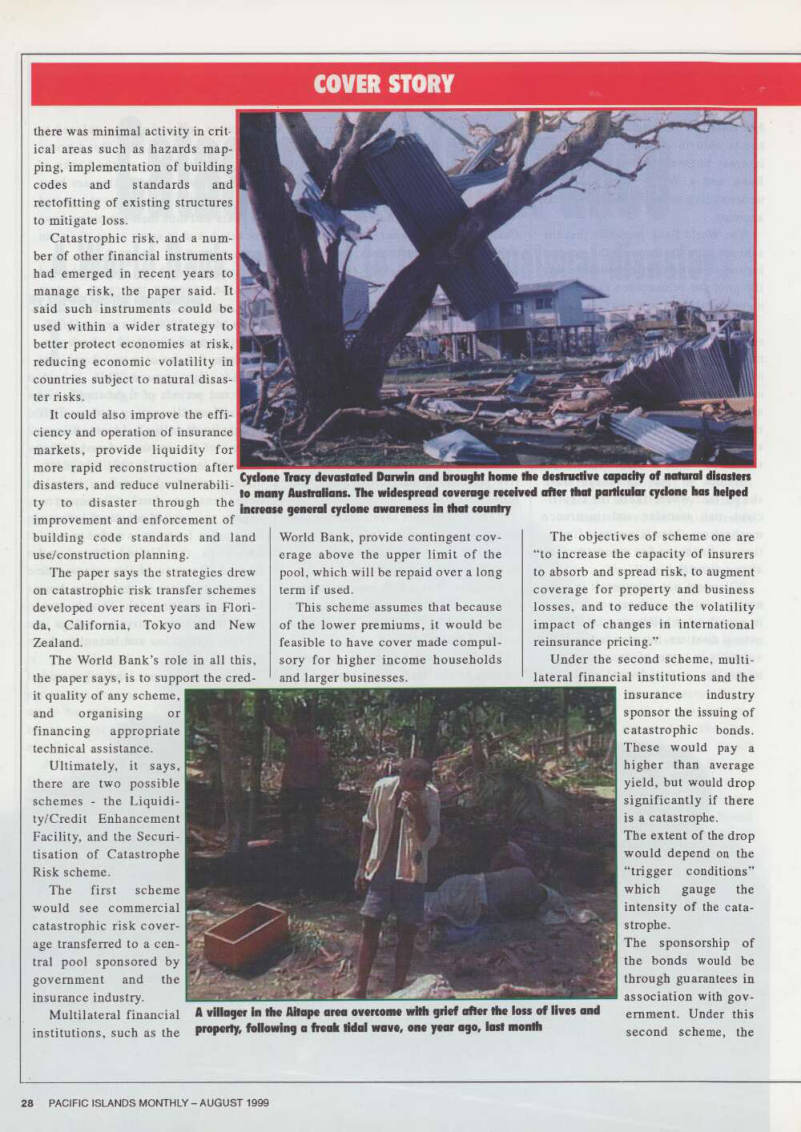
Cyclone Tracy devastated Darwin and brought home the destructive capacity of natural disasters to many Australians. The widespread coverage received after that particular cyclone has helped increase general cyclone awareness in that country
trigger conditions (wind speed or earthquake intensity) would have to be reported through an objective mecha nism that does not involve the benefi ciaries (including government). It would also be necessary to have suffi cient data to assess risk based on his
torical experience.
The objectives of the second scheme are to “establish easily mea surable weather indexed insurance/bond contracts, and to spread catastrophic risks to broader capital markets.”
The paper says that the two schemes are complementary and can be applied in “some combined form”.
The implications of such a scheme, in as far as public policy goes, will need careful consideration.
This is because it could possibly
involve the compulsory participation
of insurers, compulsory insurance for a significant segment of the economy and enforcement of stricter building codes and insurance standards.
While this may augur well for the future of the region, it will mean that
there would need to be greater regula tion and control in certain sectors.
This may well grate the nerves of some people, such as building inspec tors, city councils and construction
companies.
However, if the Pacific follows the Caribbean’s lead, businesses, insurers and the ordinary person on the street may well see the World Bank shaving dollars off insurance premiums.
How soon can you expect this to happen? Only the politicians can tell you that! ■