Innovative campaign hopes to put
pp. 20-21 · Read in the full issue
Madang back on the tourism map
By Frands Tekei
CALLED “the prettiest town in the Pacific” (Lonely Planet Travel Survival Kit), Madang
town has been the envy of both for eign and domestic travellers.
Papua New Guineans know this harbourside town with its pic turesque setting as simply “Beauti
ful Madang”.
But Madang, in recent years, has lost its beauty, its pride and its fame.
Like every growing PNG town, Madang is experiencing an unprece dented influx of people, influenced by large investments that are, in turn, attracted by the town’s peace ful and safe investment climate.
These include a meat cannery, cocoa research establishment, cigarette manufacturer WH Wills (PNG) Ltd.,
and RD Tuna Canners - PNG’s first tuna processing plant. The largest of these investments is the KB3B million Ramu- Nickel project that is expected to begin construction early next year.
Thus, the sudden increase in popula tion has naturally led to more lawlessness and urban problems.
With these factors and the worsening national economic situation, a breakdown in attitude resulting in lawlessness and care lessness has crept deep into the heart of
Madang town where beauty matters most.
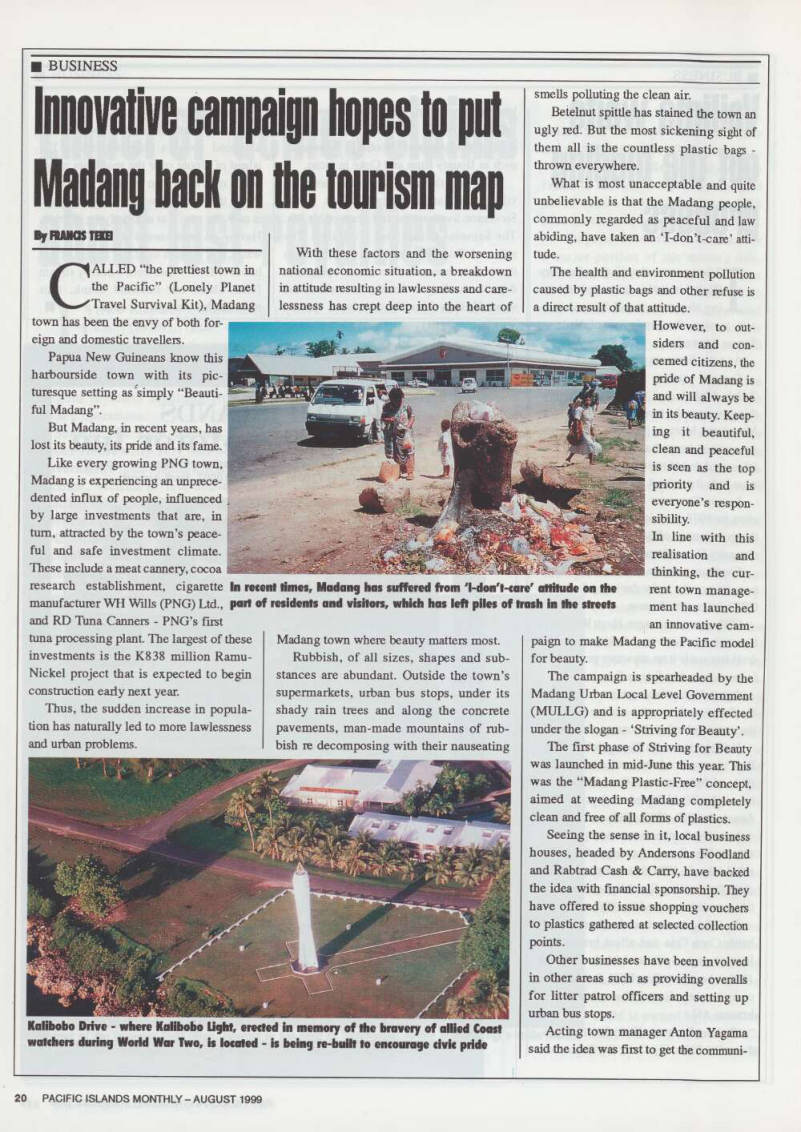
Rubbish, of all sizes, shapes and sub stances are abundant. Outside the town’s supermarkets, urban bus stops, under its shady rain trees and along the concrete pavements, man-made mountains of rub bish re decomposing with their nauseating
smells polluting the clean air.
Betelnut spittle has stained the town an ugly red. But the most sickening sight of them all is the countless plastic bags -
thrown everywhere.
What is most unacceptable and quite unbelievable is that the Madang people, commonly regarded as peaceful and law abiding, have taken an T-don’t-care’ atti tude.
The health and environment pollution caused by plastic bags and other refuse is a direct result of that attitude.
However, to out siders and con cerned citizens, the pride of Madang is and will always be in its beauty. Keep ing it beautiful, clean and peaceful is seen as the top priority and is everyone’s respon sibility.
In line with this realisation and thinking, the cur rent town manage ment has launched an innovative cam
paign to make Madang the Pacific model for beauty.
The campaign is spearheaded by the Madang Urban Local Level Government (MULLG) and is appropriately effected under the slogan - ‘Striving for Beauty’.
The first phase of Striving for Beauty was launched in mid-June this year. This was the “Madang Plastic-Free” concept, aimed at weeding Madang completely clean and free of all forms of plastics.
Seeing the sense in it, local business houses, headed by Andersons Foodland and Rabtrad Cash & Carry, have backed the idea with financial sponsorship. They have offered to issue shopping vouchers to plastics gathered at selected collection
points.
Other businesses have been involved in other areas such as providing overalls for litter patrol officers and setting up urban bus stops.
Acting town manager Anton Yagama said the idea was first to get the communi
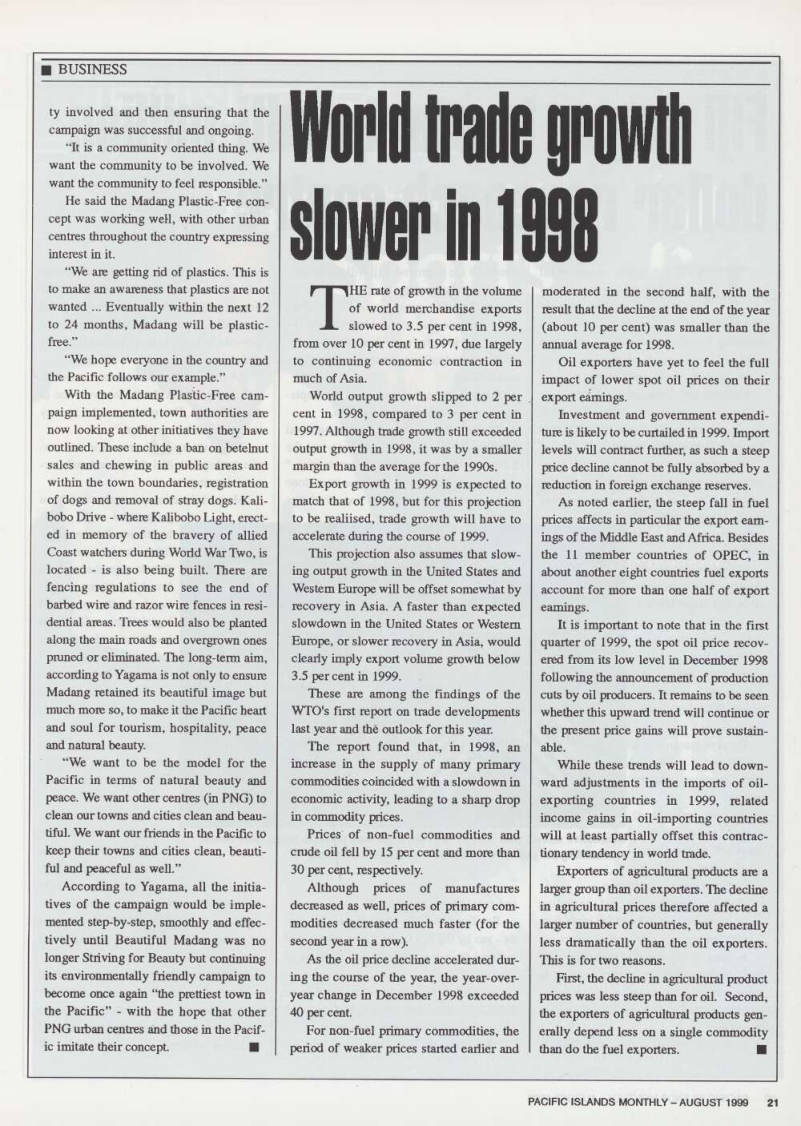
Kalibobo Drive - where Kalibobo Light, erected in memory of the bravery of allied Coast watchers during World War Two, is located - is being re-built to encourage civic pride
In recent times, Madang has suffered from 'I-don't-care' attitude on the part of residents and visitors, which has left piles of trash in the streets
ty involved and then ensuring that the campaign was successful and ongoing.
“It is a community oriented thing. We want the community to be involved. We want the community to feel responsible.”
He said the Madang Plastic-Free con cept was working well, with other urban centres throughout the country expressing interest in it.
“We are getting rid of plastics. This is to make an awareness that plastics are not wanted ... Eventually within the next 12 to 24 months, Madang will be plastic free.”
“We hope everyone in the country and the Pacific follows our example.”
With the Madang Plastic-Free cam paign implemented, town authorities are now looking at other initiatives they have outlined. These include a ban on betelnut sales and chewing in public areas and within the town boundaries, registration of dogs and removal of stray dogs. Kali bobo Drive - where Kalibobo Light, erect ed in memory of the bravery of allied Coast watchers during World War Two, is located - is also being built. There are fencing regulations to see the end of barbed wire and razor wire fences in resi dential areas. Trees would also be planted along the main roads and overgrown ones pruned or eliminated. The long-term aim, according to Yagama is not only to ensure Madang retained its beautiful image but much more so, to make it the Pacific heart and soul for tourism, hospitality, peace and natural beauty.
“We want to be the model for the Pacific in terms of natural beauty and peace. We want other centres (in PNG) to clean our towns and cities clean and beau tiful. We want our friends in the Pacific to keep their towns and cities clean, beauti ful and peaceful as well.”
According to Yagama, all the initia tives of the campaign would be imple mented step-by-step, smoothly and effec tively until Beautiful Madang was no
longer Striving for Beauty but continuing
its environmentally friendly campaign to become once again “the prettiest town in the Pacific” - with the hope that other PNG urban centres and those in the Pacif ic imitate their concept. ■