"Illegal" competitors'100 per cent
pp. 16-17 · Read in the full issue
interest rate hurting PNG's banks
DOES your bank offer you 100 per cent interest on your savings? If it is like most other banks in the world, it probably does not.
But for the people of Papua New Guinea, 100 per cent interest is prov ing to be a lure that is driving them away from commercial banks, towards “get-rich-quick” financial schemes.
The schemes, known as pyramid or ponzi schemes, have taken the country by storm, resulting in a mass exodus of customers from commer cial banks.
This has the commercial bankers, who offer six per cent interest, wor ried.
But what is probably more worry ing for the bankers is that, until last
month, these schemes were considered illegal. All this changed July 1 when then deputy prime minister and minister for treasury and planning, lairo Lasaro, gave the government’s blessing to three of the financial schemes.
Lasaro broke the government’s long silence on the schemes, using his powers under the Banks and Financial Institutions Act (Chapter 137) to exempt U-Vistract Finance Corporation Limited, Millennium Corporation Limited and Nekong Interna tional Investment Corporation.
The exemption, contained in a special, one-page issue of the National Gazette published July 1, is for up to three years allowing these three schemes to operate without any attached conditions.
The Commercial Bankers Association was the first to express concerns over the minister’s actions.
ANZ Bank’s Frank Gamble, speaking on behalf of the PNG CB A president Noel Smith, said they were surprised that the
minister had gazetted three of the schemes.
Gamble said their association remained concerned about the unregulated growth of so-called financial institutions that gave high interest in an uncontrolled environ ment.
The irony is that the Bank of PNG, which is the regulating body responsible for such operations, had already publicly vowed to prosecute those responsible for such schemes - under section four of the Banks and Financial Institutions Act.
The Bank and the Investment Promo tion Authority said, in a series of newspa per advertisements, that although the com
panies were registered with the Registrar
of Companies, they were not licensed to operate as banks or financial institutions.
They said they would not sanction any such unlicensed organisations nor accept responsibility for any loss of deposits if the schemes could not repay their depositors.
One of the first schemes to go under its microscope is U-Vistract, which conceded
that it was operating illegally.
U-Vistract’s principal director Noah Musingku wrote to the central bank saying: “We are not allowed under the Banks and Financial Institutions Act to take in deposits or give out loans until we get a formal lending licence from the BPNG.”
Musingku said, at the time, that the company was gradually making progress towards becoming a recog nised financial institution and until that happened “we are only acting as finders and brokers for a number of offshore investors.”
The problem was that the Bank of PNG’s investigations were slow to get off the ground. Central bank sources say a letter and file on U-Vis tract was handed over to the Attorney
General’s office in February to proceed with investigations and eventually prose cution.
Because of a poor working relation ship, the file was not passed on to the Criminal Investigation department of
police.
After the July 1 announcement, how ever, the whole investigation will proba bly not be necessary - well, for the next three years anyway.
If U-Vistract had been successfully prosecuted, it would have been liable for a fine of up to KlO,OOO for each of the 394 days that it had been operating.
In an attempt to discourage more peo ple from using the schemes, commercial bank executives, in a meeting with the Governor of the BPNG, warned that pyra mid schemes were destined to collapse.
In a statement released after the meet ing (before the July 1 shock announce ment), the executives said: “The conmen who establish these schemes are playing
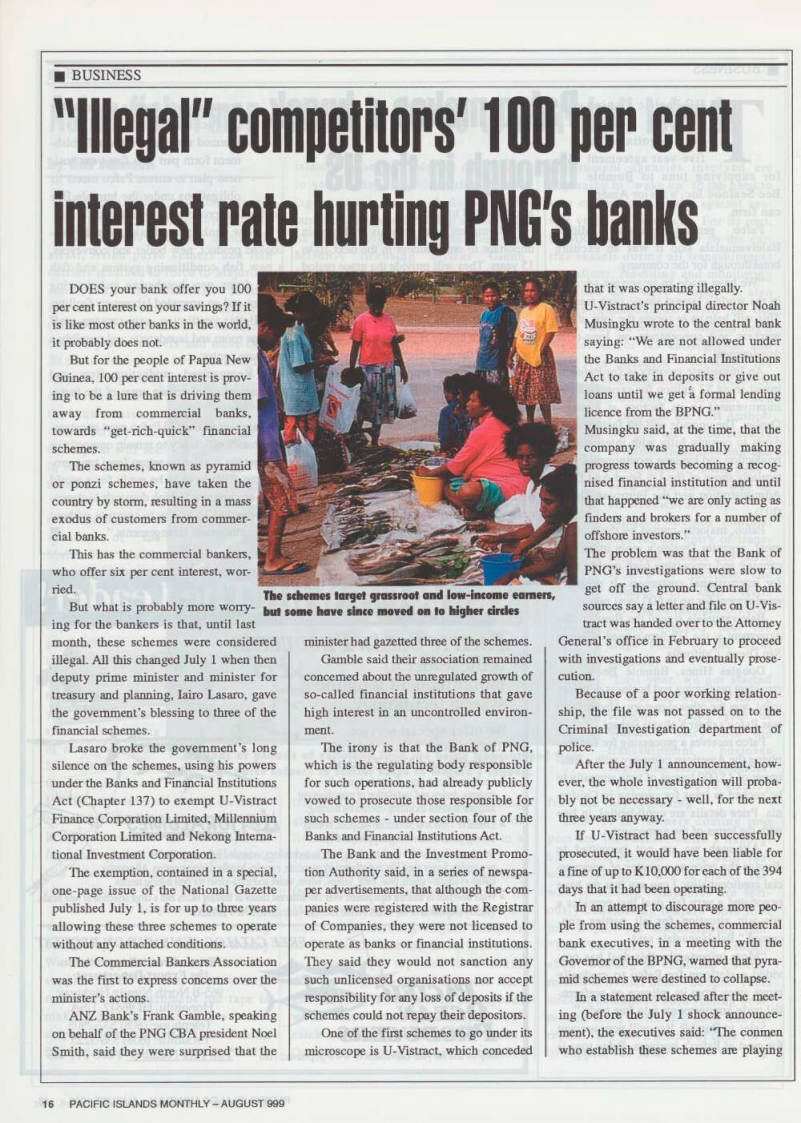
The schemes target grassrool and low-income earners, but some have since moved on to higher circles
on the gullibility and naivety of people who don’t understand the enormous risks of investing in these schemes.”
“The prospers) of each scheme and the early investors, who put their money in when the scheme still has momentum, will receive their interest and most will proba bly get their money back. However, when the scheme begins to falter, then people will lose their money. These conmen are greedy, they operate out of self-interest and they don’t care whether you lose your money or not.”
The fact of the matter is that the com mercial banks just cannot match the 100 per cent interest of the schemes. Also, unlike the banks, interest is immediate on deposits in the schemes - the least being a month - while banks offer longer periods of maturity (at six per cent interest).
For their part, the commercial bankers admitted that 100 per cent is the driving force.“lt is true that some individuals at attracted by 100 per cent rates of interest and are prepared to take the enormous risk of investing their hard-earned savings,” they said.
“However,” their statement added, “you shouldn’t complain when the cookie jar is empty and it becomes evident that you have lost your money; and you can bet your life on the fact that the ‘greedy ones’ will have eaten all the cookies and will have disap peared with the cookie jar.”
In retaliation, the commercial banks resolved to not allow accounts to be operat ed by the schemes unless a licence could be produced which showed that they could legally act as financial institutions.
But if the scheme operators had been silent until then, they certainly lashed out after the CBA statement.
Supporters of the schemes argued that commercial bankers were bitter because the organisations had entered a business that, at one time, was exclusive to them.
They claim the schemes came about as a direct result of the frustration of the small people who were not able to meet the lend ing criteria of the established banks - which was described as onerous, burdensome and, at times, unnecessary. Because of the crite ria, ordinary Papua New Guineans were alienated from meaningful participation in
the economy or from improving their way of life, the supporters claim. The bank’s biggest concern was the mass withdrawal of depositor’s funds from cheque books, supersaver accounts, passbooks and IBDs, they said.
The directors of Coral Pacific Interna tional argued that the company was offering a service that banks and financial institu tions were not able to provide to ordinary people.
“The grassroots, ordinary people,
including unemployed youth, are benefit ting immensely from the service. They all appreciate the service which has directly led to the decrease in criminal activities in Port Moresby.
“The people involved live among the people. They know and understand the problems of the people in a country faced with difficult economic times.
We are working to secure the invest ments of our customers.”
The directors lashed out at banks and their executives, whom, they claimed “live
in ivory towers, drive expensive cars - all at the expense of the small people who deposit their funds with them.”
The directors alleged that the banks “double, triple, quadruple the money the simple ordinary people deposit with them and they do not pass the benefit to the peo ple.
The banks in the country need to be seriously regulated and over-hauled and to be made accountable to the needs of Papua New Guineans.
We need to have a banking ombudsman appointed to review and sanction the arbi trary behaviour of banks.
“We are paying some of the highest interest rates charges and penalty rates in the world while the banks are enjoying some of the highest profit margins in the world against a backdrop of falling econo my and failing national business.”
The scheme supporters claimed the government had to move quickly to set up a banking ombudsman to “prevent revolt by the small people on the streets”. ■