Niue National Airline to get off
p. 12 · Read in the full issue
Business
Niue National Airline to get off the ground this month
By Sophie Foster Hildebrand
WHY would a country with about 1800 people, dubbed the smallest self governing state in the world, want an airline?
Tourism, says recently appointed Niuean premier, Sani Lakatani.
“It’s the number one industry in Niue.
For the last 10 years we made that our main economic development,” he says. “Over the last 10 years we invested almost NZ$2O million in the industry and I think we would be foolish if we let it go. Now we’ll establish an airline to hopefully bring
tourists to Niue.”
Niue National Air line will be run by newly formed compa ny, Coral Air. It is headed by former Polynesian chief executive officer, Garth Percival.
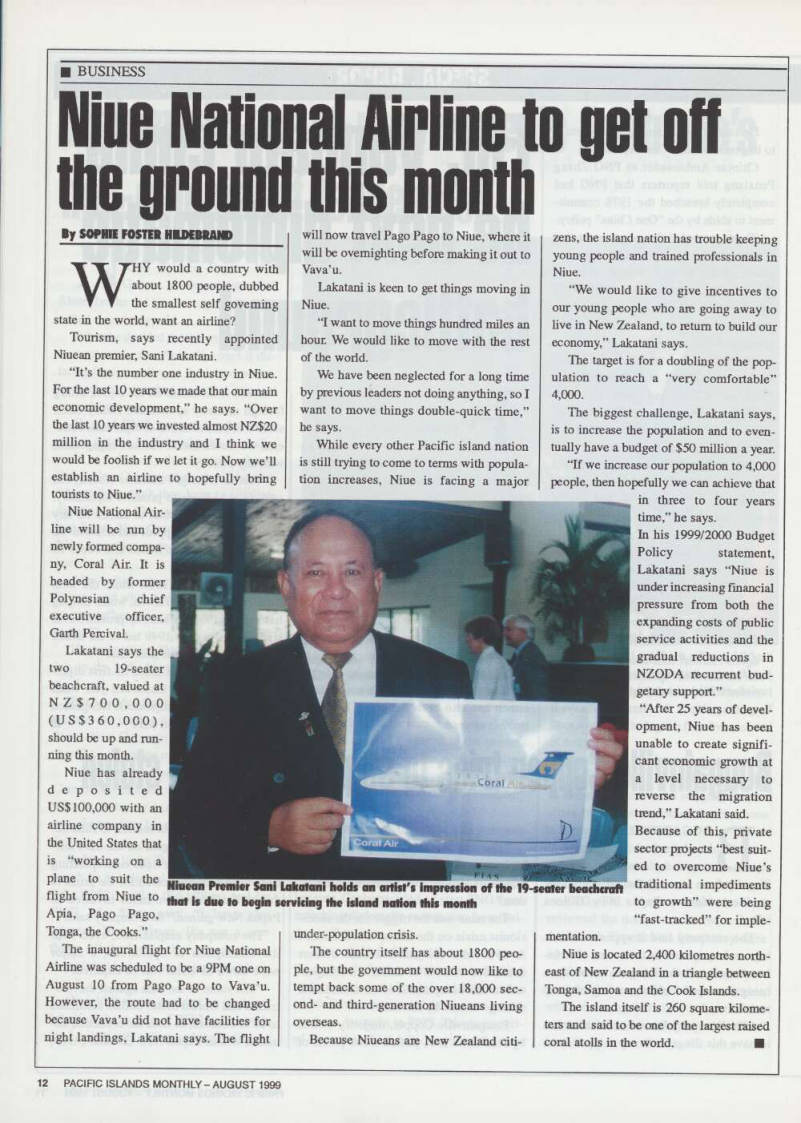
Lakatani says the two 19-seater beachcraft, valued at
Nz$7Oo,Ooo
(US$3 60,000), should be up and run ning this month.
Niue has already deposited US$lOO,OOO with an airline company in the United States that is “working on a plane to suit the flight from Niue to
Apia, Pago Pago,
Tonga, the Cooks.”
The inaugural flight for Niue National Airline was scheduled to be a 9PM one on August 10 from Pago Pago to Vava’u.
However, the route had to be changed because Vava’u did not have facilities for night landings, Lakatani says. The flight
will now travel Pago Pago to Niue, where it will be overnighting before making it out to Vava’u.
Lakatani is keen to get things moving in Niue.
“I want to move things hundred miles an hour. We would like to move with the rest of the world.
We have been neglected for a long time by previous leaders not doing anything, so I want to move things double-quick time,” he says.
While every other Pacific island nation is still trying to come to terms with popula tion increases, Niue is facing a major
under-population crisis.
The country itself has about 1800 peo ple, but the government would now like to tempt back some of the over 18,000 sec ond- and third-generation Niueans living overseas.
Because Niueans are New Zealand citi
zens, the island nation has trouble keeping young people and trained professionals in Niue.
“We would like to give incentives to our young people who are going away to live in New Zealand, to return to build our economy,” Lakatani says.
The target is for a doubling of the pop ulation to reach a “very comfortable” 4,000.
The biggest challenge, Lakatani says, is to increase the population and to even tually have a budget of $5O million a year.
“If we increase our population to 4,000 people, then hopefully we can achieve that
in three to four years time,” he says.
In his 1999/2000 Budget Policy statement, Lakatani says “Niue is under increasing financial pressure from both the expanding costs of public service activities and the gradual reductions in NZODA recurrent bud getary support.”
“After 25 years of devel opment, Niue has been unable to create signifi cant economic growth at a level necessary to reverse the migration trend,” Lakatani said.
Because of this, private sector projects “best suit ed to overcome Niue’s traditional impediments to growth” were being “fast-tracked” for imple
mentation.
Niue is located 2,400 kilometres north east of New Zealand in a triangle between Tonga, Samoa and the Cook Islands.
The island itself is 260 square kilome ters and said to be one of the largest raised coral atolls in the world. ■
Niuean Premier Sani Lakatani holds an artist's impression of the 19-seater beachcraft that is due to begin servicing the island nation this month