neo-colonialist tendencies
pp. 10-11 · Read in the full issue
Diplomatic tug-of-war reveals Australia's neo-colonialist tendencies
NOT many people may have liked former Papua New Guinea prime minister Bill Skate, but he did have one good trait - he called a spade a spade.
When he decided to take on PNG’s for mer colonial ruler, Australia, over it dic tating foreign policy to the island nation, he probably touched a nerve amongst many island nations.
He said PNG was not another Aus tralian state to be dictated to by Australia.
“I’m sad to say that Australia thinks Papua New Guinea is their state,” he said.
“Australians think they have to continue dictating to us. They must now understand that Papua New Guinea is more mature.
It’s a sovereign state. They must respect our views.”
“Australians are equally trading with Taiwan and why shouldn’t we go further to strengthen our relations with that region?”
His resignation, Skate said, had “noth ing to do with Australians influencing me.”
But he added that it was “sad that Aus tralians are putting up Mekere Morauta.
Papua New Guineans should decide who should be the prime minister.”
Diplomatic tensions between Taiwan, China, Australia and Papua New Guinea were high during early July after Skate was reported to have flown secretly to
Taipei.
Referring to the Taiwan controversy in which he is believed to have negotiated for a US$2.3 billion (K 6 billion) deal for PNG, Mr. Skate said: “I have also returned from Taiwan. It’s not a new thing. All the leaders have been talking about it but had no guts to make the deci sion.”
He said it was a decision he made on behalf of the people of PNG in line with the Look North policy and the policy to
be “friends to all, enemies to none.” Why Australia became involved in the process raises questions over its faith in island nations to control their destiny. China asked Australia to intervene, and it did, extremely vocally.
Needless to say, Australia was promptly told to mind its own business.
After that fuss, Taiwan threatened to impose trade sanctions against Australia because Canberra tried to stop PNG from switching diplomatic recognition from Bei jing to Taipei.
Taiwan’s United Evening news reported the country’s foreign ministry was drafting trade sanction measures mid-July, under which Taiwan may switch its iron ore sourc ing from Australia to PNG. Taiwan import ed more than $1.5 billion worth of goods
from Australia during the first five months of this year.
Taiwanese foreign ministry acting
spokesman Henry Chen said PNG is rich in natural resources and stepping up pur chase from allies is one of the directions that could be considered.
How the Taiwanese government han dles the withdrawal of dilpomatic recog nition remains to be seen.
PNG PM Morauta said he had reviewed the documents linked to a del made with Taiwan and found they were invalid.
“Normal procedures for opening diplo matic relations with other countries, which have applied since independence, were not followed in the case of Taiwan,” he said.
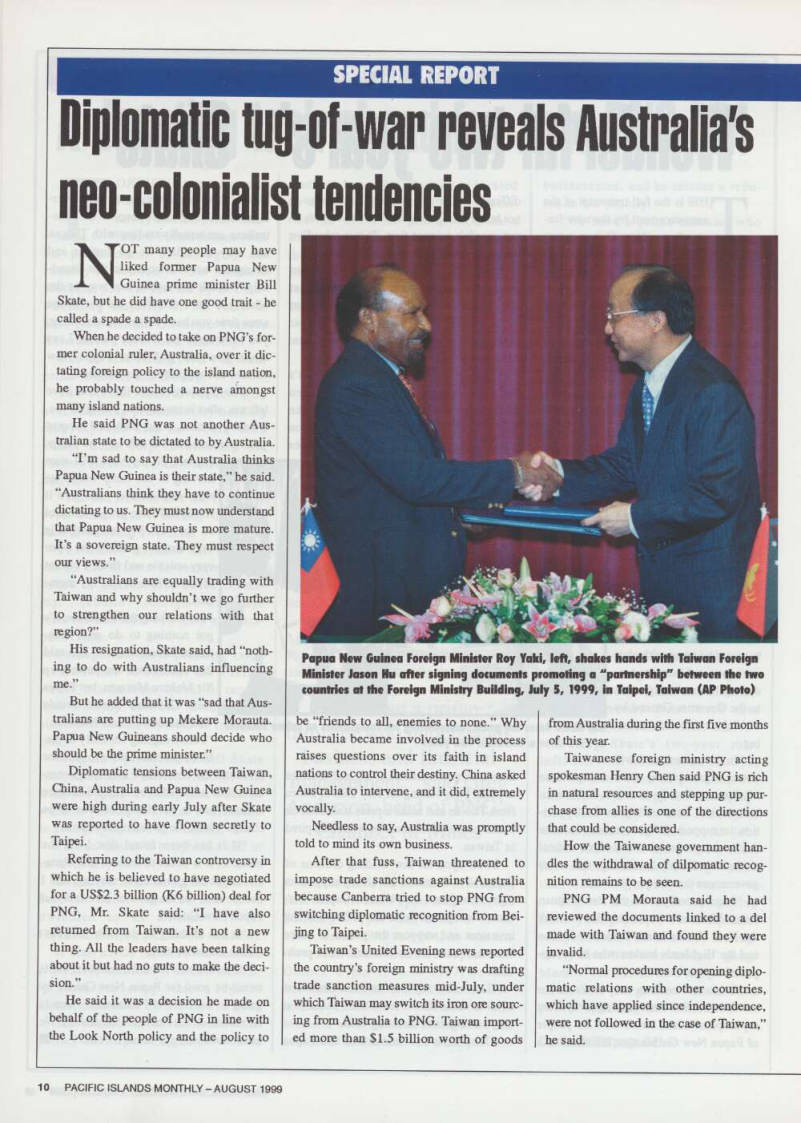
Papua New Guinea Foreign Minister Roy Yaki, left, shakes hands with Taiwan Foreign Minister Jason Hu alter signing documents promoting a "partnership" between the two countries at the Foreign Ministry Building, July 5, 1999, in Taipei, Taiwan (AP Photo)
He said his government would return to its previous “one-China” policy.
Chinese Ambassador to PNG Zhang Penxiang told reporters that PNG had completely breached the 1976 commit ment to abide by the “One China” policy.
Zhang reminded the government that China, as one of the permanent member states of the United Nations Security Council, had actively supported PNG in its effort to safeguard its national sover eignty and territorial integrity over the question of Bougainville.
On the matter of trade relations.
Ambassador Zhang said trade between PNG and China had risen to about US$l5O million in favor of PNG. This, he said, constituted two thirds of China’s trade with South Pacific countries.
PNG exports to China include oil, gold and timber while China’s exports to PNG are mainly light industrial and textile goods, hand tools, food and electronic appliances.
China built the Sir John Guise Sports Stadium, an agricultural experimental sta tion in Kandep, Enga, village houses in Henganofi, Eastern Highlands and the Markham Valley High School in Morobe.
China has also given US$3O million in “soft” loans for the Papa-Lealea salt pro ject. It seems that all’s fair in a diplomatic tug-of-war, and a bargaining chip is only a bargaining chip if the competition says it is. ■