"Beyond Paradise" returns to paradise
pp. 48-49 · Read in the full issue
By Ed Rampell
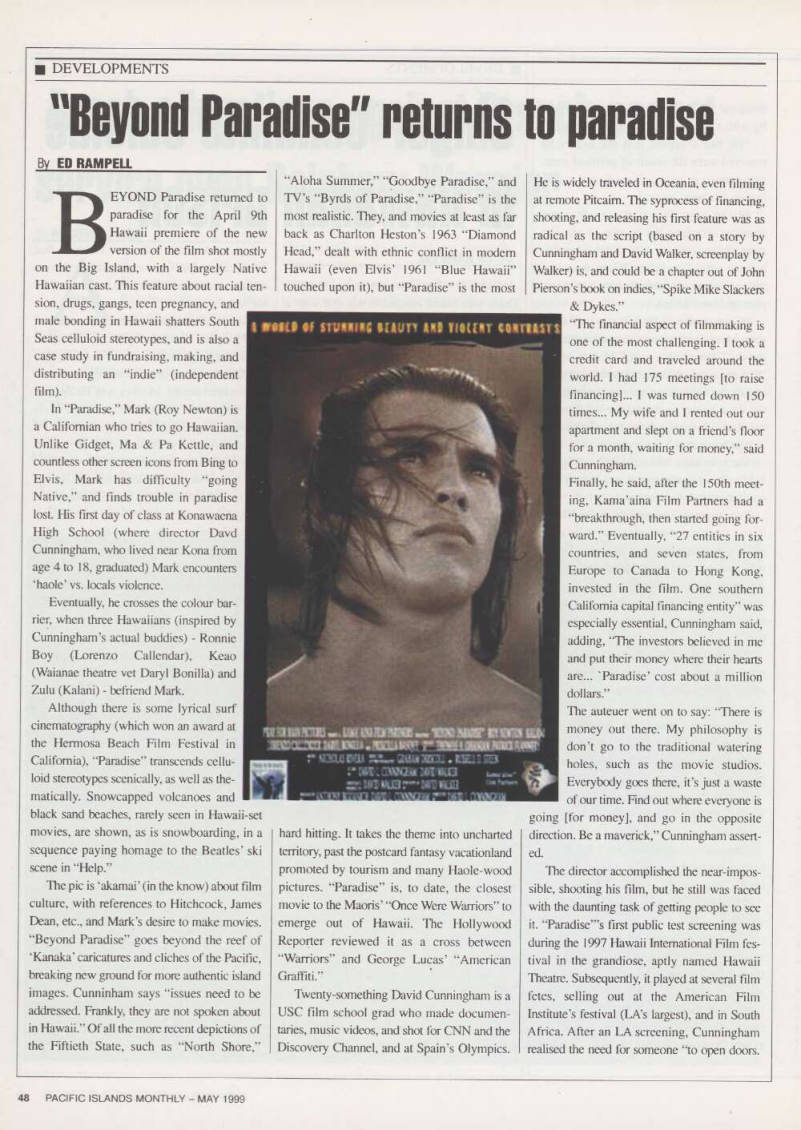
BEYOND Paradise returned to paradise for the April 9th Hawaii premiere of the new version of the film shot mostly on the Big Island, with a largely Native Hawaiian cast. This feature about racial ten
sion, drugs, gangs, teen pregnancy, and male bonding in Hawaii shatters South Seas celluloid stereotypes, and is also a case study in fundraising, making, and
distributing an “indie” (independent
film).
In “Paradise,” Mark (Roy Newton) is a Californian who tries to go Hawaiian.
Unlike Gidget, Ma & Pa Kettle, and countless other screen icons from Bing to Elvis, Mark has difficulty “going Native,” and finds trouble in paradise lost. His first day of class at Konawaena High School (where director Davd Cunningham, who lived near Kona from age 4 to 18, graduated) Mark encounters ‘haole’ vs. locals violence.
Eventually, he crosses the colour bar rier, when three Hawaiians (inspired by Cunningham’s actual buddies) - Ronnie Boy (Lorenzo Callendar), Keao (Waianae theatre vet Daryl Bonilla) and Zulu (Kalani) - befriend Mark.
Although there is some lyrical surf cinematography (which won an award at the Hermosa Beach Film Festival in California), “Paradise” transcends cellu loid stereotypes scenically, as well as the
matically. Snowcapped volcanoes and
black sand beaches, rarely seen in Hawaii-set movies, are shown, as is snowboarding, in a sequence paying homage to the Beatles’ ski scene in “Help.”
The pic is ‘akamai’ (in the know) about film culture, with references to Hitchcock, James Dean, etc., and Mark’s desire to make movies.
“Beyond Paradise” goes beyond the reef of ‘Kanaka’ caricatures and cliches of the Pacific, breaking new ground for more authentic island images. Cunninham says “issues need to be addressed. Frankly, they are not spoken about in Hawaii.” Of all the more recent depictions of the Fiftieth State, such as “North Shore,”
“Aloha Summer,” “Goodbye Paradise,” and TV’s “Byrds of Paradise,” “Paradise” is the most realistic. They, and movies at least as far back as Charlton Heston’s 1963 “Diamond Head,” dealt with ethnic conflict in modem Hawaii (even Elvis’ 1961 “Blue Hawaii” touched upon it), but “Paradise” is the most
hard hitting. It takes the theme into uncharted territory, past the postcard fantasy vacationland promoted by tourism and many Haole-wood pictures. “Paradise” is, to date, the closest movie to the Maoris’ “Once Were Warriors” to emerge out of Hawaii. The Hollywood Reporter reviewed it as a cross between “Warriors” and George Lucas’ “American Graffiti.”
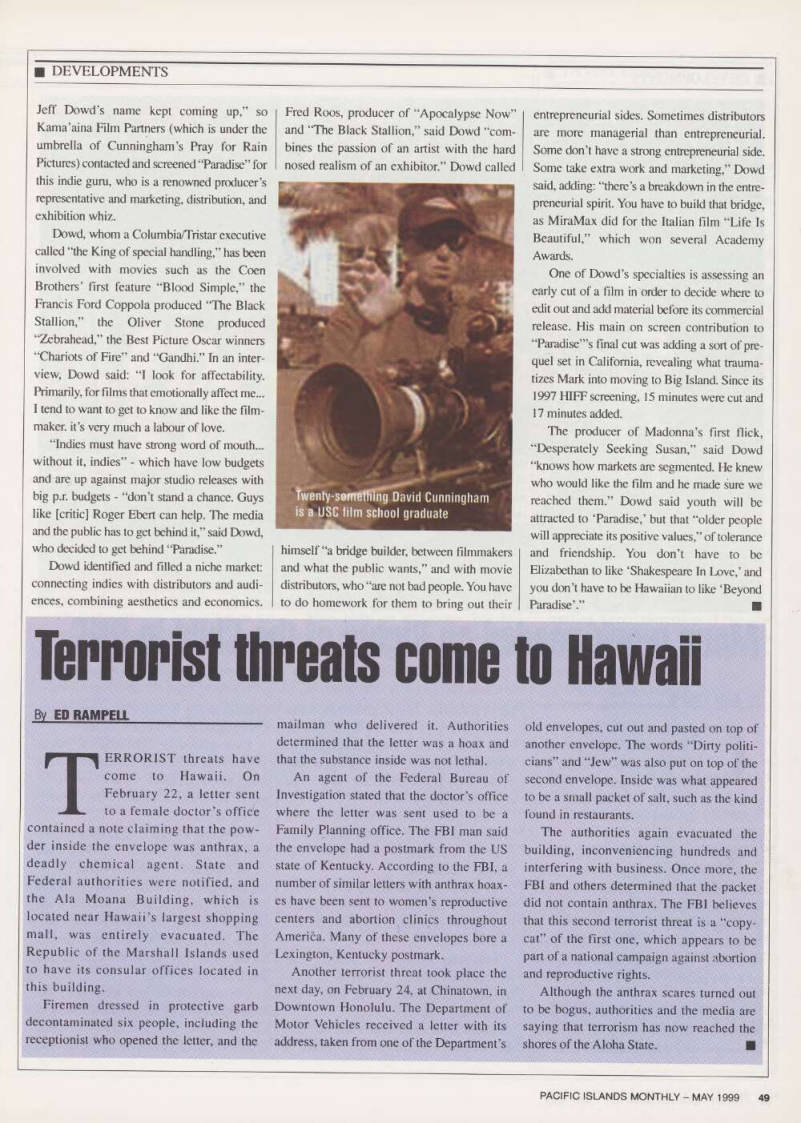
Twenty-something David Cunningham is a USC film school grad who made documen taries, music videos, and shot for CNN and the Discovery Channel, and at Spain’s Olympics.
He is widely traveled in Oceania, even filming at remote Pitcairn. The syprocess of financing, shooting, and releasing his first feature was as radical as the script (based on a story by Cunningham and David Walker, screenplay by Walker) is, and could be a chapter out of John Pierson’s book on indies, “Spike Mike Slackers
& Dykes.”
“The financial aspect of filmmaking is one of the most challenging. I took a credit card and traveled around the world. I had 175 meetings [to raise financing]... I was turned down 150 times... My wife and I rented out our apartment and slept on a friend’s floor for a month, waiting for money,” said Cunningham.
Finally, he said, after the 150th meet ing, Kama’aina Film Partners had a “breakthrough, then started going for ward.” Eventually, “27 entities in six countries, and seven states, from Europe to Canada to Hong Kong, invested in the film. One southern California capital financing entity” was especially essential, Cunningham said, adding, “The investors believed in me and put their money where their hearts are... 'Paradise’ cost about a million dollars.”
The auteuer went on to say: “There is money out there. My philosophy is don’t go to the traditional watering holes, such as the movie studios.
Everybody goes there, it’s just a waste of our time. Find out where everyone is
going [for money], and go in the opposite direction. Be a maverick,” Cunningham assert ed.
The director accomplished the near-impos sible, shooting his film, but he still was faced with the daunting task of getting people to see it. “Paradise’”s first public test screening was during the 1997 Hawaii International Film fes tival in the grandiose, aptly named Hawaii Theatre. Subsequently, it played at several film fetes, selling out at the American Film Institute’s festival (LA’s largest), and in South Africa. After an LA screening, Cunningham realised the need for someone “to open doors.
Jeff Dowd’s name kept coming up,” so Kama’aina Film Partners (which is under the umbrella of Cunningham’s Pray for Rain Pictures) contacted and screened “Paradise” for this indie guru, who is a renowned producer’s representative and marketing, distribution, and exhibition whiz.
Dowd, whom a Columbia/Tristar executive called “the King of special handling,” has been involved with movies such as the Coen Brothers’ first feature “Blood Simple,” the Francis Ford Coppola produced “The Black Stallion,” the Oliver Stone produced “Zebrahead,” the Best Picture Oscar winners “Chariots of Fire” and “Gandhi.” In an inter view, Dowd said: “I look for affectability.
Primarily, for films that emotionally affect me...
I tend to want to get to know and like the film maker. it’s very much a labour of love.
“Indies must have strong word of mouth... without it, indies” - which have low budgets and are up against major studio releases with big p.r. budgets - “don’t stand a chance. Guys like [critic] Roger Ebert can help. The media and the public has to get behind it,” said Dowd, who decided to get behind “Paradise.”
Dowd identified and filled a niche market; connecting indies with distributors and audi ences, combining aesthetics and economics.
Fred Roos, producer of “Apocalypse Now” and “The Black Stallion,” said Dowd “com bines the passion of an artist with the hard nosed realism of an exhibitor.” Dowd called
himself “a bridge builder, between filmmakers and what the public wants,” and with movie distributors, who “are not bad people. You have to do homework for them to bring out their
entrepreneurial sides. Sometimes distributors are more managerial than entrepreneurial.
Some don’t have a strong entrepreneurial side.
Some take extra work and marketing,” Dowd said, adding: “there’s a breakdown in the entre preneurial spirit. You have to build that bridge, as Mira Max did for the Italian film “Life Is Beautiful,” which won several Academy Awards.
One of Dowd’s specialties is assessing an early cut of a film in order to decide where to edit out and add material before its commercial release. His main on screen contribution to “Paradise’”s final cut was adding a sort of pre quel set in California, revealing what trauma tizes Mark into moving to Big Island. Since its 1997 HIFF screening, 15 minutes were cut and 17 minutes added.
The producer of Madonna’s first flick, “Desperately Seeking Susan,” said Dowd “knows how markets are segmented. He knew who would like the film and he made sure we reached them.” Dowd said youth will be attracted to ‘Paradise,’ but that “older people will appreciate its positive values,” of tolerance and friendship. You don’t have to be Elizabethan to like ‘Shakespeare In Love,’ and you don’t have to be Hawaiian to like ‘Beyond Paradise’.” ■
Twenly-semething David Cunningham is a USC film school graduate