PRO-independence West
pp. 40-41 · Read in the full issue
OPMRC steps up Irian Jayan campaign in PNG
By Sam Vulum
Papuan leaders in exile abroad have stepped up their activities to attract international exposure in support of recent political developments back home over the future of Indonesia’s western most province of Irian Jaya.
At least those living across the boarder in Papua New Guinea have been working quietly preparing their campaign strategies.
First up on their agenda is their partici pation in the Hague Appeal for Peace con ference in Netherlands, to be held from May 11 to 15.
In the forefront of the PNG campaign is the PNG-based Organisasi Papua Merdeka Revolutionary Council (OPMRC) chair Moses Werror.
Despite opposition from splinter pro independence groups in PNG being led by local human rights groups, Werror has had his mind set for the meeting and nothing will stop him.
Moses has been requested by those in Irian Jaya to discuss, at the Hague confer ence, a meeting between a coalition of West Papuan leaders and Indonesian President Dr B J Habibi and his cabinet at Istana Merdeka in Jakarta on February 26.
At the meeting, the West Papuan leaders signed a petition that, among other things, demanded an immediate creation of a sepa rate Papuan state in its long troublesome Irian Jayan province.
About 100 of them are signatories to the petition. They included five members of the Indonesian Parliament.
The leaders said in the petition that if their independence demand was not ful filled by March, they will call for an inter national conference to be held between Indonesia, West Papuan leaders and the
United Nations in April. Copies of the dia logue were sent to PNG, the UN, United States, the Netherlands, Australia, Germany, Canada, Japan, Switzerland, New Zealand, Belgium, Solomon Islands, Fiji, Norway, Ireland, the Philippines, Ghana, South Africa, Israel, Kenya and the European Union Parliament.
In response to the dialogue, President Habibi appealed for calm and urged the Irian leaders to return home and urge their people to consider alternatives other than
independence.
This latest development is unprecedent ed in the 38-year history of the indepen dence struggle of the Melanesians in Irian Jaya, for never before have they or their leaders been asked to place their wishes and aspirations freely and officially before the government without fearing any reprisals.
The delegation’s stand has come as a major shock, especially to the State offi cials, who, having excluded the more out spoken independence advocates such as the Chairman of the Irian Jaya Council of Traditional Chiefs, Theys Eluay, Chairman of the Combined Christian churches in Irian Jaya, Reverent Karel Philip Erari, and the province’s two former governors, Barnabas Suebu and Isaac Hindom, from the official delegation, were hoping for a vote for Irian to remain within the republic.
Meanwhile, the PNG-based Werror, has warned his people not to be captivated by the positive developments. Werror urged them to note that the developments are in line with the constitutional working guide of the OMPRC.
“I am not excited like the others because when we are excited, we cannot do any thing,” Werror said.
Talking from experience, Werror said he will not give until something concrete is done.
He said everything happened according
to the seven-stage strategy of the OPMRC, which it adopted during its inception on April 23, 1983.
The first stage was an act of free choice, which was observed between 1964 to 1969.
The OPMRC chief said the current developments are in line with the sixth stage of the plan the international recog nition of West Papua. They planned this to occur between 1994 and 1999.
The final stage, which is the establish ment of a West Papuan state, is expected to be achieved between 2000 and 2005.
Werror said instead of being excited about the events. West Papuans, including the OPMRC, should support the elected leaders in Irian Jaya to push their agenda through.
The OPMRC chief, who was in Port Moresby to meet with other West Papuan leaders to discuss the Jakarta meeting, was also preparing to attend the Hague meeting.
He has so far sent out appeal letters to various international organisations and individuals for donations to fund his trip to the meeting.
The conference, which is sponsored by the UN, will also be opened by UN secre tary-general Kofi Annan. Other notable speakers are Nobel Laureates Archbishop Desmond Tutu, Grace Machel and UNICEF’s executive director Carol Beltamy.
Werror said the conference will be an important part of their international cam paign and lobbying to establish diplomatic dialogue between the Netherlands, Indonesia, the US and West Papuan leaders to discuss the political independence of West Papua/Irian Jaya before 2000.
The OPMRC has adopted a “moderate policy” since its inception and its aims are to re-organise and revolutionise inside the organisation for unification of all factional groups in the OPM/West Papua struggle.
Moses, who was expected to lead the PNG delegation to the Hague meeting, has been around a lot longer than many of those in the struggle.
Moses, who was expected to lead the PNG delegation to the Hague meeting, has been around a lot longer than many of those in the struggle.
Before crossing over the PNG in 1971,
Moses was an outspoken leader against the Indonesians.
He fled following his release from prison in fear of his life. Moses alleged in an unpublished report that a year after his departure, a senior Indonesian official, the team leader responsible for conducting the
act of free choice elections or Pepera in Bahasa,
Soedjarwo
Tjondronegoro met
him at Sentani air port and offered him a senior posi tion as governor or ambassador but he refused.
Moses said in the report that again in March 1972, after he had already been living in the Madang Province, where he still lives, Jakarta had instructed
Tjondronegoro to
get him back to Indonesia where he would take up a senior post with the government of his choice. Moses said
he again refused the offer.
He alleged in the report that later in 1972, Tjondronegoro and a military com mander who conducted the Pepera with him, General Serwo Edhie died from poi
soning.
“If I had accepted the offers, I would be in the same situation as them,” Moses said in the report.
Moses, who was a member of an Indonesian team to a United Nations General Assembly to discuss a self-determi nation resolution introduced by the Dutch government in New York, United States in November 1961, was refused to take part in every other meetings of the same nature afterwards.
According to the report, although the meeting was unsuccessful, another self determination agreement was prepared by
the United States and signed by the Indonesian and Dutch officials on August 15, 1962 as an international agreement.
Pepera, the military commander General Edhie issued a strong warning to OPM members and other West Papuans planning to disrupt the election.
He quoted the commander as saying: “Those who wanted to campaign against the government would have their tongues cut out, and it was better for them to ask the US to find them a new home in the moon.”
Moses also alleged that a UN envoy Dr Fernado Ortiz Sonz and his team, who arrived in Jakarta in April 1968, to observe the Pepera, were not permitted to visit the territory. They were kept out until the Indonesian team had conducted about 80 per cent of the election.
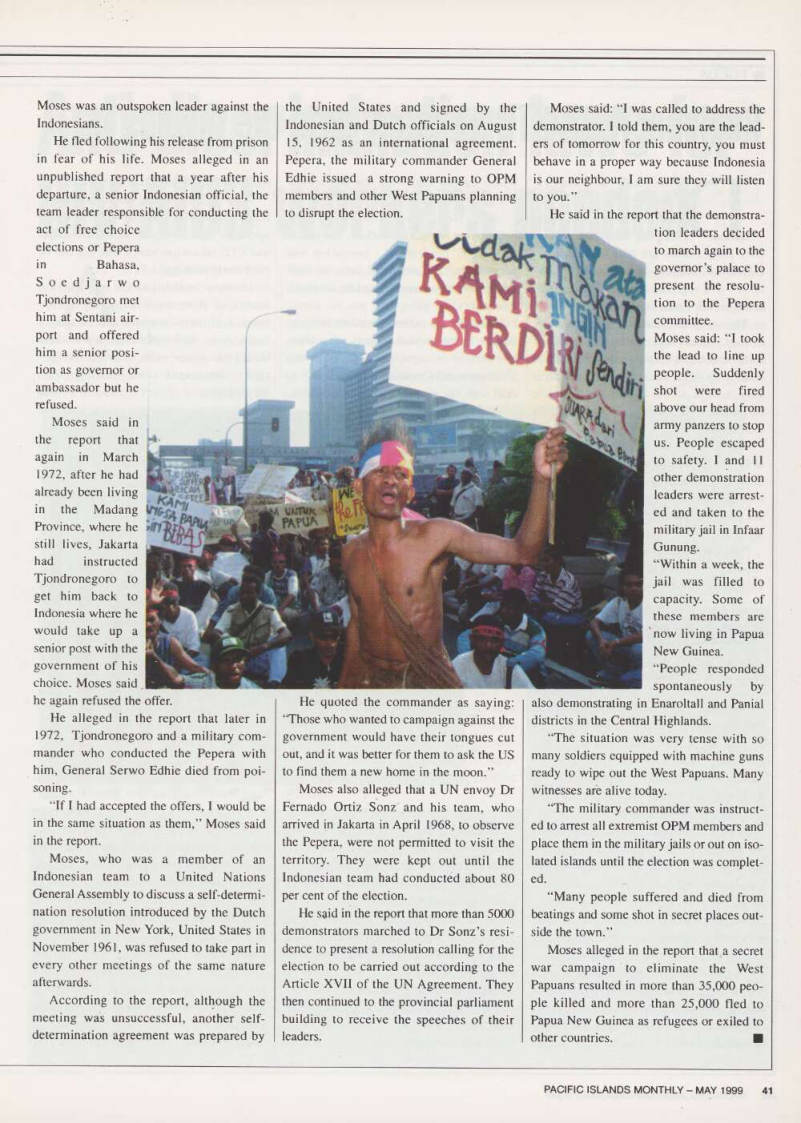
He said in the report that more than 5000 demonstrators marched to Dr Sonz’s resi dence to present a resolution calling for the election to be carried out according to the Article XVII of the UN Agreement. They then continued to the provincial parliament building to receive the speeches of their leaders.
Moses said: “I was called to address the demonstrator. I told them, you are the lead ers of tomorrow for this country, you must behave in a proper way because Indonesia is our neighbour, I am sure they will listen to you.”
He said in the report that the demonstra
tion leaders decided to march again to the governor’s palace to present the resolu tion to the Pepera committee.
Moses said: “I took the lead to line up
people. Suddenly
shot were fired above our head from army panzers to stop us. People escaped to safety. I and 11 other demonstration leaders were arrest ed and taken to the military jail in Infaar Gunung.
“Within a week, the jail was filled to capacity. Some of these members are now living in Papua New Guinea.
“People responded spontaneously by
also demonstrating in Enaroltall and Panial districts in the Central Highlands.
“The situation was very tense with so many soldiers equipped with machine guns ready to wipe out the West Papuans. Many witnesses are alive today.
“The military commander was instruct ed to arrest all extremist OPM members and place them in the military jails or out on iso lated islands until the election was complet ed.
“Many people suffered and died from beatings and some shot in secret places out side the town.”
Moses alleged in the report that a secret war campaign to eliminate the West Papuans resulted in more than 35,000 peo ple killed and more than 25,000 fled to Papua New Guinea as refugees or exiled to other countries. ■