environmental impact study
p. 20 · Read in the full issue
Sea Launch promises to conduct environmental impact study
THE Kiribati Government has announced that Sea Launch, the company behind the launching of commercial satellites into orbit from a floating oil platform off Kiribati waters, has reportedly agreed to con duct a project environmental impact study.
This was confirmed by Kiribati’s Secretary for Information, Communication and Transport, Taakei Taoaba.
Taoaba said Sea Launch, a con sortium involving Boeing and Russian, Ukranian and Norwegian companies, agreed to the study request made by the Kiribati Government at a recent meeting in Hawaii.
Kiribati’s main concern, he said, is the environmental impact of the project, on both the ocean and the atmosphere.
The Government, Taoaba emphasised, wants to ensure that the people and environment of Kiribati are safe from any possible accidents that might result from the launches near the equator.
According to Taoaba, Kiritimati (Christmas) Islanders, in the Northern Line Islands group, are particularly concerned because of their very close proximity to the actual launch site.
Sea Launch carried out a demonstration firing of a dummy satellite from the float ing oil rig, 800 kilometers (480 miles) southeast of the island and just outside Kiribati waters, in March.
The joint venture company has invested about US$5O4 million in the first ever com mercial marine-based launch system.
Environmental group Greenpeace had called for a stop to further launches of com mercial rockets from the floating facility until the company completes and evaluates a project environmental impact study.
Greenpeace Pacific spokesperson Samantha Magick said leaders of the South Pacific Forum had called for a comprehen sive environmental assessment report on the Sea Launch proposal.
“We believe consultation with the Pacific region (about the project) has been inadequate. Details of the extent of environ mental assessment programs have been sketchy. We simply don’t know the impact of the program on the Pacific,” she said.
The Sea Launch rocket successfully com-
pleted its maiden flight on March 27, according to company officials. The event, which placed a demonstration payload into geostationary transfer orbit, marked the first commercial launch from a floating platform at sea.
“Today’s successful launch demon strates the viability of the Sea Launch sys tem to the entire world,” announced Sea Launch President Allen B. Ashby on the day. “We are now ready to begin full-scale service, as a proven and cost-effective com mercial satellite launch service.”
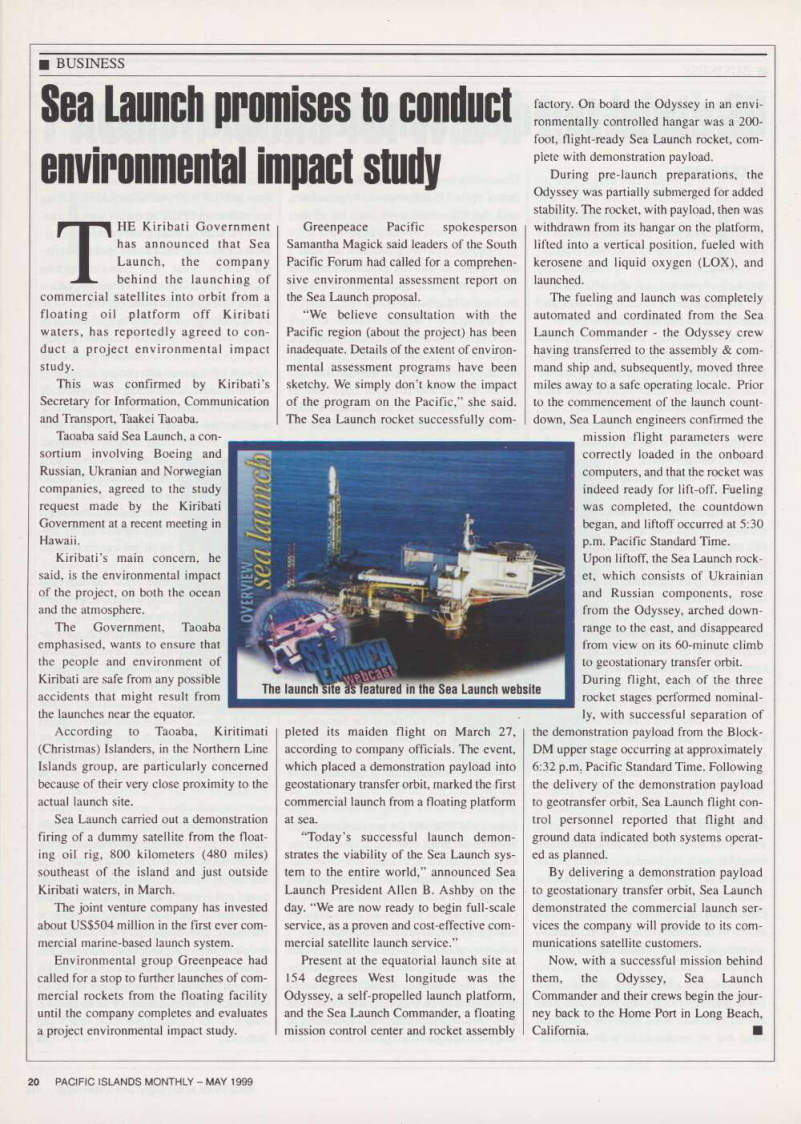
Present at the equatorial launch site at 154 degrees West longitude was the Odyssey, a self-propelled launch platform, and the Sea Launch Commander, a floating mission control center and rocket assembly
factory. On board the Odyssey in an envi ronmentally controlled hangar was a 200foot, flight-ready Sea Launch rocket, com plete with demonstration payload.
During pre-launch preparations, the Odyssey was partially submerged for added stability. The rocket, with payload, then was withdrawn from its hangar on the platform, lifted into a vertical position, fueled with kerosene and liquid oxygen (LOX), and launched.
The fueling and launch was completely automated and cordinated from the Sea Launch Commander - the Odyssey crew having transferred to the assembly & com mand ship and, subsequently, moved three miles away to a safe operating locale. Prior to the commencement of the launch count down, Sea Launch engineers confirmed the
mission flight parameters were correctly loaded in the onboard computers, and that the rocket was indeed ready for lift-off. Fueling was completed, the countdown began, and liftoff occurred at 5:30 p.m. Pacific Standard Time.
Upon liftoff, the Sea Launch rock et, which consists of Ukrainian and Russian components, rose from the Odyssey, arched down range to the east, and disappeared from view on its 60-minute climb to geostationary transfer orbit.
During flight, each of the three rocket stages performed nominal ly, with successful separation of
the demonstration payload from the Block- DM upper stage occurring at approximately 6:32 p.m. Pacific Standard Time. Following the delivery of the demonstration payload to geotransfer orbit, Sea Launch flight con trol personnel reported that flight and ground data indicated both systems operat ed as planned.
By delivering a demonstration payload to geostationary transfer orbit, Sea Launch demonstrated the commercial launch ser vices the company will provide to its com munications satellite customers.
Now, with a successful mission behind them, the Odyssey, Sea Launch Commander and their crews begin the jour ney back to the Home Port in Long Beach, California. ■
The launch site as featured in the Sea Launch website