things in
Editorial
Are the best things in life free?
IT is no secret that, despite covering one-third of the globe, the Pacific and its island nations do not wield much influence in the big bad world of international trade.
Indeed, some businesses in Pacific island countries have had to rely on preferential access to key markets to par ticipate as exporters.
Without it, their products find it hard to compete in an equal playing field.
By far, the most important agreement for countries such as Papua New Guinea and Fiji (the two most vibrant of Pacific economies) is the Lome IV convention.
Under this agreement ACP countries get zero tariff on goods that they export to the European Union and for some goods such as sugar under the Sugar Protocol, these countries get paid much
more than the World Market Price.
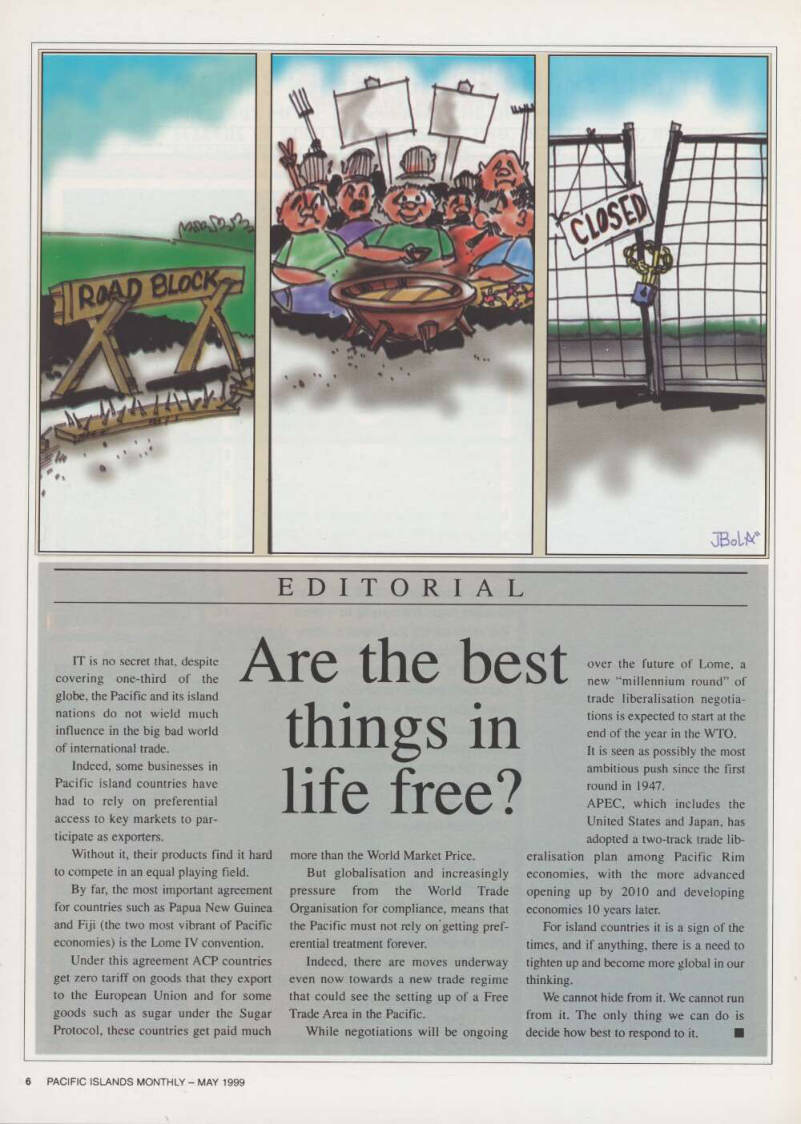
But globalisation and increasingly pressure from the World Trade Organisation for compliance, means that the Pacific must not rely on getting pref erential treatment forever.
Indeed, there are moves underway even now towards a new trade regime that could see the setting up of a Free Trade Area in the Pacific.
While negotiations will be ongoing
over the future of Lome, a new “millennium round” of trade liberalisation negotia tions is expected to start at the end of the year in the WTO.
It is seen as possibly the most ambitious push since the first round in 1947.
APEC, which includes the United States and Japan, has adopted a two-track trade lib
eralisation plan among Pacific Rim economies, with the more advanced opening up by 2010 and developing economies 10 years later.
For island countries it is a sign of the times, and if anything, there is a need to tighten up and become more global in our
thinking.
We cannot hide from it. We cannot run from it. The only thing we can do is decide how best to respond to it. ■