Preserving culture:
p. 56 · Read in the full issue
history as dance
Story and picture by PAULINE WALKER
THE dancers may never have seen the place they sing about - but in their songs and dance, the are claiming an identity and preserving their history.
They are Tikopians. But most of them
have never been to Tikopia.
Living in Makira province of the Solomon Islands, they “remem ber” their home - a tiny island far from everywhere in the nation's south-eastern ocean vastness.
Tikopia for years has been too small for a growing population, and many of its people have had to move elsewhere.
Among the first to move, right after World War 11, was Willy
Vaka - now an octogenarian and still active in the village of Nukukaisi that he founded in 1957 on Makira Island (then called San Cristobal). Willy is the "father” of the dancers, a troupe of about sixty who all are members of one extended Polynesian fam ily. In his younger days, Willy was known as a great dancer. Songs and custom dances are a vital element of Tikopian culture, and Willy learnt the ancient lore from his father. He also composed songs of his own
and, from them, made dances. Tikopian songs tell stories - of chiefs and battles, of whales and frigate birds. Old legends and great deeds are preserved in songs and dance, and new events are similarly recorded. There are songs to accompany every ritual of the life cycle - including cir cumcision, marriage, and mourning for the dead. Dances always follow the words of
the song. "Dancing is our culture, passed down from our forefathers,” said Willy through an interpreter in Honiara. "We must keep it, not lose it”.
So Willy Vaka taught his sons, and they taught others. In songs and dances, Tikopia came alive to a new generation. Preserving their customs and culture through practice, they affirmed their identity with pride and joy. The idea of performing for others was born only five years ago, in 1994, when
there was much dancing for a great cere mony in which the Tikopians of Nukukaisi “bought” the land where they had settled from their Melanesian neighbours.
Instrumental in organising the dancers was the local area council member, Willy Vaka’s son, Graig Matakitofi.
The Mapungamanu Cultural Group, as it is named, now comprises about sixty males and females of all ages, the older ones teaching the young people. They have learnt over two hundred dances, and at home in Nukukaisi, they practice very evening for three hours in a custom house they have built for themselves.
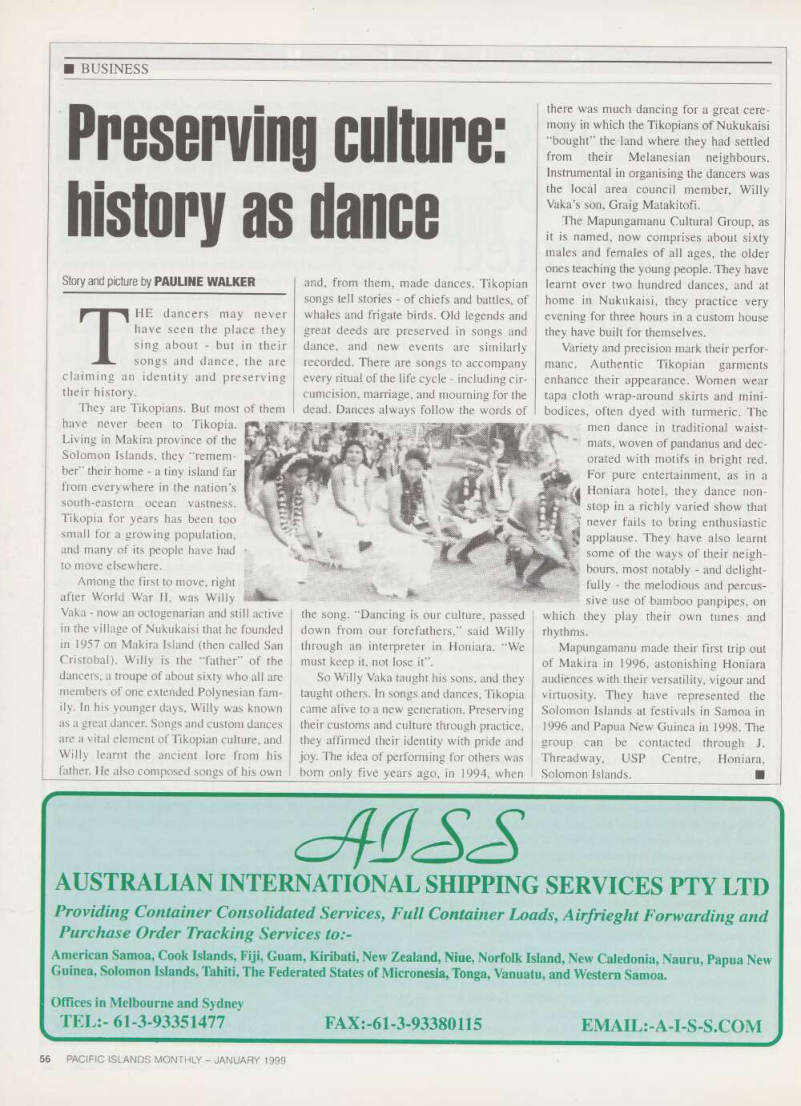
Variety and precision mark their perfor manc. Authentic Tikopian garments enhance their appearance. Women wear tapa cloth wrap-around skirts and mini bodices, often dyed with turmeric. The
men dance in traditional waist mats, woven of pandanus and dec orated with motifs in bright red.
For pure entertainment, as in a Honiara hotel, they dance non stop in a richly varied show that never fails to bring enthusiastic applause. They have also learnt some of the ways of their neigh bours, most notably - and delight fully - the melodious and percus sive use of bamboo panpipes, on
which they play their own tunes and rhythms.
Mapungamanu made their first trip out of Makira in 1996, astonishing Honiara audiences with their versatility, vigour and virtuosity. They have represented the Solomon Islands at festivals in Samoa in 1996 and Papua New Guinea in 1998. The group can be contacted through J.
Threadway, USP Centre, Honiara, Solomon Islands. ■