Bringing light
pp. 52-53 · Read in the full issue
Yachting
Bringing light to Pentecost
Story and pictures by SALLY ANDREWS
AFTER the sun goes down in most Pacific villages, the only light comes from kerosene lanterns. Each lantern can consume as much as 50 cents worth of kerosene each night, 365 nights a year.
That’s a lot of money when you consider that most families need more than one small kerosene light to cook and eat by.
In Vanuatu, Philip Varean is a budding entrepreneur. Given his ideal location on a white sand beach in protected Loltong Harbour, on the leeward side of Pentecost, Philip’s Tiare restaurant caters to the crews and guests of foreign yachts and local char ter boats who stop in the harbour during the cruising season.
Income from tourism is spread through the village - to the string band, cooks, providers of pigs, chickens and produce. Last year we brought alternative light to the vil lage.
Several years ago, during a three week stopover in the Harbour, we rigged a small motorcycle battery and a low-power electric light to use ashore at night. Temporarily, because there was no way of charging the battery once we left. During the day, we brought the battery back to the boat and used our ship's solar panels to recharge the small battery. It was a hit!
This year, after much discussion, we decided that a solar set-up would save a few vatu for Philip and his business, which brings a few vatu into the village.
An auto shop in Port Vila donated an old fela truck battery and we bought a used solar panel from a chap living and working in Vila.
A bit of wire and some bulbs from our boson’s locker completed the package.
Philip usually goes to the garden during
the day, so as soon as we arrived I asked; ■'Will you be around tomorrow - we’ve got something HEAVY to bring ashore?” His eyes twinkled in hope and disbelief.
Early next morning, the solar panel went ashore.
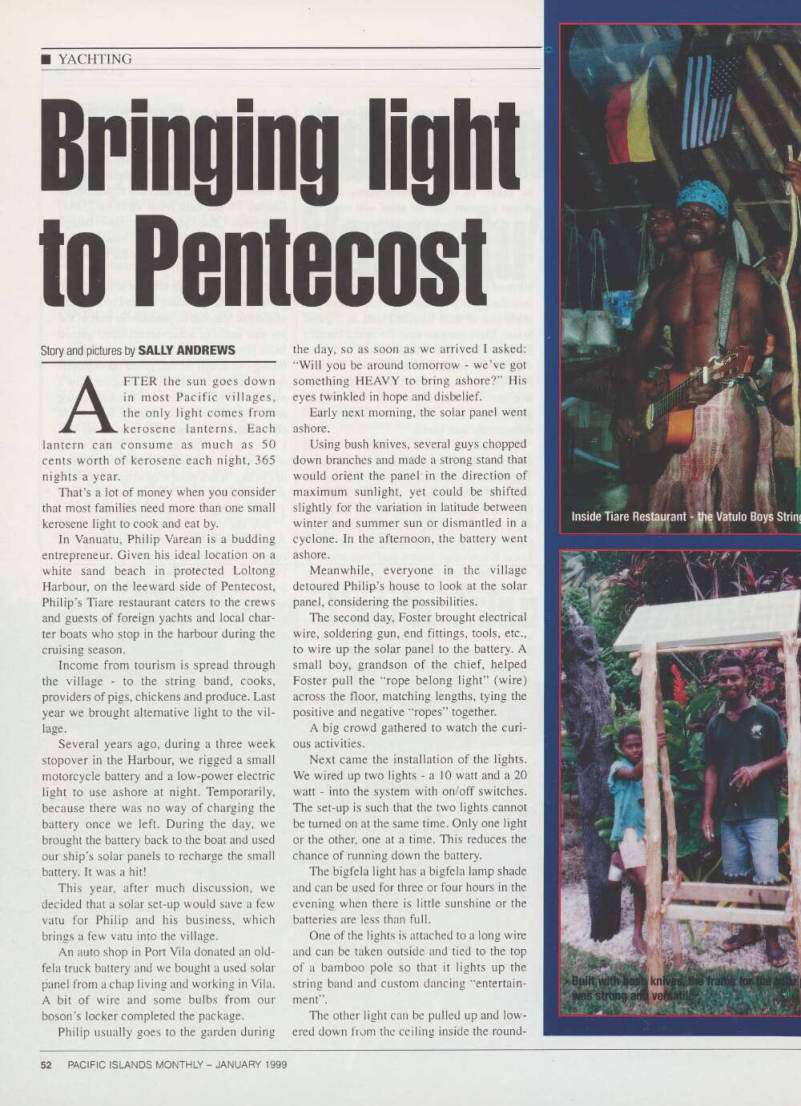
Using bush knives, several guys chopped down branches and made a strong stand that would orient the panel'in the direction of maximum sunlight, yet could be shifted slightly for the variation in latitude between winter and summer sun or dismantled in a cyclone. In the afternoon, the battery went ashore.
Meanwhile, everyone in the village detoured Philip’s house to look at the solar panel, considering the possibilities.
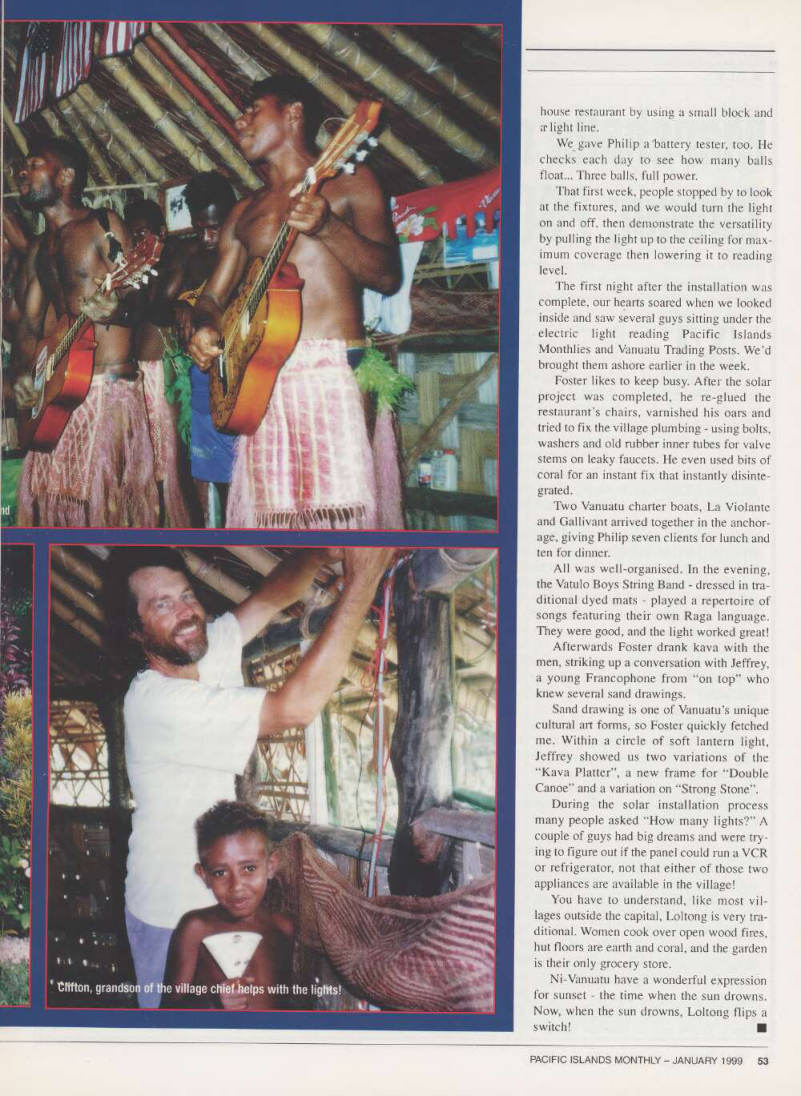
The second day, Foster brought electrical wire, soldering gun, end fittings, tools, etc., to wire up the solar panel to the battery. A small boy, grandson of the chief, helped Foster pull the “rope belong light” (wire) across the floor, matching lengths, tying the positive and negative “ropes” together.
A big crowd gathered to watch the curi ous activities.
Next came the installation of the lights.
We wired up two lights - a 10 watt and a 20 watt - into the system with on/off switches.
The set-up is such that the two lights cannot be turned on at the same time. Only one light or the other, one at a time. This reduces the chance of running down the battery.
The bigfela light has a bigfela lamp shade and can be used for three or four hours in the evening when there is little sunshine or the batteries are less than full.
One of the lights is attached to a long wire and can be taken outside and tied to the top of a bamboo pole so that it lights up the string band and custom dancing "entertain ment”.
The other light can be pulled up and low ered down from the ceiling inside the round-
Inside Tiare Restaurant - the Vatulo Boys String[?]
Built with bush knives, the frame for the sofar [?] was strong am versatile
house restaurant by using a small block and a' light line.
We gave Philip a battery tester, too. He checks each day to see how many balls float... Three balls, full power.
That first week, people stopped by to look at the fixtures, and we would turn the light on and off, then demonstrate the versatility by pulling the light up to the ceiling for max imum coverage then lowering it to reading level.
The first night after the installation was complete, our hearts soared when we looked inside and saw several guys sitting under the electric light reading Pacific Islands Monthlies and Vanuatu Trading Posts. We’d brought them ashore earlier in the week.
Foster likes to keep busy. After the solar project was completed, he re-glued the restaurant’s chairs, varnished his oars and tried to fix the village plumbing - using bolts, washers and old rubber inner tubes for valve stems on leaky faucets. He even used bits of coral for an instant fix that instantly disinte grated.
Two Vanuatu charter boats, La Violante and Gallivant arrived together in the anchor age, giving Philip seven clients for lunch and ten for dinner.
All was well-organised. In the evening, the Vatulo Boys String Band - dressed in tra ditional dyed mats - played a repertoire of songs featuring their own Raga language.
They were good, and the light worked great!
Afterwards Foster drank kava with the men, striking up a conversation with Jeffrey, a young Francophone from “on top” who knew several sand drawings.
Sand drawing is one of Vanuatu’s unique cultural art forms, so Foster quickly fetched me. Within a circle of soft lantern light, Jeffrey showed us two variations of the “Kava Platter”, a new frame for “Double Canoe” and a variation on “Strong Stone”.
During the solar installation process many people asked “How many lights?” A couple of guys had big dreams and were try ing to figure out if the panel could run a VCR or refrigerator, not that either of those two appliances are available in the village!
You have to understand, like most vil lages outside the capital, Loltong is very tra ditional. Women cook over open wood fires, hut floors are earth and coral, and the garden is their only grocery store.
Ni-Vanuatu have a wonderful expression for sunset - the time when the sun drowns.
Now, when the sun drowns, Loltong flips a switch! ■
Clifton, grandson of the village chief helps with the lights!
nd