Sugar chairman admits
p. 49 · Read in the full issue
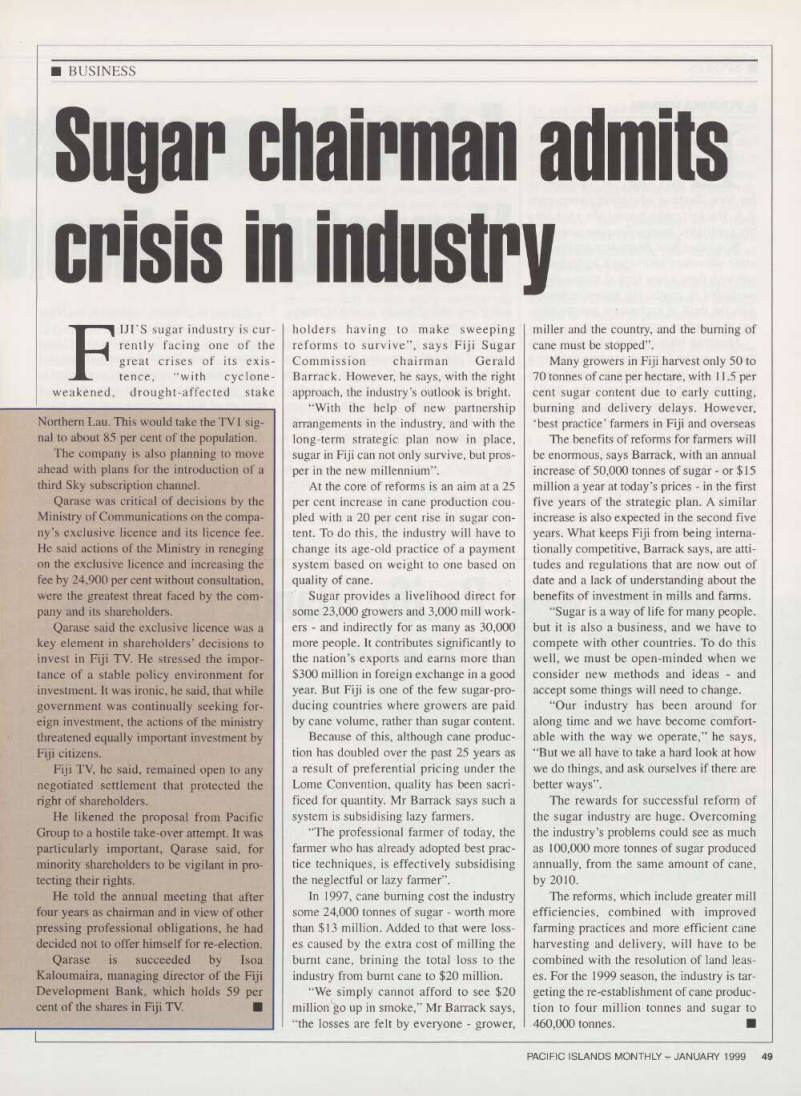
crisis in industry
FIJI’S sugar industry is cur rently facing one of the great crises of its exis tence, “with cyclone weakened, drought-affected stake
holders having to make sweeping reforms to survive”, says Fiji Sugar Commission chairman Gerald Barrack. However, he says, with the right approach, the industry’s outlook is bright.
“With the help of new partnership arrangements in the industry, and with the long-term strategic plan now in place, sugar in Fiji can not only survive, but pros per in the new millennium”.
At the core of reforms is an aim at a 25 per cent increase in cane production cou pled with a 20 per cent rise in sugar con tent. To do this, the industry will have to change its age-old practice of a payment system based on weight to one based on quality of cane.
Sugar provides a livelihood direct for some 23,000 growers and 3,000 mill work ers - and indirectly for as many as 30,000 more people. It contributes significantly to the nation’s exports and earns more than $3OO million in foreign exchange in a good year. But Fiji is one of the few sugar-pro ducing countries where growers are paid by cane volume, rather than sugar content.
Because of this, although cane produc tion has doubled over the past 25 years as a result of preferential pricing under the Lome Convention, quality has been sacri ficed for quantity. Mr Barrack says such a system is subsidising lazy farmers.
“The professional farmer of today, the farmer who has already adopted best prac tice techniques, is effectively subsidising the neglectful or lazy farmer”.
In 1997, cane burning cost the industry some 24,000 tonnes of sugar - worth more than $l3 million. Added to that were loss es caused by the extra cost of milling the burnt cane, brining the total loss to the industry from burnt cane to $2O million.
“We simply cannot afford to see $2O million go up in smoke,” Mr Barrack says, “the losses are felt by everyone - grower,
miller and the country, and the burning of cane must be stopped”.
Many growers in Fiji harvest only 50 to 70 tonnes of cane per hectare, with 11.5 per cent sugar content due to early cutting, burning and delivery delays. However, ‘best practice’ farmers in Fiji and overseas The benefits of reforms for farmers will be enormous, says Barrack, with an annual increase of 50,000 tonnes of sugar - or $l5 million a year at today’s prices - in the first five years of the strategic plan. A similar increase is also expected in the second five years. What keeps Fiji from being interna tionally competitive, Barrack says, are atti tudes and regulations that are now out of date and a lack of understanding about the benefits of investment in mills and farms.
“Sugar is a way of life for many people, but it is also a business, and we have to compete with other countries. To do this well, we must be open-minded when we consider new methods and ideas - and accept some things will need to change.
“Our industry has been around for along time and we have become comfort able with the way we operate,” he says, “But we all have to take a hard look at how we do things, and ask ourselves if there are better ways”.
The rewards for successful reform of the sugar industry are huge. Overcoming the industry’s problems could see as much as 100,000 more tonnes of sugar produced annually, from the same amount of cane, by 2010.
The reforms, which include greater mill efficiencies, combined with improved farming practices and more efficient cane harvesting and delivery, will have to be combined with the resolution of land leas es. For the 1999 season, the industry is tar geting the re-establishment of cane produc tion to four million tonnes and sugar to 460,000 tonnes. ■