Fiji's garment industry
pp. 39-41 · Read in the full issue
Advertising Feature
Clearing dark clouds from Fiji's garment industry
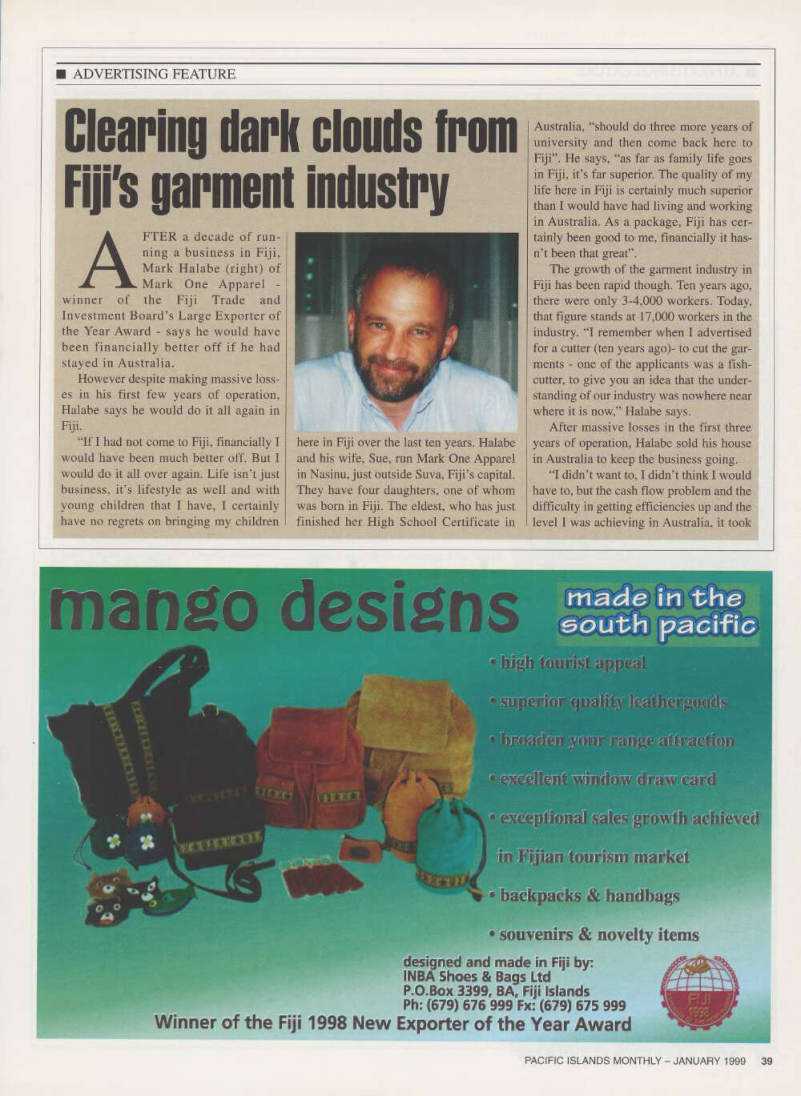
AFTER a decade of run ning a business in Fiji, Mark Halabe (right) of Mark One Apparel winner of the Fiji Trade and Investment Board’s Large Exporter of the Year Award - says he would have been financially better off if he had stayed in Australia.
However despite making massive loss es in his first few years of operation, Halabe says he would do it all again in
Fiji.
“If I had not come to Fiji, financially I would have been much better off. But I would do it all over again. Life isn’t just business, it’s lifestyle as well and with young children that I have, I certainly have no regrets on bringing my children
here in Fiji over the last ten years. Halabe and his wife, Sue, run Mark One Apparel in Nasinu, just outside Suva, Fiji’s capital.
They have four daughters, one of whom was born in Fiji. The eldest, who has just finished her High School Certificate in
Australia, “should do three more years of university and then come back here to Fiji”. He says, “as far as family life goes in Fiji, it’s far superior. The quality of my life here in Fiji is certainly much superior than I would have had living and working in Australia. As a package, Fiji has cer tainly been good to me, financially it has n’t been that great”.
The growth of the garment industry in Fiji has been rapid though. Ten years ago, there were only 3-4,000 workers. Today, that figure stands at 17,000 workers in the industry. “I remember when I advertised for a cutter (ten years ago)- to cut the gar ments - one of the applicants was a fish cutter, to give you an idea that the under standing of our industry was nowhere near where it is now,” Halabe says.
After massive losses in the first three years of operation, Halabe sold his house in Australia to keep the business going.
“I didn’t want to, I didn’t think I would have to, but the cash flow problem and the difficulty in getting efficiencies up and the level I was achieving in Australia, it took
much longer,” he says. He says however that the decision to come to Fiji was long term. “We understood that the manufac turing process in Australia was going to suffer with loss of tariffs, the same thing as Fiji is doing now where you are taking away its protection, internationally com petitive and going off-shore. It happened to us ten years ago and we realised that we weren’t going to survive in Australia, so Fiji was the option we came up with”.
Halabe still has a company in Australia which over the past ten years has done very well. That’s not to say that the Fiji company has been resting. Their order books are full and of the four times, that Mark One has applied for the Exporter of the Year awards, they won three prizes.
“I believe in applying for these because we’re supposed to show overseas an image of quality and of excellent work place employment. We have customers who insist on this. One American compa ny dealing in the States is Levi Strauss and when they approached us, they gave us 14 pages of a questionnaire. An example would be; Do you hire child labour?
What’s the youngest that you hire? What hours do they work? All these factors make up their minds whether to deal with a company or not and having awards assist us in our presentation to our overseas cus tomers. It’s a positive thing,” he says.
Halabe says he wished that more exporters would apply for the awards.
There were only 35 entries for the catego ry that he won although there are 105 tax free factories in the garment industry alone. Mark One predominantly exports to Australia, with 10 per cent going to New Zealand. “Our order books are full, so full that we have to expand even fur ther. The growth that we’ve had in the last 12 months has been from 200 to 350. I expect this time next year it will be in excess of 500 workers that we have here”.
The short-term potential of the garment industry is very good, he says. “I expect between now and the year 2004 to have increased employment and exports in our industry and we will beat sugar. We will export more than sugar. So we will over the next 12 months expand even further still, and in other areas, not just shirts.
“Fiji as an industry deals mostly in men’s-wear - suits, shirts, trousers - and that’s the strength of the industry but now we’re moving towards women’s clothing which has been untapped and that’s a fac tor of five of what men’s-wear is in Australia - so Fiji has a very short term positive growth factor,” he says However, Halabe says in the long term Fiji has to solve a few problems before it can progress. “We have some very dark clouds that we have to sort out. SPARTE CA is going to be maintained at 25 per cent preference up to the year 2005 and there’s going to be a review after that.
Before that there is another thing that’s causing some pain and that’s called the import credits - that allows Fiji to buy fab ric from Australia at a discount.
“If the Australians export their cloth then they get a 20 per cent discount. So we’re losing that on July 3. It’s gone. It did have a life plan. It did say it was going to end in July. But we are hoping we can convince the Australian government that through another programme - the regional development scheme - they can continue
on these import credits to the Australian exporter to Fiji or the Forum Islands”.
Another dark cloud, he says, is the expansion of the Australian government’s Overseas Assembly Programme (OAP). Through this, textiles from Australia can now be exported to South East Asia, made into finished garments and brought back into Australia, paying only a tariff paid on the value-added, that is, the cost of making the garment, not the fabric.
“To make a garment in Indonesia is much, much lower than making it in Fiji. So paying a tariff on nothing is nothing - so price for price, price-point
we are going to suffering on that area as well,” Halabe says.
The Fiji garment industry is pushing hard for the continuance of the import credit scheme to make up for the losses of the OAP.
Regarding expansion into the American market, Halabe says one problem is that quotas to the US will be lifted world-wide in the year 2005.
The reasons to stay in Fiji, he says, are “that we would be a reliable, quick turnaround, quality-conscious, easy place to do business with”, “In our industry, you’ve got to have long-term certainty and Fiji can give them that,” he says. ■