control in PNG
pp. 32-35 · Read in the full issue

Special Report
Unions seize control in PNG
A Spate Of
industrial
action gripped
Papua New Guinea for weeks - placing tremendous strain and bur den on the private sector and subsequently affecting the
country’s already crippled
economy.
The impact was severe, espe cially for the private sector that lost considerable business over three successive weeks in October and November.
What began as a Communications Workers Union (CWU) strike in October culminated with a day’s stop work action by the Air Traffic Controllers’ Association and further threats of nation-wide industrial action in November.
This was led by the Papua New Guinea Trade Union Congress (PNGTUC) and supported by its
affiliates in protest over the government’s 1999 budget.
The PNGTUC was supported by unions representing teachers, health workers, police, warders (correctional services offi cers), maritime workers, communication workers and others.
The CWU members went on strike on October 22 with demands that the govern ment pay their overdue superannuation (from after the corporatisation of the for mer Post and Telecommunication Corporation in 1996).
Because the former PTC became two separate companies - Telikom and Post PNG - their employees had to have their superannuation contributions transferred from the Public Officers Superannuation Fund to the private sector’s National Provident Fund.
But the worst for Port Moresby busi nesses was yet to come.
On October 27, after a fault in a tele phone exchange, linked to the strike, all communication links were disrupted.
Telephones and faxes were down in most offices all day.
Banks were worst hit, complaining of being isolated from other branches, that electronic banking facilities were affected and they were not able to provide the full range of customer services.
Airline and corporate travel agencies
were also severely affected.
After almost three weeks of wrangling, including several court hearings, the gov ernment finally gave in to all the 10 demands of the union.
The government signed a Memorandum of Agreement that entitles members to receive their funds over a period of 12 months at an amended figure of Kl 5 mil lion, ending the strike.
Two agreements were signed on November 10. One agreement was between the State, employers and CWU and the other between the two superannua tion funds.
The first instalment of K 6 million from the government was to be paid to the NPF by lunch-time on November 10.
The agreement stated the following: - State and employer agree to pay to NPF K 15,049,412 over 12 months as of November 10. - Payment to be made on two equal instalments of K 6 million at six-monthly intervals, with the final payment to be
completed by November 1999.
A contention in the agreement, which called for the State and employer organisa tions not to take action against the union executives or members as result of the strike, was also amended and agreed upon.
Deputy prime minister and treasurer lairo Lasaro, speaking after the signing,
said it was the first of its kind and called for
improved relations
between the government and the union movement.
He acknowledged the prolonged strike had affected the private sector and created concern within PNG and abroad.
The CWU also made sure the two agreements favoured some of their members who are employ ees of PANGTEL and
Nbc.
The provision for PANGTEL calls for POSE to consider them redundant employees and pay them to January 1, 1996, when PTC was corporatised.
The union further called on government to transfer all contributions owing to NBC employees and to be
paid over to the POSE immediately.
However, this did not calm union agita tion.
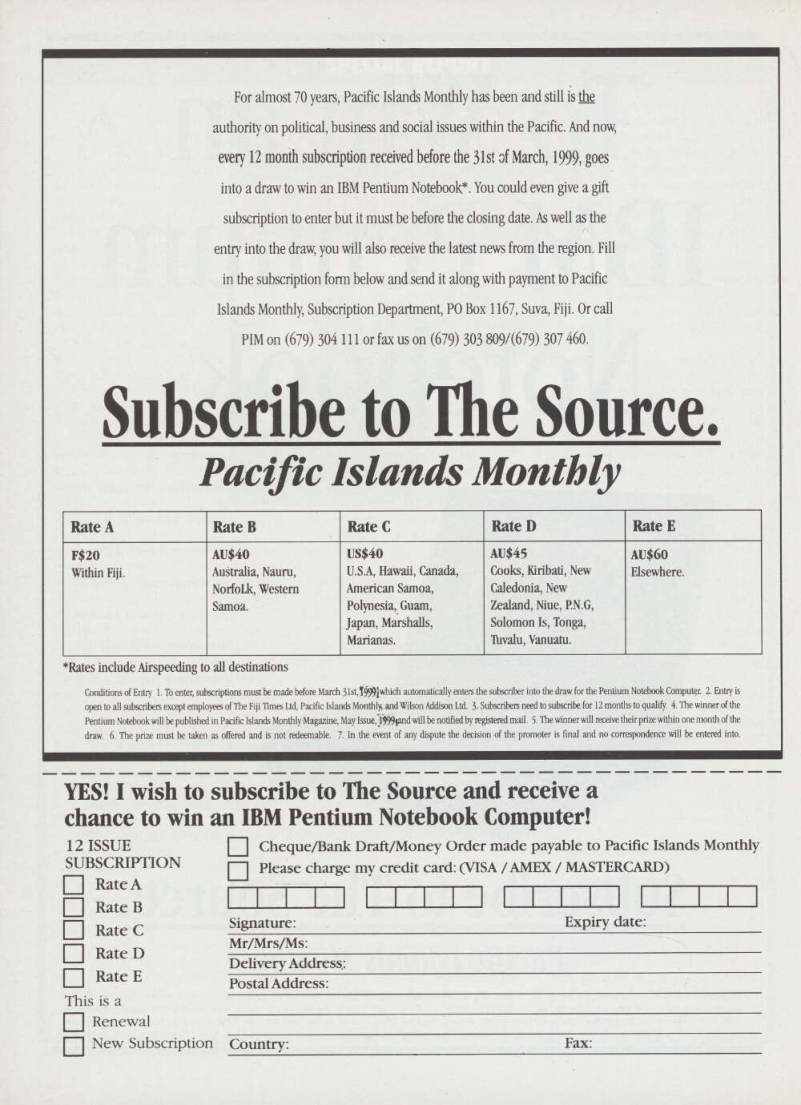
On November 24, the unionists staged a peaceful protest march to parliament when deliberations on the budget were proceed ing.
The PNGTUC was critical of the gov ernment’s decision to abolish 15 govern ment statutory authorities, agencies and committees under the 1999 budget.
The union was seeking the reinstate ment of four particular organisations - the Industrial Conciliation and Arbitration Tribunal, Industrial Registrar, National Tripartite Consultative Council and National Training Council.
According to the budget papers, the organisations were to be abolished or streamlined with their functions merged with line departments as one of the cost saving measures under the public sector reforms.
The unions called for the return of the 1999 budget to the finance department for review, reinstating all other abolished func tions, activities and all industrial agree ments and awards that the 1999 budget did not cater for.
It also wanted the immediate termina tion of the contract held by the govern-
Continued on page 35
Continued from page 32
ment’s chief economic advisor Dr Pirouz Hamidian-Rad and his deportation; and the abolishment of Value Added Tax (VAT).
However, after receiving the petition from the union leaders outside parliament, the government used its numerical strength to bulldoze the budget through parliament.
This happened despite the union’s protest march and 59 recommended amendments to the expenditure budget by the Opposition. It was on the same day that, amid the uncertainties over the CWU strike, the Air Traffic Controllers Association created more chaos by sudden ly stopping work.
Theirs was a protest over management’s failure to buy vehicles for the controllers.
Both domestic and international flights were disrupted, leaving travellers stranded everywhere on November 24. The slop work by controllers forced a Qantas plane with 169 passengers aboard to turn back to Brisbane. An Air Niugini Airbus that was supposed to have landed at Port Moresby was diverted to Caims.
A flight to Manila in the Philippines could not leave because traffic controllers in Brisbane reportedly refused to clear the plane in sympathy with their PNG col leagues.
Although the stop-work had been called off. Air Niugini reported a loss of K 60,000 in potential revenue as a result of the strike.
Air Niugini managing director Andrew Ogil said 29 “PX” flights were grounded, causing disruptions to at least 2000 travel ling passengers.
However, on November 27, after a lunch-time meeting with prime minister Bill Skate, the PNGTUC and its affiliates called off the strike. Skate and union lead ers reached a deal to avert the strike during talks lasting more than three hours at par liament house.
A concerned Port Moresby Chamber of Commerce and Industry president, Michael Mayberry, said businesses were unneces sarily losing revenue every time a strike occurred. He said this should not be the case if there was consultation and dialogue
with employers.
Mayberry said unions should show some responsibility and try to solve prob lems by engaging in meaningful dialogue with employers.
The Lae Chamber of Commerce and Industry president Alan McLay said the strike had a detrimental impact on busi
nesses in Lae. McLay said the difficulty in telecommunications alone, with overseas and domestic buyers and suppliers, had caused loss of income to many companies.
“Some of these companies have already stated through the Chamber that their loss of revenue was very high,” he said.
The main victim, Telikom - whose employees comprise the highest number in the CWU membership - lost Kl, 107,923 in business. The company had to use the national court to order the PTC employees to return to work. In November, the other company affected, Post PNG, reported its highest loss due to the strike by its work
ers. Post PNG managing director, Passingan Taru, said the company lost K 500,000 because of the two-week rolling strike and therefore failed to achieve its 1998 target revenue of KlB million.
The damaging impact of the strike forced the Papua New Guinea Banking Corporation (PNGBC) National Staff Association to step in and publicly plead with the CWU to restore all data links and telephones, especially to the banks.
Association president, Felix Unage, claimed that PNGBC’s nation-wide net work was adversely affected, losing mil lions of kina in business. ■