Greenpeace
p. 27 · Read in the full issue
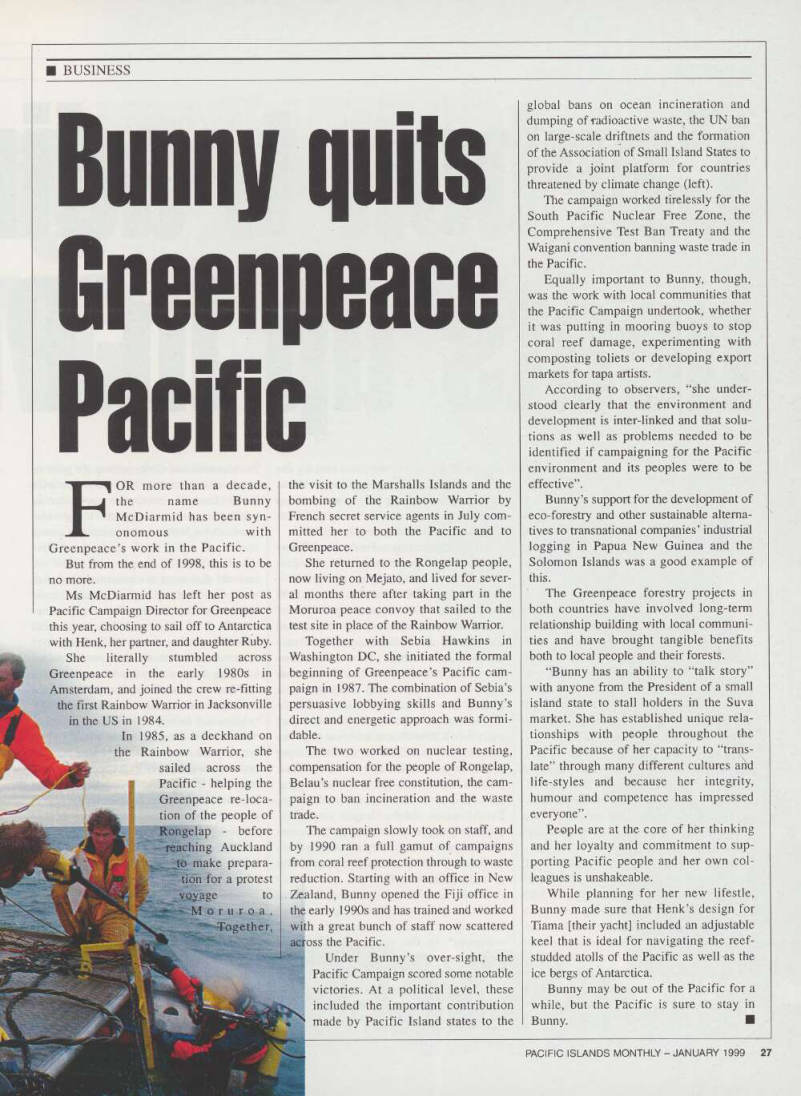
Bunny quits Greenpeace Pacific
FOR more than a decade, the name Bunny McDiarmid has been syn onomous with Greenpeace’s work in the Pacific.
But from the end of 1998, this is to be no more.
Ms McDiarmid has left her post as Pacific Campaign Director for Greenpeace this year, choosing to sail off to Antarctica with Henk, her partner, and daughter Ruby.
She literally stumbled across Greenpeace in the early 1980 s in Amsterdam, and joined the crew re-fitting the first Rainbow Warrior in Jacksonville in the US in 1984.
In 1985, as a deckhand on the Rainbow Warrior, she sailed across the 1 Pacific - helping the Greenpeace re-loca t I tion of the people of i Rongelap - before reaching Auckland to make prepara- Blp tion for a protest K ' v °y a c e t 0 Moru r o a .
Together,
the visit to the Marshalls Islands and the bombing of the Rainbow Warrior by French secret service agents in July com mitted her to both the Pacific and to Greenpeace.
She returned to the Rongelap people, now living on Mejato, and lived for sever al months there after taking part in the Moruroa peace convoy that sailed to the test site in place of the Rainbow Warrior.
Together with Sebia Hawkins in Washington DC, she initiated the formal beginning of Greenpeace’s Pacific cam paign in 1987. The combination of Sebia’s persuasive lobbying skills and Bunny’s direct and energetic approach was formi dable.
The two worked on nuclear testing,
compensation for the people of Rongelap,
Belau’s nuclear free constitution, the cam paign to ban incineration and the waste trade.
The campaign slowly took on staff, and by 1990 ran a full gamut of campaigns from coral reef protection through to waste reduction. Starting with an office in New Zealand, Bunny opened the Fiji office in the early 1990 s and has trained and worked with a great bunch of staff now scattered across the Pacific. 55S*-; Under Bunny’s over-sight, the Pacific Campaign scored some notable • ; victories. At a political level, these w included the important contribution made by Pacific Island states to the
global bans on ocean incineration and dumping of radioactive waste, the UN ban on large-scale driftnets and the formation of the Association of Small Island States to
provide a joint platform for countries
threatened by climate change (left).
The campaign worked tirelessly for the South Pacific Nuclear Free Zone, the Comprehensive Test Ban Treaty and the Waigani convention banning waste trade in the Pacific.
Equally important to Bunny, though, was the work with local communities that the Pacific Campaign undertook, whether it was putting in mooring buoys to stop coral reef damage, experimenting with composting toliets or developing export markets for tapa artists.
According to observers, “she under stood clearly that the environment and development is inter-linked and that solu tions as well as problems needed to be identified if campaigning for the Pacific environment and its peoples were to be effective”.
Bunny’s support for the development of eco-forestry and other sustainable alterna tives to transnational companies’ industrial logging in Papua New Guinea and the Solomon Islands was a good example of this.
The Greenpeace forestry projects in both countries have involved long-term relationship building with local communi ties and have brought tangible benefits both to local people and their forests.
“Bunny has an ability to “talk story” with anyone from the President of a small island state to stall holders in the Suva market. She has established unique rela tionships with people throughout the Pacific because of her capacity to “trans late” through many different cultures arid life-styles and because her integrity, humour and competence has impressed everyone”.
People are at the core of her thinking and her loyalty and commitment to sup porting Pacific people and her own col leagues is unshakeable.
While planning for her new lifestle, Bunny made sure that Henk’s design for Tiama [their yacht] included an adjustable keel that is ideal for navigating the reef studded atolls of the Pacific as well as the ice bergs of Antarctica.
Bunny may be out of the Pacific for a while, but the Pacific is sure to stay in Bunny. ■