PNG's logging industry
pp. 24-25 · Read in the full issue
Malaysian firm moves towards value-adding in PNG's logging industry
By Brian Tobia
THE Papua New Guinea government’s many years of constant pleas for downstream processing in the forestry sector have been well received by a leading log exporter in the country.
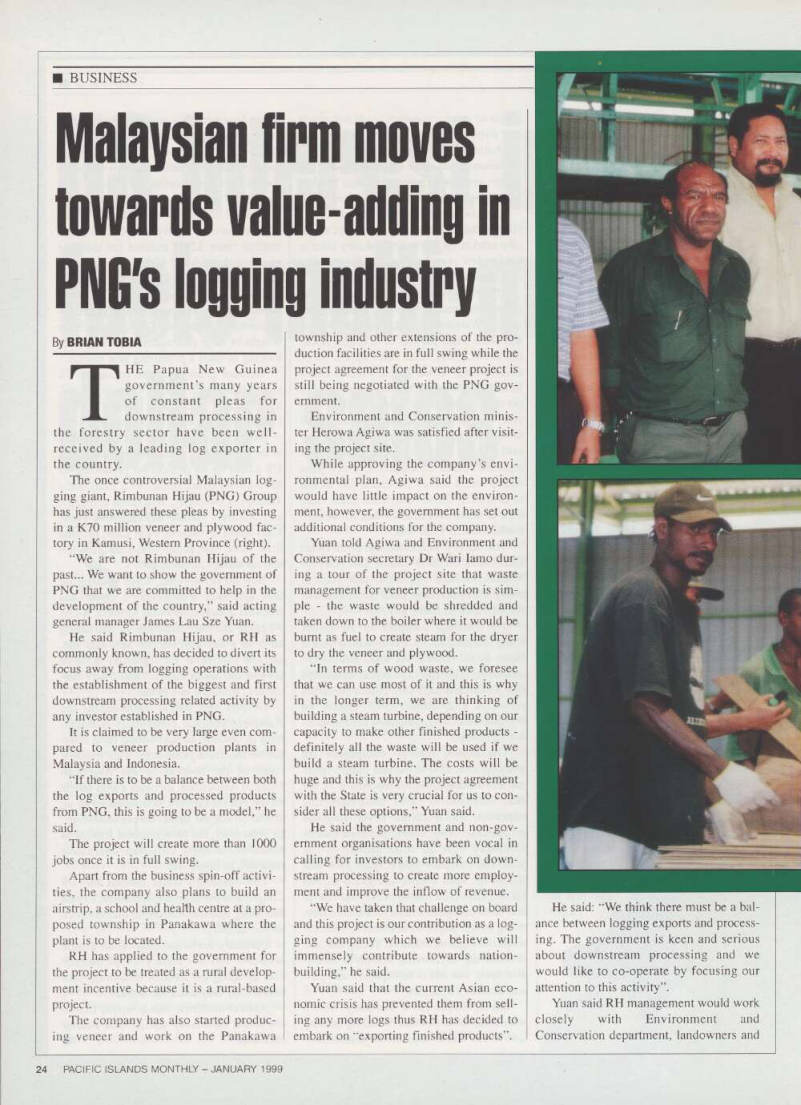
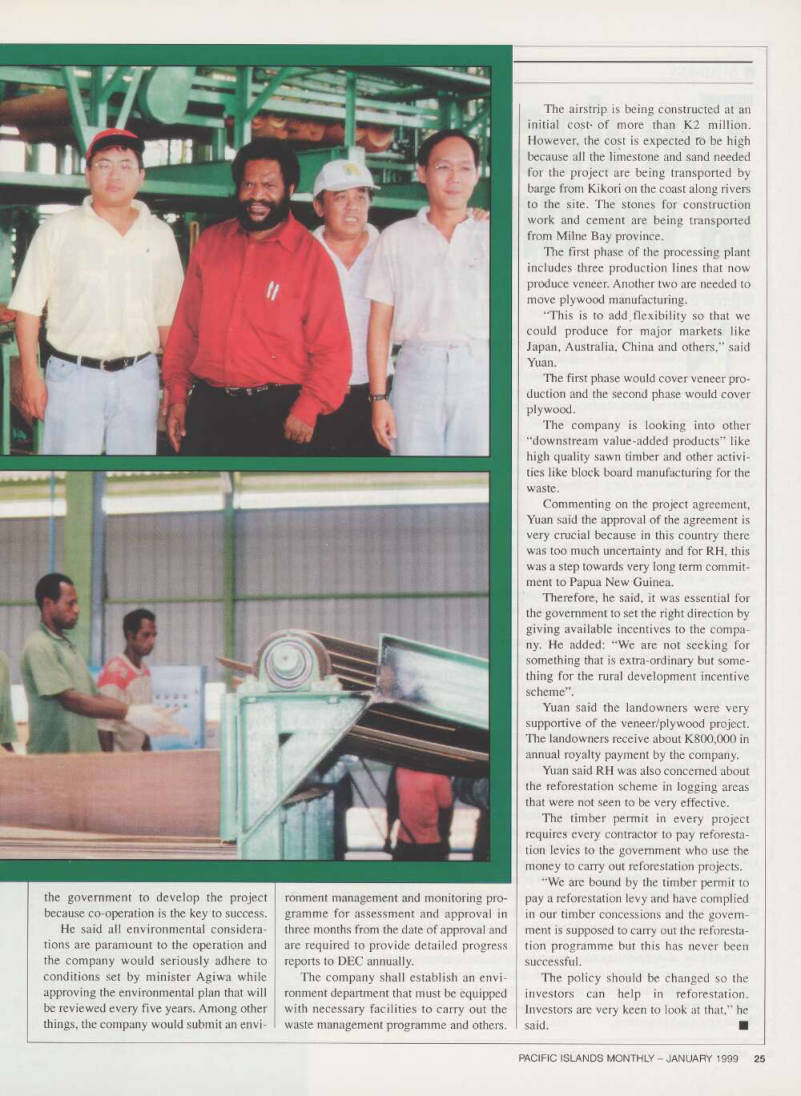
The once controversial Malaysian log ging giant, Rimbunan Hijau (PNG) Group has just answered these pleas by investing in a K7O million veneer and plywood fac tory in Kamusi, Western Province (right).
“We are not Rimbunan Hijau of the past... We want to show the government of PNG that we are committed to help in the development of the country,” said acting general manager James Lau Sze Yuan.
He said Rimbunan Hijau, or RH as commonly known, has decided to divert its focus away from logging operations with the establishment of the biggest and first downstream processing related activity by any investor established in PNG.
It is claimed to be very large even com pared to veneer production plants in Malaysia and Indonesia.
“If there is to be a balance between both the log exports and processed products from PNG, this is going to be a model,” he said.
The project will create more than 1000 jobs once it is in full swing.
Apart from the business spin-off activi ties, the company also plans to build an airstrip, a school and health centre at a pro posed township in Panakawa where the plant is to be located.
RH has applied to the government for the project to be treated as a rural develop ment incentive because it is a rural-based project.
The company has also started produc ing veneer and work on the Panakawa
township and other extensions of the pro duction facilities are in full swing while the project agreement for the veneer project is still being negotiated with the PNG gov ernment.
Environment and Conservation minis ter Herowa Agiwa was satisfied after visit
ing the project site.
While approving the company’s envi
ronmental plan, Agiwa said the project
would have little impact on the environ ment, however, the government has set out additional conditions for the company.
Yuan told Agiwa and Environment and Conservation secretary Dr Wari lamo dur ing a tour of the project site that waste management for veneer production is sim ple - the waste would be shredded and taken down to the boiler where it would be burnt as fuel to create steam for the dryer to dry the veneer and plywood.
“In terms of wood waste, we foresee that we can use most of it and this is why in the longer term, we are thinking of building a steam turbine, depending on our capacity to make other finished products definitely all the waste will be used if we build a steam turbine. The costs will be huge and this is why the project agreement with the State is very crucial for us to con sider all these options,” Yuan said.
He said the government and non-gov emment organisations have been vocal in calling for investors to embark on down stream processing to create more employ ment and improve the inflow of revenue.
“We have taken that challenge on board and this project is our contribution as a log ging company which we believe will immensely contribute towards nation building,” he said.
Yuan said that the current Asian eco nomic crisis has prevented them from sell ing any more logs thus RH has decided to embark on “exporting finished products”.
He said: "We think there must be a bal ance between logging exports and process ing. The government is keen and serious about downstream processing and we would like to co-operate by focusing our attention to this activity”.
Yuan said RH management would work closely with Environment and Conservation department, landowners and
the government to develop the project because co-operation is the key to success.
He said all environmental considera tions are paramount to the operation and the company would seriously adhere to conditions set by minister Agiwa while approving the environmental plan that will be reviewed every five years. Among other things, the company would submit an envi
ronment management and monitoring pro gramme for assessment and approval in three months from the date of approval and are required to provide detailed progress reports to DEC annually.
The company shall establish an envi ronment department that must be equipped with necessary facilities to carry out the waste management programme and others.
The airstrip is being constructed at an initial cost- of more than K 2 million.
However, the cost is expected to be high because all the limestone and sand needed for the project are being transported by barge from Kikori on the coast along rivers to the site. The stones for construction work and cement are being transported from Milne Bay province.
The first phase of the processing plant includes three production lines that now produce veneer. Another two are needed to move plywood manufacturing. ‘This is to add flexibility so that we could produce for major markets like Japan, Australia, China and others,” said Yuan.
The first phase would cover veneer pro duction and the second phase would cover plywood.
The company is looking into other “downstream value-added products” like high quality sawn timber and other activi ties like block board manufacturing for the waste.
Commenting on the project agreement, Yuan said the approval of the agreement is very crucial because in this country there was too much uncertainty and for RH, this was a step towards very long term commit ment to Papua New Guinea.
Therefore, he said, it was essential for the government to set the right direction by giving available incentives to the compa ny. He added: “We are not seeking for something that is extra-ordinary but some thing for the rural development incentive scheme”.
Yuan said the landowners were very supportive of the veneer/plywood project.
The landowners receive about KBOO,OOO in annual royalty payment by the company.
Yuan said RH was also concerned about the reforestation scheme in logging areas that were not seen to be very effective.
The timber permit in every project requires every contractor to pay reforesta tion levies to the government who use the money to carry out reforestation projects.
“We are bound by the timber permit to pay a reforestation levy and have complied in our timber concessions and the govern ment is supposed to carry out the reforesta tion programme but this has never been successful.
The policy should be changed so the investors can help in reforestation.
Investors are very keen to look at that,” he said. ■