against dengue
p. 19 · Read in the full issue
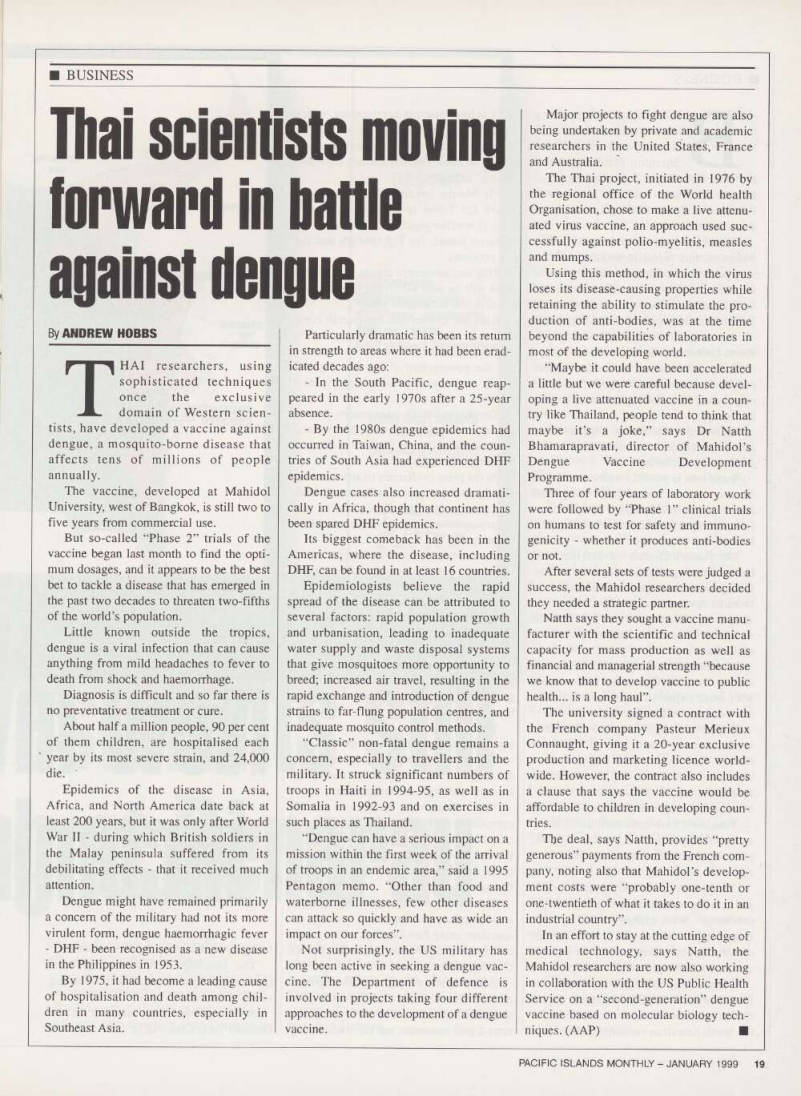
Thai scientists moving forward in battle against dengue
By Andrew Hobbs
THAI researchers, using
sophisticated techniques once the exclusive domain of Western scien tists, have developed a vaccine against dengue, a mosquito-borne disease that affects tens of millions of people annually.
The vaccine, developed at Mahidol University, west of Bangkok, is still two to five years from commercial use.
But so-called “Phase 2” trials of the vaccine began last month to find the opti mum dosages, and it appears to be the best bet to tackle a disease that has emerged in the past two decades to threaten two-fifths of the world’s population.
Little known outside the tropics, dengue is a viral infection that can cause anything from mild headaches to fever to death from shock and haemorrhage.
Diagnosis is difficult and so far there is no preventative treatment or cure.
About half a million people, 90 per cent of them children, are hospitalised each year by its most severe strain, and 24,000 die.
Epidemics of the disease in Asia, Africa, and North America date back at least 200 years, but it was only after World War II - during which British soldiers in the Malay peninsula suffered from its debilitating effects - that it received much attention.
Dengue might have remained primarily a concern of the military had not its more virulent form, dengue haemorrhagic fever - DHF - been recognised as a new disease in the Philippines in 1953.
By 1975, it had become a leading cause of hospitalisation and death among chil dren in many countries, especially in Southeast Asia.
Particularly dramatic has been its return in strength to areas where it had been erad icated decades ago: - In the South Pacific, dengue reap peared in the early 1970 s after a 25-year absence. - By the 1980 s dengue epidemics had occurred in Taiwan, China, and the coun tries of South Asia had experienced DHF epidemics.
Dengue cases also increased dramati cally in Africa, though that continent has been spared DHF epidemics.
Its biggest comeback has been in the Americas, where the disease, including DHF, can be found in at least 16 countries.
Epidemiologists believe the rapid
spread of the disease can be attributed to several factors: rapid population growth and urbanisation, leading to inadequate water supply and waste disposal systems that give mosquitoes more opportunity to breed; increased air travel, resulting in the rapid exchange and introduction of dengue strains to far-flung population centres, and inadequate mosquito control methods.
“Classic” non-fatal dengue remains a concern, especially to travellers and the military. It struck significant numbers of troops in Haiti in 1994-95, as well as in Somalia in 1992-93 and on exercises in such places as Thailand.
“Dengue can have a serious impact on a mission within the first week of the arrival of troops in an endemic area,” said a 1995 Pentagon memo. “Other than food and waterborne illnesses, few other diseases can attack so quickly and have as wide an impact on our forces”.
Not surprisingly, the US military has long been active in seeking a dengue vac cine. The Department of defence is involved in projects taking four different approaches to the development of a dengue vaccine.
Major projects to fight dengue are also being undertaken by private and academic researchers in the United States, France and Australia.
The Thai project, initiated in 1976 by the regional office of the World health Organisation, chose to make a live attenu ated virus vaccine, an approach used suc
cessfully against polio-myelitis, measles
and mumps.
Using this method, in which the virus loses its disease-causing properties while retaining the ability to stimulate the pro duction of anti-bodies, was at the time beyond the capabilities of laboratories in most of the developing world. ‘‘Maybe it could have been accelerated a little but we were careful because devel oping a live attenuated vaccine in a coun try like Thailand, people tend to think that maybe it’s a joke,” says Dr Natth Bhamarapravati, director of Mahidol’s Dengue Vaccine Development Programme.
Three of four years of laboratory work were followed by “Phase 1” clinical trials on humans to test for safety and immuno genicity - whether it produces anti-bodies or not.
After several sets of tests were judged a success, the Mahidol researchers decided they needed a strategic partner.
Natth says they sought a vaccine manu facturer with the scientific and technical capacity for mass production as well as financial and managerial strength “because we know that to develop vaccine to public health... is a long haul”.
The university signed a contract with the French company Pasteur Merieux Connaught, giving it a 20-year exclusive production and marketing licence world wide. However, the contract also includes a clause that says the vaccine would be affordable to children in developing coun tries.
The deal, says Natth, provides “pretty generous” payments from the French com pany, noting also that Mahidol’s develop ment costs were “probably one-tenth or one-twentieth of what it takes to do it in an industrial country”.
In an effort to stay at the cutting edge of medical technology, says Natth, the Mahidol researchers are now also working in collaboration with the US Public Health Service on a “second-generation” dengue vaccine based on molecular biology tech niques. (AAP) ■