Warfare
pp. 10-13 · Read in the full issue
Special Report
Carrier
A market share fight in the skies
By Sophie Foster Hildebrand
EVERY day, thousands of
feet above sea-level, planes criss-cross the vast Pacific Ocean.
Majestic in flight, and still seen with awe in many island countries, these planes are part of a complex network of strategies to increase market share and boost revenue.
This is a fight for control of the skies and it is not little league either with big island corporations such as Qantas, Air New Zealand, Air Pacific, and now Ansett Australia competing to stay in the air.
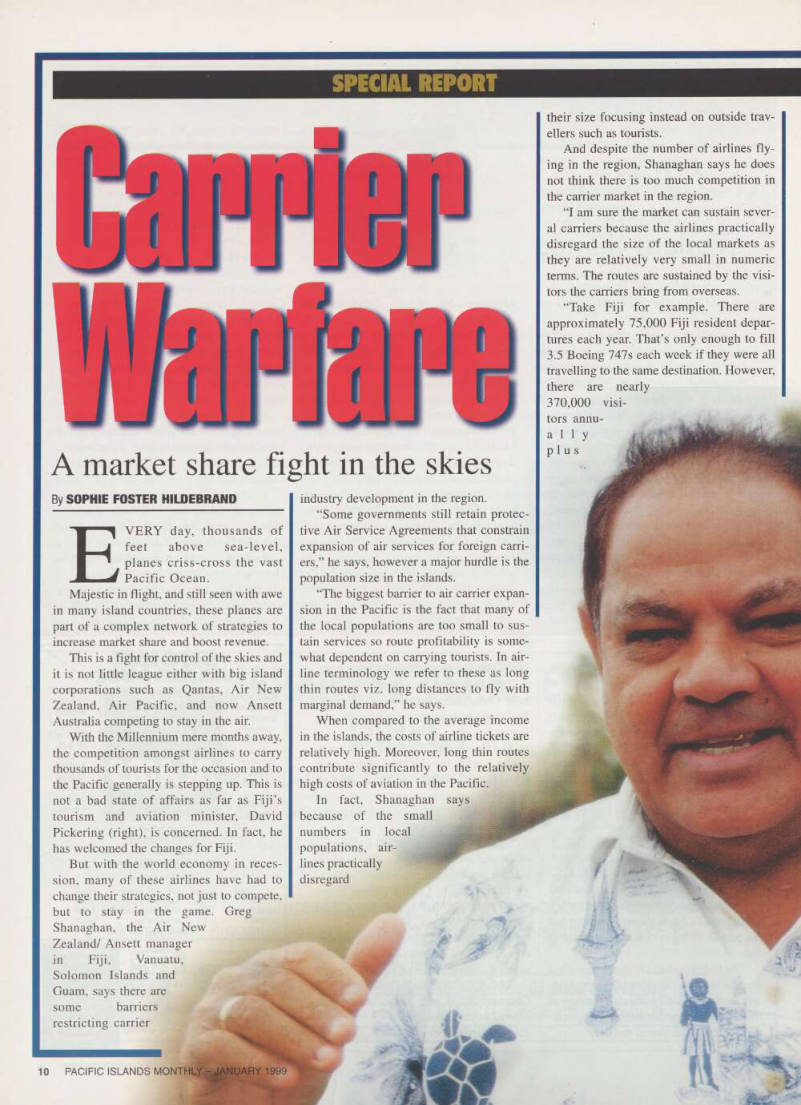
With the Millennium mere months away, the competition amongst airlines to carry thousands of tourists for the occasion and to the Pacific generally is stepping up. This is not a bad state of affairs as far as Fiji’s tourism and aviation minister, David Pickering (right), is concerned. In fact, he has welcomed the changes for Fiji.
But with the world economy in reces sion, many of these airlines have had to change their strategies, not just to compete, but to stay in the game. Greg Shanaghan, the Air New Zealand/ Ansett manager in Fiji, Vanuatu, Solomon Islands and Guam, says there are some barriers
restricting carrier
industry development in the region.
“Some governments still retain protec tive Air Service Agreements that constrain expansion of air services for foreign carri ers,” he says, however a major hurdle is the population size in the islands.
“The biggest barrier to air carrier expan sion in the Pacific is the fact that many of the local populations are too small to sus tain services so route profitability is some what dependent on carrying tourists. In air line terminology we refer to these as long thin routes viz. long distances to fly with marginal demand,” he says.
When compared to the average income in the islands, the costs of airline tickets are relatively high. Moreover, long thin routes contribute significantly to the relatively high costs of aviation in the Pacific.
In fact, Shanaghan says because of the small numbers in local
populations, air
lines practically
disregard
their size focusing instead on outside trav ellers such as tourists.
And despite the number of airlines fly ing in the region, Shanaghan says he does not think there is too much competition in the carrier market in the region.
“I am sure the market can sustain sever al carriers because the airlines practically disregard the size of the local markets as they are relatively very small in numeric terms. The routes are sustained by the visi tors the carriers bring from overseas.
“Take Fiji for example. There are approximately 75,000 Fiji resident depar tures each year. That’s only enough to fill 3.5 Boeing 747s each week if they were all travelling to the same destination. However, there are nearly 370,000 visi tors annu a 11 y juJALo plus
another 150,000 people who transit Fiji to somewhere else - so when you put these numbers to route profitability models, things hopefully begin to add up. That’s why Fiji has significantly more flights serv ing it than other Pacific Islands,” he says.
He said, looking at the market dimen sions from an airline perspective, “the cur rent level of competition is reflective of the existing customer demand”.
“If there was excessive demand then the existing carriers would look to increase their flights or new entrants would enter the market,” he says. In December, a new entrant did begin operations in Fiji. Ansett’s arrival in Fiji has pushed down the price of an air ticket to Sydney already. Ansett’s Nadi-Sydney airfare sits at $599 - a price which Air Pacific has matched by dropping its Sydney-Suva ticket by $3OO to $599.
“Ansett has just started operations to Fiji and already they have started big noisy promotions in Australia beating out the Fiji message. Air Pacific has known Ansett were coming for some I time now so their marketing efforts in Australia have intensified this ilfc. year and Fiji is reaping the H reward from their sharpened (hocus and the increased effort they are putting in. There's nothing like some real competi tion to sharpen the players up,”
Shanaghan says. f ; : While choosing not to com ment on Ansett’s arrival, nor any j;'|l other constraints faced by the industry, Michael McQuay. the I managing director of Air Pacific says the
:A '%|jl biggest hurdle 1
V for the airline i
try is room capacity in the islands. “The challenge for the industry over the next 18 to 24 months in Fiji is to juggle excess air
craft capacity against the declining avail
ability of quality tourism hotel rooms.
“Government must work aggressively to attract investors to construct additional two star and five-star hotels so that market momentums are maintained and enhanced,” he says. In fact, there are many plans for new hotels in Fiji that should be in the building stage over 1999/2000. In Suva, the Fslo-12 million (AsB-10m) Tanoa Suva is in the planning stage, while plans for the Grand Pacific on Suva’s waterfront have stalled because the financier has pulled out.
The American investor, Thor Larsson, ceased funding and the project plans have for now been suspended.
Work on the Trend West resort won’t start until a new builder is found. The builder the company was negotiating with, Mainzeal of New Zealand pulled out and tenders for a new builder were to close in December. The Sheraton Royal Denarau Hotel in Nadi is due to start its Fsl4 million (Asll million) upgrade in this first quarter with a major upgrade of rooms, lobby, entertainment lounge, ballroom and new furniture and fittings for some rooms.
Even Air Pacific itself has plans to build a resort that will be run by the Grand Hyatt on Denarau Island. Work on the resort is yet to begin. It is this sort of diversification that now typifies airline strategies in the region.
With major investments required to stay in the air, many Pacific airlines are finding that they have to re-think their approach. Many have had to merge or negotiate with bigger
airlines to extend their reach. Qantas shares in Air TPacific were increased last year, and seats on either airline’s planes to Fiji are still shared between them. Air New Zealand, a company that has been involved in flying to the South Pacific longer than any other airline, has negotiated several agreements with other airlines outside the region to increase its customers.
“With our global alliance partners like United Airlines, Lufthansa German Airlines, Scandinavian Airlines, Varig and other partners like Ansett Australia and Singapore Airlines now beginning to mar ket products to these parts of the world, we will fly their customers to and through the South Pacific on their behalf,” Shanaghan says. Earlier in 1998, the Australian Competition and Consumer Association (ACCC) approved a five year trilateral rela tionship between Ansett, Air New Zealand and Singapore Airlines. In September Ansett Chief executive Rod Eddington said he thought Singapore becoming a partner would be a “terrific idea”.
In mid-December, Singapore Airlines chief executive Cheong Choong Kong said that expansion remained part of Singapore’s strategy. “In the longer term, we aim to grow globally into an international group of airline and airline-related companies,” he said. “As part of our globalisation strategy, we are extending our route network, not only through flying to more destinations ourselves, but also with suitable alliance partners”. Dr Cheong said that Singapore Airlines was finding the going hard in the
Continued on page 13
Continued from page 11
midst of the Asian downturn but, unlike other regional airlines, had remained in the black. The company reported a 24 per cent fall in after tax profit for the six months to September 30, 1998, to Ss46B million from Ss6l6 million previously. Singapore Airlines has deferred delivery of 11 aircraft because it did not need the additional capacity. Meanwhile, Dr Cheong has remained coy about speculation that the airline was taking an equity interest in Ansett Australia. Speaking at an Asialink
seminar in Melbourne, he said he was enthusiastic about Ansett’s future but would not comment directly on any poten tial equity interest for Singapore.
“There is no doubt that Ansett is a qual ity airline with a strong brand, excellent management and considerable potential.
We believe Ansett has a great future,” he said.
“You must forgive me if I opt to adhere to our company policy of not comment ing... of course - and here it can be duly reported that I’m speaking with a smile you can consider the enthusiasm I’ve been
displaying over Ansett and draw your own conclusions”. With numerous mergers and alliances necessary in the current climate, it would not be surprising if Singapore Airlines does take an equity interest in Ansett, giving it a foot in the Australian market.
Meanwhile, Ansett has already begun its flights to Fiji, providing direct competi tion for the Qantas-Air Pacific duo.
It remains to be seen what, if any, change new alliances bring. ■ (*Some material has been sourced through AAP)