Hundreds in despair as fire ravages Savaii
pp. 48-49 · Read in the full issue
Disaster
MP says fire-starter will be banished
By Chris Peteru
A MASSIVE scrub fire that swept across the Samoan island of Savaii has left a trail of destruction and despair for hundreds of rural villagers already battling one of the worst droughts on record.
For seven days the blaze swept in a relentless wave from just outside the main township of Asau, then north east across three villages, the inland settlements at Aopo and Satui and to Sasina on the coast, with the former two coming off the worst.
With such widescale damage, emotions are high. Agriculture minister Solia Papu Vaai of Faleaupo, MP for one of the three electorates most affected, says the person who lit the fire would be banished.
“Once this fire is under control, the vil lages around that area will look for the per son who started the fire and they will be banished from the village. In fact, the whole family will be banished,” he said.
People have lost their crops, which took years to grow, especially kava roots and cocoa trees, he said. Valuable mahogany and teak timber and acres of coconut trees also went down. The losses mean more shortages of cocoa, kava and copra at a time when local manufacturers and exporters are taking every bit of produce that comes through their gates.
With little or no access to running water and the lowest rainfall averages in Samoa, the chances of rapid rebuilding are small.
Several attempts by the government to find fresh water bores have been partially suc cessful. Water rationing is a daily fact of life. For most villagers, who rely on small scale farming to get by on, the fire has extinguished their main sources of food and income. “My family has lost all our yams, bananas and especially kava that we were hoping would make some money this year,” says Tavita, an Asau planter. “Now we have nothing, look at that black dust”.
With the majority in the area having limited financial resources to tide them over, some will inevitably be forced to join
the growing rural urban drift to Apia in search of work and a
fresh start. The extent of the damage is fully realised from the air. Fire, with smoke
kilometres high, turned huge strips of
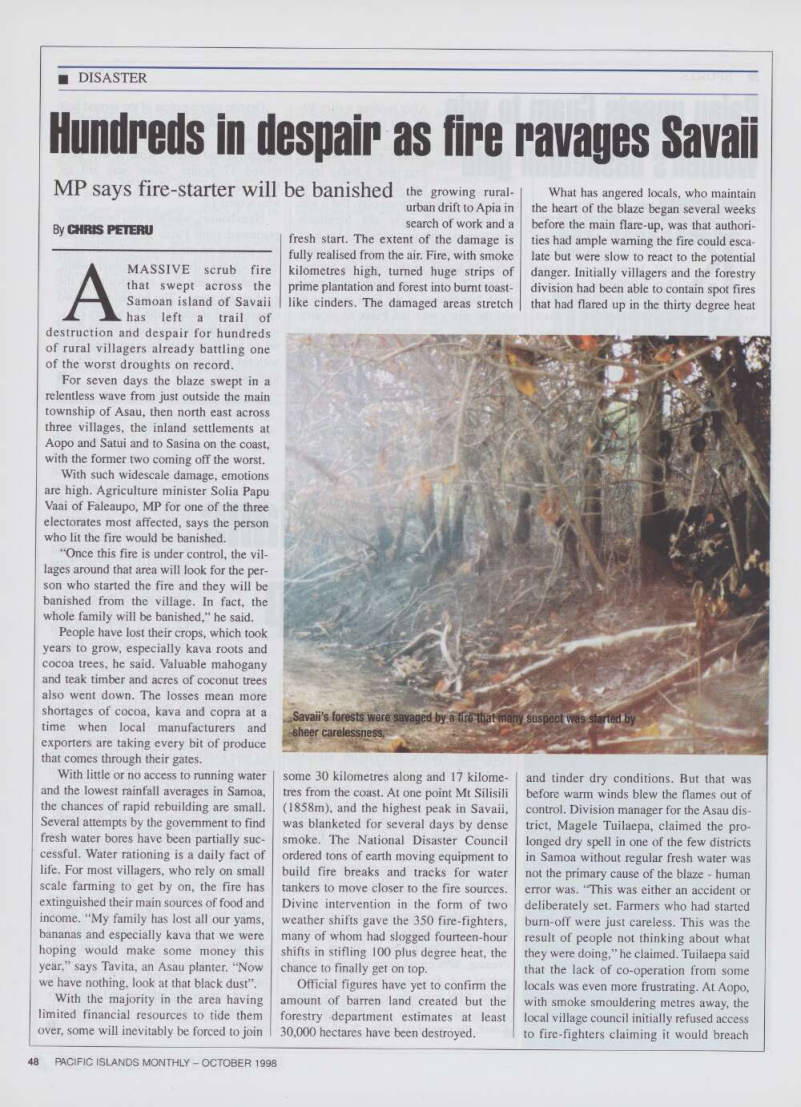
prime plantation and forest into burnt toast like cinders. The damaged areas stretch
some 30 kilometres along and 17 kilome tres from the coast. At one point Mt Silisili (1858 m), and the highest peak in Savaii, was blanketed for several days by dense smoke. The National Disaster Council ordered tons of earth moving equipment to build fire breaks and tracks for water tankers to move closer to the fire sources.
Divine intervention in the form of two weather shifts gave the 350 fire-fighters, many of whom had slogged fourteen-hour shifts in stifling 100 plus degree heat, the chance to finally get on top.
Official figures have yet to confirm the amount of barren land created but the forestry department estimates at least 30,000 hectares have been destroyed.
What has angered locals, who maintain the heart of the blaze began several weeks before the main flare-up, was that authori ties had ample warning the fire could esca late but were slow to react to the potential
danger. Initially villagers and the forestry
division had been able to contain spot fires that had flared up in the thirty degree heat
and tinder dry conditions. But that was before warm winds blew the flames out of control. Division manager for the Asau dis trict, Magele Tuilaepa, claimed the pro longed dry spell in one of the few districts in Samoa without regular fresh water was not the primary cause of the blaze - human error was. “This was either an accident or deliberately set. Farmers who had started burn-off were just careless. This was the result of people not thinking about what they were doing,” he claimed. Tuilaepa said that the lack of co-operation from some locals was even more frustrating. At Aopo, with smoke smouldering metres away, the local village council initially refused access to fire-fighters claiming it would breach
Savaii’s forests were savaged by a fire that many suspect was started by sheer carelessness.
customary land rights. The blaze also
highlighted some shortcomings with
emergency services. Besides fire fight ing equipment held at the forestry divi sion stores in Asau, Savaii has no full time fire brigade. This meant fire fight ers, volunteers, and vehicles from the capital had to make a high-speed 60 kilometre dash on the inter-island ferry, leaving the main urban centre unprotect ed.“We were up against that idea from the start. Fighting long range fires is a lot different to trying to put out a grocery store, and we (are) really short on expe rience in this type of situation,” said an exhausted volunteer. Logistics made the
job tougher. To safeguard the sparse
water supply, tanker trucks had to travel more than 10 kilometres to the sea for water, then head back along rough inland tracks - a round trip of two hours.
Before they arrived, a fleet of pick-up trucks with forty-four gallon containers shuttled back and forth. A huge shortage of hose reel meant almost anything able to carry water, from teapots to knapsack sprayers were pressed into service.
Environmentalist Peter Brown says the spread of the fire was encouraged by the slash-and-bum method of forest clearance for crops or logging by remov ing the canopy that allows for moisture on the forest floor. Deputy Prime minis ter Tuilaepa Malielegaoi says village councils should impose heavy fines on those who light uncontrolled fires during the dry season to clear ground for plant ing. Commander Falaula Manu, the head of the Apia fire service, has called for permanent full-time staff and facilities to be set up in Savaii. He pointed out that the forestry services had equipment to fight fires, but lacked the necessary expertise and personnel to get the job done, meaning thousands of dollars in overseas equipment left gathering cob webs.
“This is a problem, big fires are hap pening more and more often, but they don’t know how to use that equipment they have. It’s not their fault. I mean you don’t send a plumber to fix your car, do you?” The Savaii inferno recalled a huge fire in the same area in 1983 that took years to recover from. Whether there will be a comeback now is a question being considered by scores of families living in one of Samoa’s harshest environ ments. ■