conies together
pp. 17-21 · Read in the full issue


Advertising Feature-Tourism
South Pacific travel conies together
IN the lead-up to the turn of the century, tourism looks set to be one of the biggest growth areas for the countries of the South Pacific.
Because the International Dateline cuts through the middle of the Pacific Ocean, the first day of the new millennium will dawn and close in the areas around it.
In anticipation of this there is an increased interest by airline and tour oper ators in the region and this looks set to pro vide a huge boost for the ailing economies of the Pacific.
To help keep the interest up, 13 South Pacific travel destinations represented by the Tourism Council of the South Pacific (TCSP) are about to increase their Internet presence by signing of an agreement with
Australasia’s leading travel publishing
company, Jason Publishing Co Ltd (Jasons).
TCSP has agreed to amalgamate its existing web site SPICE with Jasons’
South Pacific Islands Travel Channel, launched late September.
South Pacific Islands Travel Channel is part of Jasons award-winning and highly acclaimed Travel Channels project on the internet’s world wide web. (Australia Travel Channel (www.au travel.com.au) and New Zealand Travel Channel (www.nz-travel.co.nz)are the other two parts of Jasons’ Travel Channels
project.)
New Zealand Travel Channel was launched in June 1996. Traffic for July 1998 for that site was 1,788,653 hits with 803,792 pageviews and 35768 user ses sions in excess of 2 minutes.
“This is a significant website traffic and is just an example of the great potential for enhancing our tourism marketing profile
through the relationship we now have with Jasons” said Mr. Levani Tuinabua, Chief Executive of TCSP.
The new channel will feature the offi cial web sites of all TCSP member coun tries, as well as industry web pages, Jasons managing director John Sandford said.
Future developments will also include
other travel-related publications.
The tourism destinations that currently make up TCSP country members are American Samoa, Cook Islands, Fiji, Kiribati, New Caledonia, Niue, Papua New Guinea, Samoa, Solomon Islands, Tahiti, Tonga, Tuvalu and Vanuatu.
“This is an exciting development for
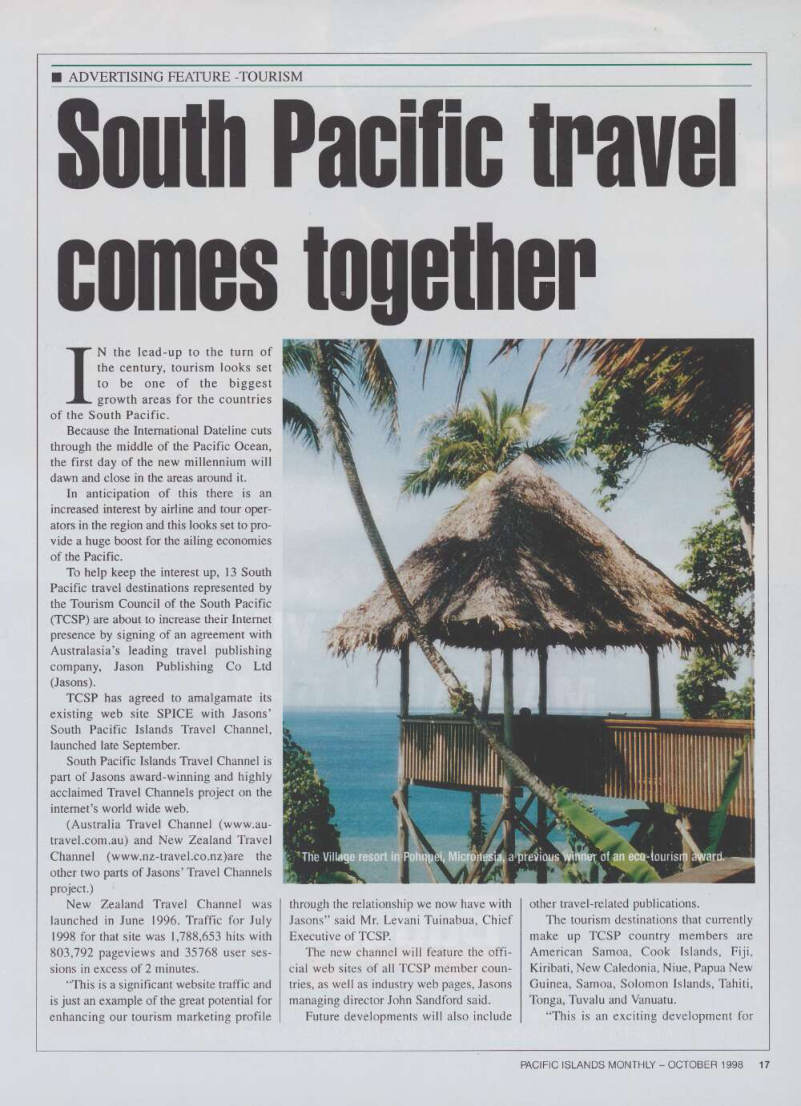
The Village resort in Pohnpei, Micronesia, a previous dinner of an eco-tourism ward.
TCSP,” said Mr. Tuinabua.
“The ability to be linked with Jasons will dramatically increase our presence on the Internet, as well as lift our overall stan dards of presentation”.
Jasons has been a specialist tourism and travel publisher for over 30 years and cur rently operates in New Zealand, Australia, New Caledonia, Niue and the Cook Islands.
Founded in the early 1980 s as an infor mal association of national tourism organisations in the region, the Tourism Council of the South Pacific (TCSP) is now a regional intergov ernmental organisation with a permanent Secretariat based in Suva, Fiji. Its funda mental objective is to foster regional co operation in the development of tourism in the island nations of the Pacific.
There were concerns about the future of TCSP projects but these were alleviated after the recent Post-Forum Dialogue Partners Session, when a significant amount of money was promised to the council.
In a significant move announced mid- September, an Australian airline wants to start a new service between Sydney and Nadi next month.
Ansett Australia expects to increase Australian visitors to Fiji by four per cent once it commences services in November -
subject to regulatory approval.
Ansett has formally applied to the International Air Services Commission in Australia for an allocation of capacity to operate two weekly services between the two cities - one a Boeing 767-200 on Saturdays and the other an Airbus 320 on Tuesdays.
The airline’s business development director Kit Naidu said Ansett firmly believed that the Pacific would be one of the most exciting growth areas of air travel in the new millennium.
Fiji’s minister for tourism Mr David Pickering says the announcement was the biggest boost to the tourism industry in 25 years.
In another development, the general manager operations for P & O Holidays, Captain Steve Hunt, said the Pacific region should expect an influx of cruise vessels dur to the increase in interest in Pacific waters.
Captain Hunt said some of the vessels the Pacific could expect include Royal Caribbean Cruise Lines ‘The Legend of the Seas’, Holland America’s ‘Nieuw Amsterdam’, and Carnival Corporation’s ‘Royal Viking Sun’.
“As in the airline industry,” he said, “economies of scale play a part and greater volume results in a reduction in costs, hence a reduction in fares. At one time
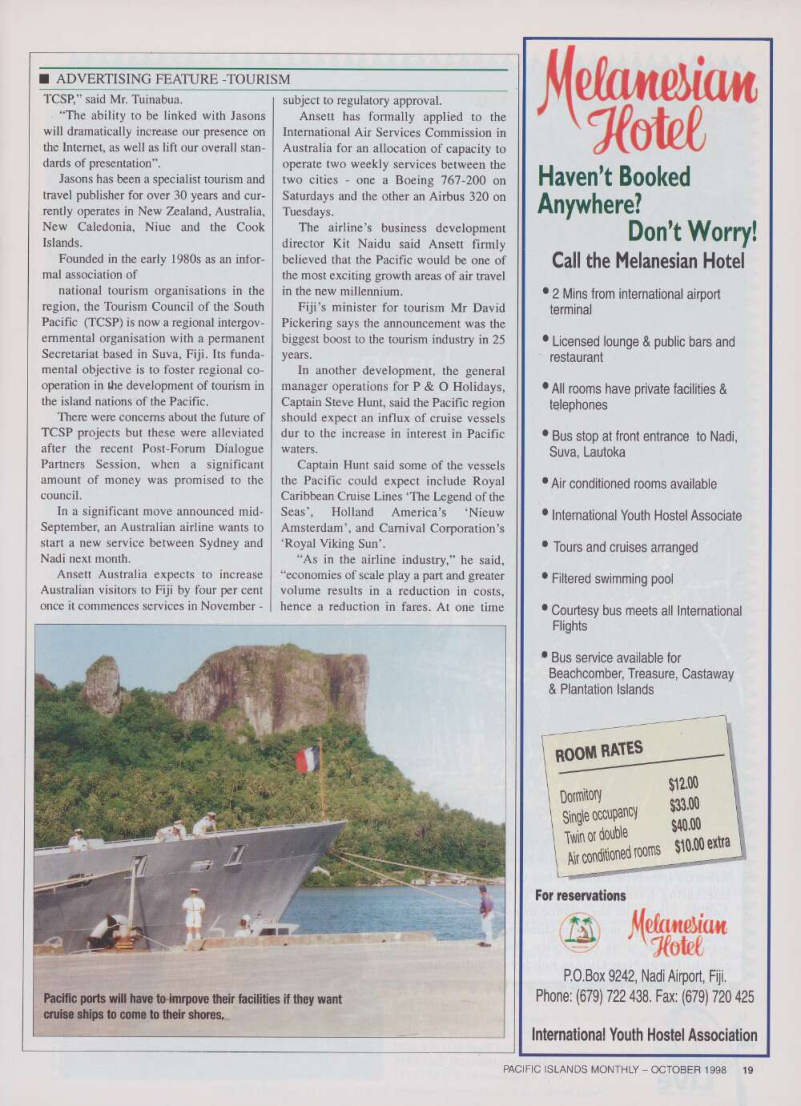
Pacific ports will have to imrpove their facilities if they want cruise ships to come to their shores.
cruising was considered to be a holiday for the rich only but these days the range of cruise products means that anybody can cruise virtually anywhere”.
Captain Hunt said with the current weakness of the Asian and Australasian currencies against the US Dollar and the major European currencies, a holiday in this region was very affordable to the peo ple who come from those areas. conversely, he said, the weakness of the Australian dollar makes an overseas holi day relatively expensive for Australians and New Zealanders so a South Pacific cruise was a good option as it could be paid for at home and was all inclusive except for onboard expenditure and shore excur sions.
At the moment, the cruise industry in the South Pacific represents only about two per cetn of cruising world-wide.
Captain Hunt said there was still a long way to go before the Pacific became a threat to already established cruising grounds. he said one aspect of South Pacific tourism which had to be looked into was cutting red (ape and bureaucracy.
"We need to try harder in this region
because of the additional costs of distance, marketing effort and regulation, which are detrimental in attracting new business to the area,” he said.
He said unless the Pacific concentrates now on the fundamentals of creating the right environment, “we may always be a ‘backwater’ which would be a pity as we have a lot to offer down here”.
Meanwhile, with regard to a different type of environment, Mr Alf Simpson, the director of SOPAC, said sound manage ment (including regulation) of tourism development was vital, in order to min imise the impact of the industry and avoid some of the conflicts that have occurred with mining, forestry or agricultural sec tors.
“For the most part in the Pacific Island countries, almost all tourists come from overseas. The rapidly developing tourist industry is bringing increased numbers of people and demands for a developed infrastructure, which in turn place demands on the environment. This in turn leads to unsustainable development by increased demands for land for develop ment; aggregates for construction of build ings and roads; freshwater; energy; and
acceptable solid and liquid waste disposal to minimize pollution.
“Fortunately, tourism is in its infancy in many Pacific Island countries and the opportunity for preventative rather than curative strategies exists,” he said.
Mr Simpson said there was a growing importance placed by Pacific island coun tries on the potential of the tourist industry to contribute to their national economies.
However, he said, the threats of the tourism industry through human interven tion with the fragile island environments, particularly the coral reef and related envi ronments of the region were potentially huge. He cautioned that often, as with min ing, it was easy to see how these threats may be overlooked in the light of the
potential income.
“There is therefore, an urgent need to initiate appropriate baseline data collection programs to minimize the impacts of tourism development,” he said.
There is no doubt that tourism develop ment in the Pacific over the next few years is going to accelerate, and if trends towards sustainable developments continue, the industry looks set to prop up Pacific economies for a long time to come. ■
With the International Dateline running through the region, thousands are visitors are expected to witness the dawn of the new millennium.