predicted
pp. 14-15 · Read in the full issue
Tribal unrest predicted over Porgera gold mine
By Sam Vulum
THE Porgera gold mine, one of Papua New Guinea’s largest gold deposits, has again come under threat over its handling of envi ronmental concerns of the landowners.
Serious allegations have again been lev elled against Porgera Joint Venture, the developer of the mine, regarding the dump ing of waste into the Strickland river.
On September 3, the local MP, Opis Papo claimed in parliament that Porgera Joint Venture was disposing an increased volume of mine tailings, without proper government approval, into the Porgera river.
He said the problem was serious and could lead to tribal unrest if nothing was done to address the problem.
Papo also said PJV has failed to fully comply with government direction that it pay K 15.2 million as compensation to the landowners of Porgera river area who were affected by the deposition of the tailings.
All this was in a set of questions that he directed to Environment and Conservation Minister Herowa Agiwa. Agiwa said he was aware of the increasing volume of mine waste being dumped into the river system, adding that the water permit was already issued by the government and there was also a dispute on the matter that is before the court.
He said he was waiting for the outcome of the court and whatever the court direct-
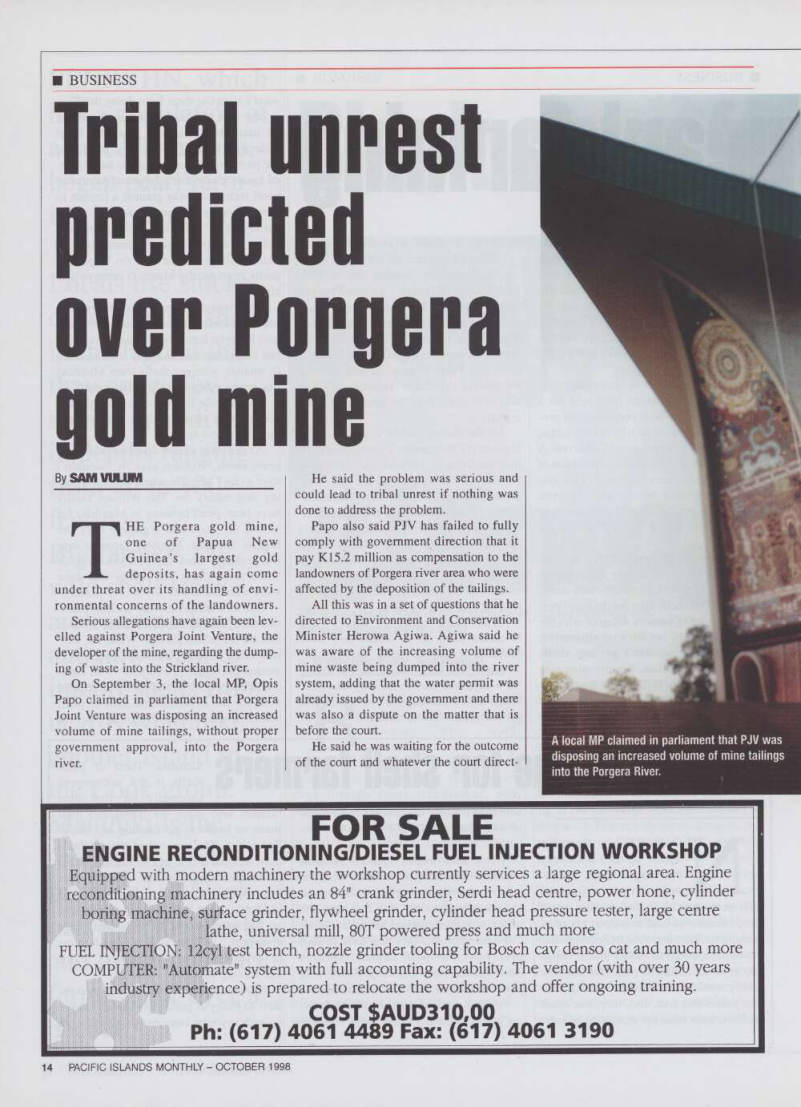
A local MP claimed in parliament that PJV was disposing an increased volume of mine tailings into the Porgera River.
ed them to do, would have to be done. PJV did not respond immediately, how ever it had earlier main tained that the mine did not have a significant impact on people or the environ ment.
This was based on the find
ings of an independent
review by the Commonwealth Scientific and Industrial Research
Organisation, an
Australian-based research organisation with a reputa tion for integrity and scien tific excellence. The testing of motor nerve develop ment showed no clinical or
epidemiological evidence
of heavy metal effects on children or adults. As a fur ther safeguard, the PJV has installed water tanks in vil lages along the Strickland river to improve the avail ability and quality of drink
ing water.
The review concluded that the potential for acid condi tions, in the Lagaip and Strickland rivers, is extremely low and hence the potential risk of metal impacts is also low.
The PJV collects signifi cantly more monitoring data than required by gov ernment to allow for early detection for mine-derived
impacts.
This data includes: - metal levels in fish to assess potential health effects; - research into natural mer
cury levels at Lake Murray to determine if PJV activities will have any long term effects.
The review concluded that the PJV has been in compliance since the project start-up; sampling and analysis tech niques used for the monitoring pro gramme are appropriate; predictions made in the environmental plan about the impact of reverine disposal on the upper river system have proved to be reason
ably accurate.
PJV has also stated earlier that it will improve its monitoring programme. ■