Black days fo[?] pearl farming
pp. 12-13 · Read in the full issue
Business
By Florence Syme-Buchanan
BEHIND the mystique of pearls are island families who work
incredibly hard and long
on their tiny atolls to produce these gems - but one third of their effort pays foreign pearl technicians, and now some farmers are crying “unfair.”
The tiny atolls of Penryhn nestle in the second biggest lagoon in the Southern Hemisphere, and pearl farmers there believe this massive natural feature is the key to producing the best black pearls in the world. But four years after the island launched into pearl farming, some farmers are experiencing the same problems as their relatives in nearby Manihiki. The prob lems, they say, have been caused by greedy farmers, whose crafty behaviour has result ed in a payment system that’s disadvan taged everyone and broken the very by
laws set up to stop foreigners farming in their vast lagoon. Through a lucrative pay ment system, foreign pearl technicians are ending up owning more pearl shells than indigenous Penryhn islanders, and many aren’t happy about this. Penryhn islanders are limited to 5,000 pearl shells each.
Another island by-law restricts pearl farm ing in the 130 square kilometre lagoon to people of Penryhn descent. Despite the bylaws, about four technicians originally from Japan, have accumulated pearl shells well over the limit and have set up thriving farms. Minister of Marine Resources Tepure Tapaitau admits the foreign techni cians are technically farming without licenses and a problem situation exists. But he, the Pearl Federation and concerned pearl farmers are stumped how best to resolve the problem. That’s because farm ers and authorities are in a catch-22 situa tion. The foreign technicians are needed to
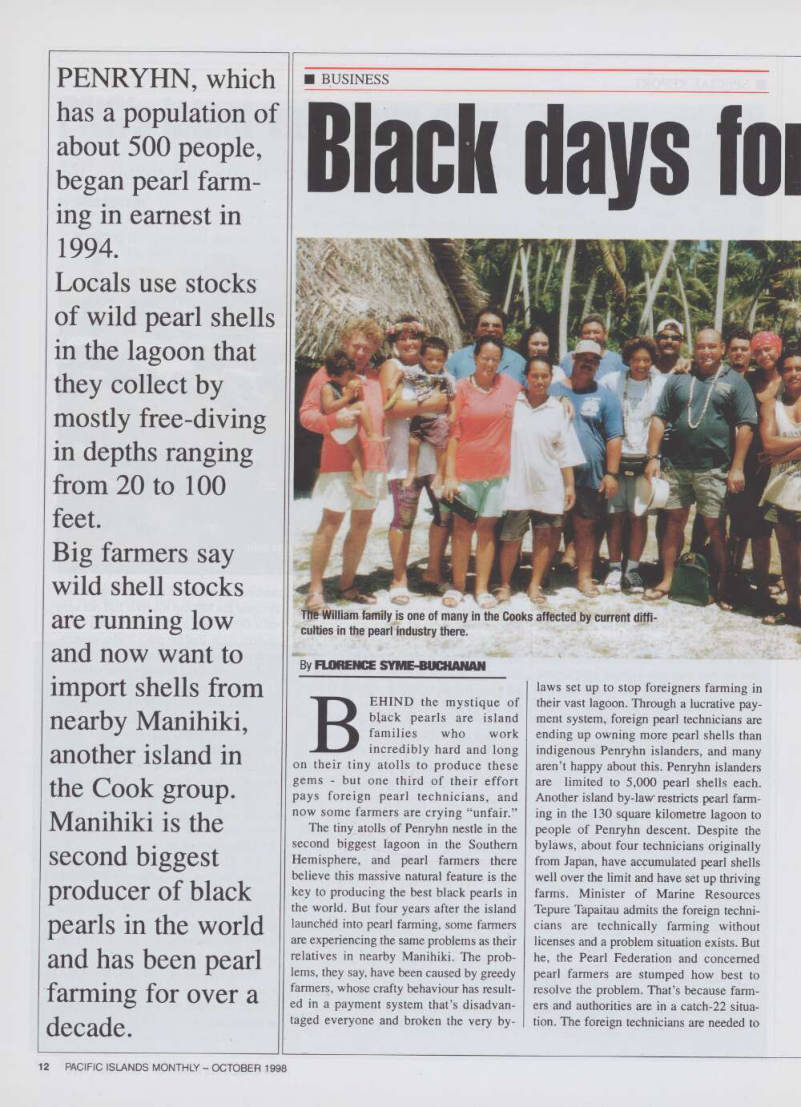
The William family is one of many in the Cooks affected by current diffi culties in the pearl industry there.
seed the pearl shells as just one local, John Lyons, is fully qualified. About six other locals are trainee technicians and farmers are reluctant to use them because mistakes are costly. No one sees a way around the problem, caused mostly by some dishonest farmers who made the original percentage of harvest payment too risky for techni cians to accept anymore.
Technicians are now demanding one shell out of every three they seed for a farmer. It used to be a percentage of pro ceeds, or harvested pearls, which some times runs up to 60 per cent of a harvest. A technician used to be paid one pearl out of every three that were harvested. That sys tem went out over the reef when Penryhn farmers began stealing their own pearls so they wouldn’t have to share them with the technicians.
Big time pearl farmer Peter William says technicians are seeding up to 30,000 shells at a time and, from this, earn them selves 10,000 shells after the delicate oper ations. “A lot of farmers disagree with the payment system, but have no alternative, otherwise they wouldn’t get any shells seeded,” says William. But the other side of the coin, says William, is that a few technicians have been burnt by dishonest farmers, “So their trust has gone - they pre
fer to have payment in (seeded) shells.”
“What’s happened, says William, is that we’ve condoned farming by a non- Manihikian Islander, a non-Penryhn islander, and that leaves a bad taste in my mouth.” Marine Resources minister Tepure
Tapaitau is talking about standardising
rates, but says this would need pressure from the Pearl Federation and farmers themselves to enforce. Tapaitau says he’s told technicians that “the farmers are miss ing out.
It’s the farmers’ shells, it’s the farmer’s lagoon, it’s the farmer’s accommodation they are living in. Let’s be fair.” The min ister says Penryhn farmers are in a “des perate position.” Tapaitau says “technical ly” the foreign technicians are bigger farm ers than the Penryhn islanders and this isn’t conducive to growing the industry for the islanders. Pearl Federation member and farmer Glenice Lyons says technicians get an allotted area for their shells, then pay a local to look after the farm.
“The point really is other Cook Islanders can’t do it, unless they have Manihiki or Penryhn blood,” says Lyons.
She says Cook Islanders must be asking “if a Japanese can do it, why can’t I?”
Lyons says eventually the technicians will get companies behind them and “move in,
what’s stopping them from doing that?”
She says another payment method must be used, but is unsure what the Pearl Federation is doing, if anything, to address the problem. Minister Tapaitau has disput ed Lyons’ claim that a Japanese/Australian pearl technician was granted a license to farm pearls by the Penryhn island council.
He says it is “not true.” Another problem being faced by big time farmers such as Peter William is the ban on importing shells from nearby Manihiki or anywhere else.
The island council has fears that imported shells will bring disease. William says Penryhn lagoon’s wild shell stocks are fast being depleted and they want to bring in smaller, younger shells from Manihiki that produce better quality black pearls.
The Marine Resources hatchery can’t keep up with the demand the William fam ily has for new stock.
As for talk about diseased Manihiki pearl shells, William says he “wouldn’t have a clue” what the island council is bas ing that theory on. The William family have been pearl farming in Manihiki for almost 20 years and regularly have the biggest harvests. Minister Tapaitau says it’s probably time the Penryhn limit of 5,000 pearl shells per farmer was done away with.
But he wants to discuss shell importa tion with pearl farmers in French Polynesia first before lifting the ban. While the min ister talks, the pearl farms of foreign tech nicians get bigger in Penryhn - with farm ers virtually held to ransom by the critical need for the expertise and skill of pearl seeders from outside the huge lagoon. ■