with the ship?
Editorial
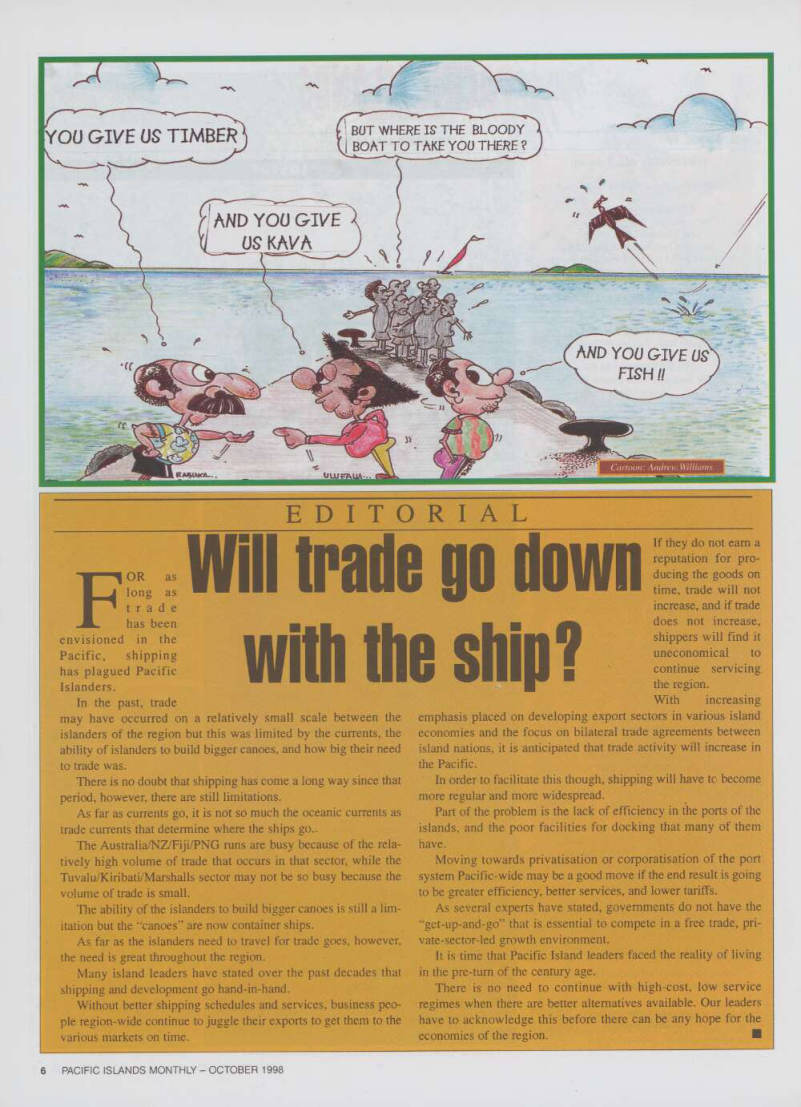
Will trade go down with the ship?
FOR as
long as trade has been envisioned in the
Pacific, shipping
has plagued Pacific Islanders.
In the past, trade
may have occurred on a relatively small scale between the islanders of the region but this was limited by the currents, the ability of islanders to build bigger canoes, and how big their need to trade was.
There is no doubt that shipping has come a long way since that period, however, there are still limitations.
As far as currents go, it is not so much the oceanic currents as trade currents that determine where the ships go..
The Australia/NZ/Fiji/PNG runs are busy because of the rela tively high volume of trade that occurs in that sector, while the Tuvalu/Kiribati/Marshalls sector may not be so busy because the volume of trade is small.
The ability of the islanders to build bigger canoes is still a lim itation but the “canoes” are now container ships.
As far as the islanders need to travel for trade goes, however, the need is great throughout the region.
Many island leaders have stated over the past decades that shipping and development go hand-in-hand.
Without better shipping schedules and services, business peo ple region-wide continue to juggle their exports to get them to the various markets on time.
If they do not earn a reputation for pro ducing the goods on time, trade will not increase, and if trade does not increase, shippers will find it uneconomical to continue servicing the region.
With increasing
emphasis placed on developing export sectors in various island economies and the focus on bilateral trade agreements between island nations, it is anticipated that trade activity will increase in the Pacific.
In order to facilitate this though, shipping will have tc become more regular and more widespread.
Part of the problem is the lack of efficiency in the ports of the islands, and the poor facilities for docking that many of them have.
Moving towards privatisation or corporatisation of the port system Pacific-wide may be a good move if the end result is going to be greater efficiency, better services, and lower tariffs.
As several experts have stated, governments do not have the “get-up-and-go” that is essential to compete in a free trade, pri vate-sector-led growth environment.
It is time that Pacific Island leaders faced the reality of living in the pre-turn of the century age.
There is no need to continue with high-cost, low service regimes when there are better alternatives available. Our leaders have to acknowledge this before there can be any hope for the economies of the region. ■