a heavy anti-corruption campaign
pp. 28-29 · Read in the full issue
Election
No Change in Vanuatu parliament despite a heavy anti-corruption campaign
By Patrick Decloitre
Although there were per ceived high hopes from a new breed of politi cians to challenge Vanuatu’s old guard of politicians at
March 6 general elections, no signifi cant change occurred as a result of the poll. Put off by corrupt party politics, more independent candidates than ever were contesting Vanuatu’s general elections.
They wanted to challenge the old guard of politicians who have since the last poll in November 1995 come under heavy attack by this island state’s ombudsman, Marie-Noelle Patterson. The general elec tions were triggered last November 27 by Vanuatu President Jean-Marie Leye, who dissolved a 50-seat, corruption-tainted parliament.
His move was first challenged by MPs who wanted a motion against Prime Minister Serge Vohor debated in parlia ment, but a Court of Appeal confirmed the presidential dissolution on January 9.
Three days later, there was a riot in Port Vila, which Justice Minister Walter Lini later said was manipulated by the angry MPs.
A four-week state of emergency, giving
police and paramilitary Vanuatu Mobile Force (YMF) extended powers, entailed to restore order.
But the root of the unrest had started from yet another corruption case - the peo ple’s discontent at politicians tampering with their National Provident Fund (VNPF). An ombudsman report last December accused top leaders, including Vohor and his predecessor Maxime Carlot of using the compulsory retirement scheme’s money to grant themselves loans and buy private houses. The old guard of politicians however still runs for these fresh polls, including Vanuatu’s only four once-prime ministers - Vohor, Carlot, out going opposition leader Donald Kalpokas and first prime minister and independence father Walter Lini.
They campaign on usual themes; better health, better education, development.
During an electoral campaign that was shortened by the state of emergency, hard hitting French-bom ombudsman Patterson
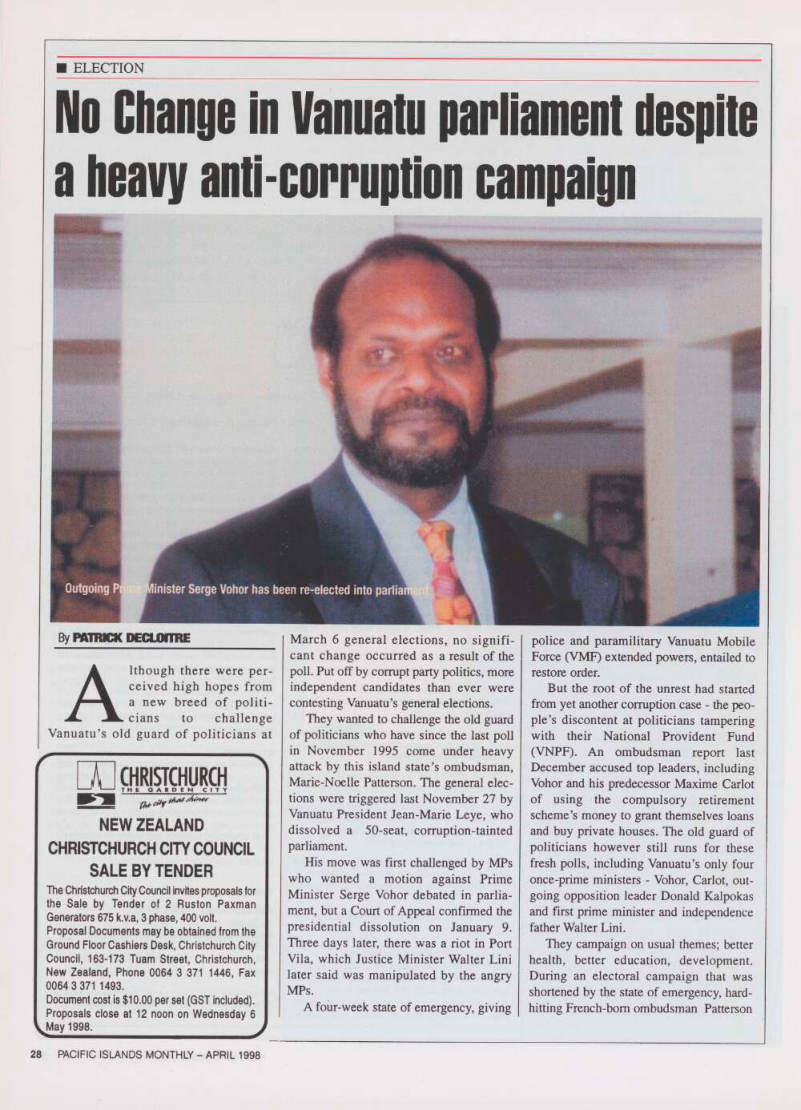
Outgoing Prime Serge Vohor has been re-elected into Parliament
dramatically increased the publishing pace of her reports.
Since January, she not only publicly accused Vohor, but also his predecessor Carlot and many of his cabinet ministers of corruption in scandals ranging from the sale of Vanuatu passports to Asians, to cyclone relief foreign aid misused for per sonal use, or an alleged case of rape by Vohor’s telecommunications minister in office premises.
“I think the message is getting across gradually,” Patterson said. “People now realise that it’s up to them to choose who they want as leaders for their country, and who they don’t want”.
The number of candidates (220) at last month’s elections was a record, so was the number of independent ones (over 60), including new, educated and young politi cians who wanted things to change.
Their campaign themes were more
along anti-corruption lines and outspoken
support for Patterson’s reports. But they, unlike the senior ones, didn’t necessarily have the same campaigning logistics, including the not-so-regular ones. To ensure a smooth running of elections, a ban was declared on liquor sale. To top it all, two Commonwealth observers stayed in
Vanuatu during elec tion week to ensure respect of democratic principles at this island state’s crucial time.
But the change was not around the comer unofficial results gave 18 seats to Kalpokas’s Vanuaaku Pati; 12 to Vohor’s Union of Moderate Parties and 11 to Lini’s National United Party. Even if the proportions slight ly differed, the main parties were still poised to lead the 52seat house and form yet another coalition
government. Only
three independents
seem to have got
through. Among
prominent leaders, Vohor, Carlot and Lini, and a number of for mer ministers, were re elected in their con
stituencies. After two years of bitter, tit-to tat rivalry that caused a spell of instability in this island state, Vohor’s foe, Carlot split from UMP last January to form his own Republican party. Official results were not announced when this edition went to press but this was expected to be done amidst allegations by the electoral office of double voting, either with proxies or electoral cards duplicates.
The electoral commission did not rule out a possibility of voiding the results on some constituencies, especially in Vanuatu’s only two towns - the capital Port Vila and Luganville, 250 kilometres (155 miles) north and run by-elections.
According to Vanuatu’s constitution, com plaints have to be lodged in the Supreme Court within 21 days after official results naming the 52 members in Vanuatu’s par liament are proclaimed.
“There was a lot of confusion in the polling officers reports. For instance, their total numbers on the turnout differed from ours. So we have asked some officers to come to our office and explain,” Principal Electoral Officer Jeanette Bolenga said.
But we will count and proclaim (the results), whatever these ballot boxes con tain”. ■
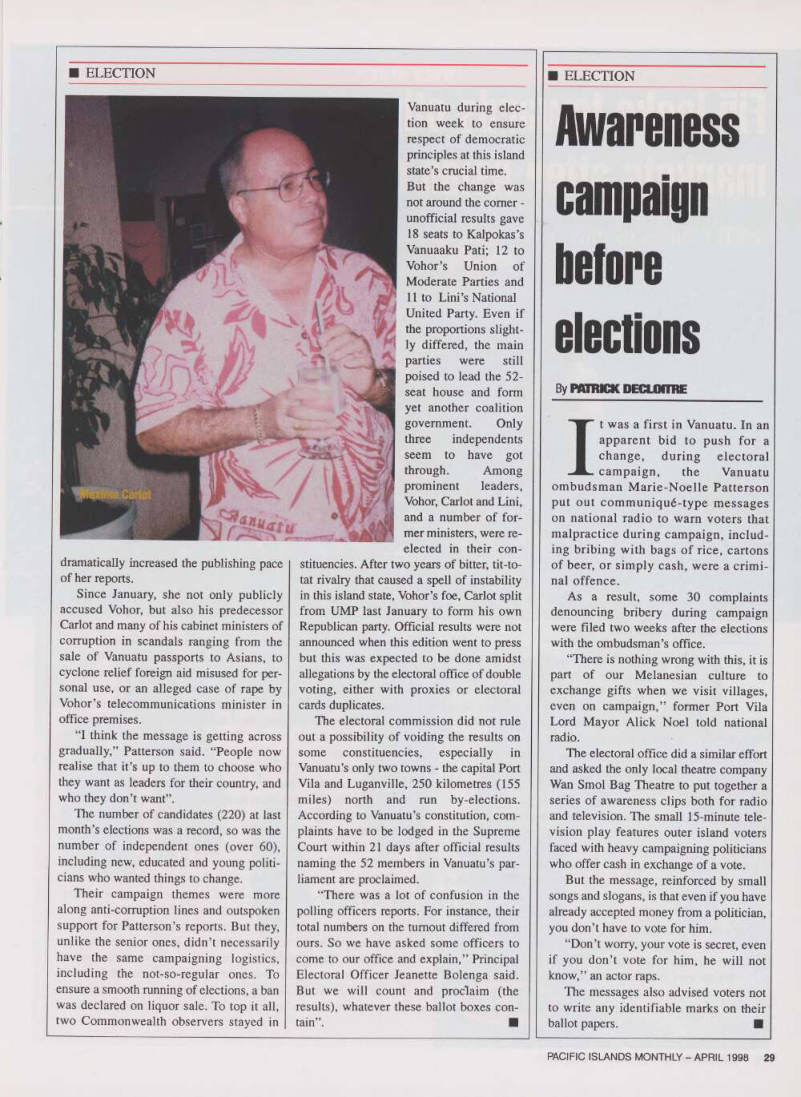
Maxime Carlot