protests gather momentum
pp. 40-41 · Read in the full issue
Governance
Pressure mounts as Samua protests gather momentum
By Chris Peteru
PROTEST Movements
come and go. But the series of anti-government
demonstrations regularly
taking place in Samoa’s capital Apia shows few signs of wilting in the face of mounting pressure.
Led by the chiefly group Tumua, Pule and Aiga, they want the Prime Minister, Tofilau Eti Alesana and his ruling Human Rights Protection Party to step down after continued allegations of corruption and financial mismanagement. Their other grievances include: * The failure of Deputy PM and Finance Minister Tuilaepa Malielegaoi to
table audited treasury for the past eight years. * The changing of the Constitution to allow the dismissal of the Chief Auditor. * Illegal passport sales to Chinese nationals involving senior government officials. * The cost of living.
“We are quite prepared to keep our protests going until kingdom come. The people have lost confidence in this govern ment. The people are suffering,” says TPA leader Faamatuainu Talamailei after he again led hundreds of demonstrators on the three kilometre march from the outskirts of Apia last month. “I think the Government has to understand that the days of people suffering while they eat our
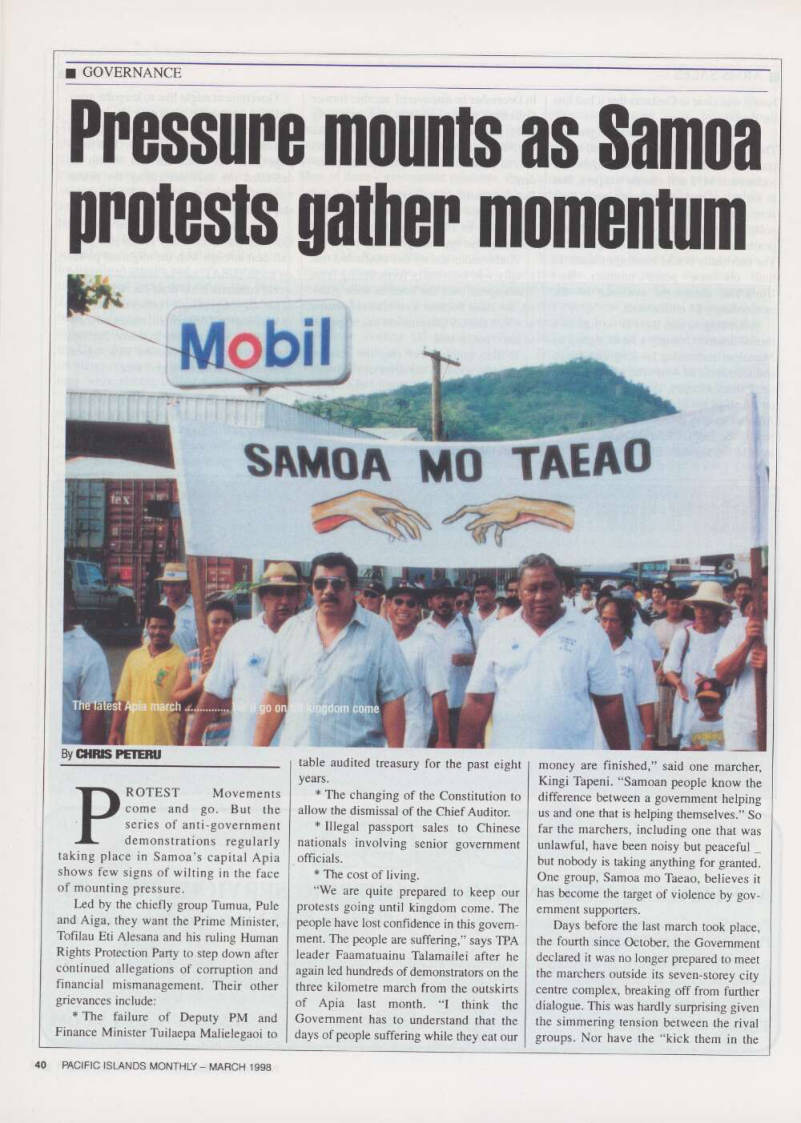
money are finished,” said one marcher, Kingi Tapeni. “Samoan people know the difference between a government helping us and one that is helping themselves.” So far the marchers, including one that was unlawful, have been noisy but peaceful but nobody is taking anything for granted.
One group, Samoa mo Taeao, believes it has become the target of violence by gov ernment supporters.
Days before the last march took place, the fourth since October, the Government declared it was no longer prepared to meet the marchers outside its seven-storey city centre complex, breaking off from further dialogue. This was hardly surprising given the simmering tension between the rival groups. Nor have the “kick them in the
The latest Apia march... Well go on [?] kingdom come
head” type tactics gained public support.
The Prime Minister has said that the demonstrators are often unemployed and make up less than one per cent of the pop ulation.
“They can have their marches but they are getting nowhere, and I don’t think any thing more needs to be said. It is all becom ing quite ridiculous,” said Malielegaoi.
Amnesty International, which has mon itored the activity, disagrees calling the Government’s January refusal to issue a permit for a TPA march “weird” and point ing to Samoan constitutional rights to peaceful assembly. The Government explained it was concerned about the potential for violence. From the outset, the
Government’s key ploy to sustain public
credibility has been to focus on economic growth (6 per cent) plus other develop ments while constantly labelling the TPA the political loony tune of failed MPs urged on the media, the church and opposi tion leader Tupua Tamasese. A royal blue blood but a political lightweight after los ing the last four elections, Tamasese and his eight-member Samoa National Development Party have borne the brunt of government anger over the issue in Parliament.
His support for the TPA leadership is seen as an attempt to score points by the back door. This could even be the case. For while both the SNDP and Tumua, Pule and Aiga say they are different entities, his par ticipation as an individual in all of the
protests has led the Prime Minister to claim that Tamasese is the brains behind the whole movement. “You are their leader, you are the one responsible for this,” Prime Minister Alesana told the House for the umpteenth time recently.
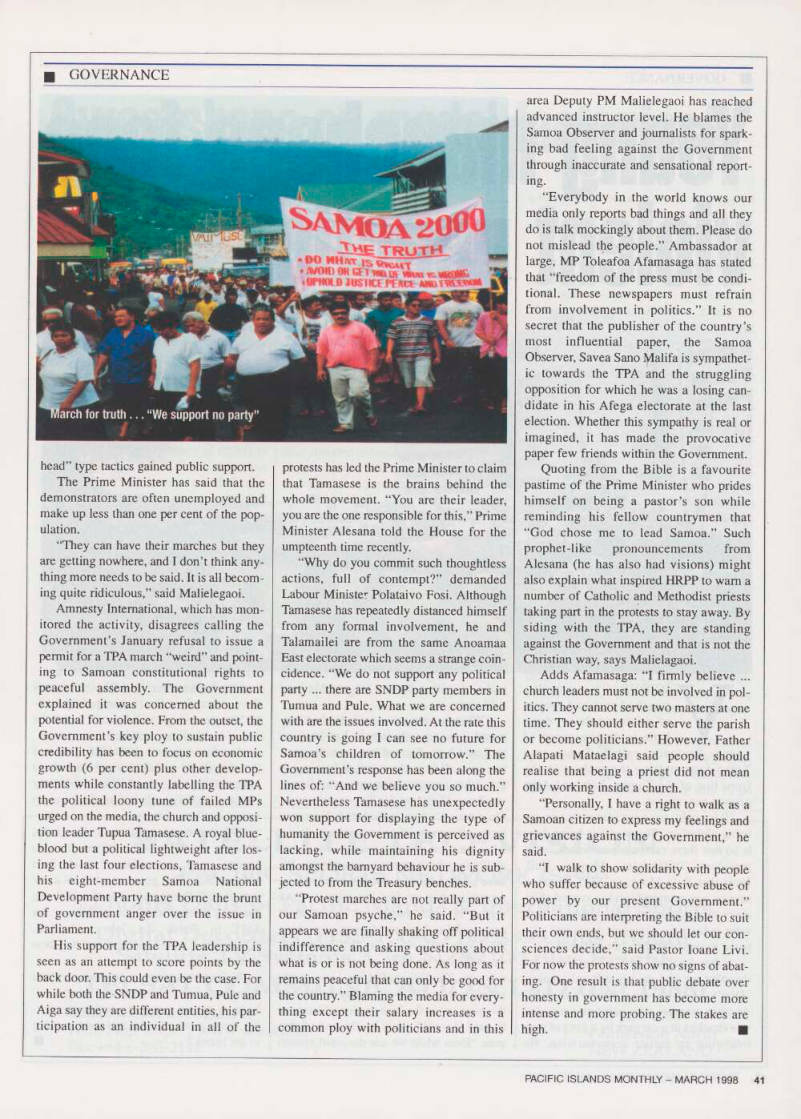
“Why do you commit such thoughtless actions, full of contempt?” demanded Labour Minister Polataivo Fosi. Although Tamasese has repeatedly distanced himself from any formal involvement, he and Talamailei are from the same Anoamaa East electorate which seems a strange coin cidence. “We do not support any political party ... there are SNDP party members in Tumua and Pule. What we are concerned with are the issues involved. At the rate this country is going I can see no future for Samoa’s children of tomorrow.” The Government’s response has been along the lines of: “And we believe you so much.”
Nevertheless Tamasese has unexpectedly won support for displaying the type of humanity the Government is perceived as
lacking, while maintaining his dignity
amongst the barnyard behaviour he is sub jected to from the Treasury benches.
“Protest marches are not really part of our Samoan psyche,” he said. “But it appears we are finally shaking off political indifference and asking questions about what is or is not being done. As long as it remains peaceful that can only be good for the country.” Blaming the media for every thing except their salary increases is a common ploy with politicians and in this
area Deputy PM Malielegaoi has reached advanced instructor level. He blames the Samoa Observer and journalists for spark
ing bad feeling against the Government
through inaccurate and sensational report
ing.
“Everybody in the world knows our media only reports bad things and all they do is talk mockingly about them. Please do not mislead the people.” Ambassador at large, MP Toleafoa Afamasaga has stated that “freedom of the press must be condi tional. These newspapers must refrain from involvement in politics.” It is no secret that the publisher of the country’s most influential paper, the Samoa Observer, Savea Sano lyialifa is sympathet ic towards the TPA and the struggling opposition for which he was a losing can didate in his Afega electorate at the last election. Whether this sympathy is real or imagined, it has made the provocative paper few friends within the Government.
Quoting from the Bible is a favourite pastime of the Prime Minister who prides himself on being a pastor’s son while reminding his fellow countrymen that “God chose me to lead Samoa.” Such prophet-like pronouncements from Alesana (he has also had visions) might also explain what inspired HRPP to warn a number of Catholic and Methodist priests taking part in the protests to stay away. By siding with the TPA, they are standing against the Government and that is not the Christian way, says Malielagaoi.
Adds Afamasaga: “I firmly believe ... church leaders must not be involved in pol itics. They cannot serve two masters at one time. They should either serve the parish or become politicians.” However, Father Alapati Mataelagi said people should realise that being a priest did not mean only working inside a church.
“Personally, I have a right to walk as a Samoan citizen to express my feelings and grievances against the Government,” he said.
“I walk to show solidarity with people who suffer because of excessive abuse of power by our present Government.”
Politicians are interpreting the Bible to suit their own ends, but we should let our con sciences decide,” said Pastor loane Livi.
For now the protests show no signs of abat ing. One result is that public debate over honesty in government has become more intense and more probing. The stakes are high. ■
march for truth ... “We support no party”