How a country with no
pp. 37-39 · Read in the full issue
Arms Sales
How a country with no army spent $4m on arms
By Mary - Louise O' Callaghan
ARMA Jane Karaer was flattered but she was flustered too.
The newly appointed US Ambassador to Papua New Guinea, Solomon Islands and Vanuatu, had planned a suitably lavish reception for her inaugural trip to Honiara.
Floating candles and plucked tropical flowers drifted across the surface of the
swimming pool.
From the kitchen, the staff of Lelei, the town’s best restaurant, were issuing a stream of sumptuous finger-food. But the ambassador wasn’t staying. As she slipped away unexpectedly from her own recep tion to a dinner with the nation’s prime minister just a few of her distinguished guests knew the other reason for her trip to Honiara: Solomon Islands was about to sign off on a secret US$4 million arms deal
but first they needed the ambassador’s
approval. Those potentially destabilising
arms are now on their way to a nation that does not even have ari army. The first con signment - parts for an aircraft hangar left the port of Brisbane last month aboard the container ship. The Explorer, after
being inspected by Australian Customs
officials at Solomon Islands’ request.
The new government in Solomon Islands, disturbed by the potent effect such a shipment could have on the small South Pacific state and unsure how its tiny police force could even store the arms securely, has asked Australia for help in halting the delivery of the second and third consign ments before crates of Ml 6 machine guns, small arms, a quantity of ammunition and night vision equipment plus two Cessna aircraft reach its shores. It also wants its money back.
Commercial estimates put the ship ment’s real worth at US$7OO,OOO - US$l million, a quarter of what was eventually paid by the cash-strapped South Pacific state to US middlemen associated with the former prime minister and author of the deal, Solomon Mamaloni.
It was the change of governr ent in the Solomon Islands which prompted the change of view on the US$4 million deal.
The current prime minister, Mr Bart Ulufa’alu has described it as “warmonger ing”. It has also left Australia with a dilem ma that it did its best to avoid. When Karaer made her visit to Honiara last June, the region was still reeling from the shock of the Sandline mercenary affair in neigh bouring Papua New Guinea, where Karaer was resident. There Australia had moved quickly to defuse a potentially explosive situation, taking delivery in March, on behalf of the Sandline mercenaries and the PNG Government, of a huge shipment of arms, helicopter gunships, rockets and other hardware bound for riot-ridden Port
Moresby.
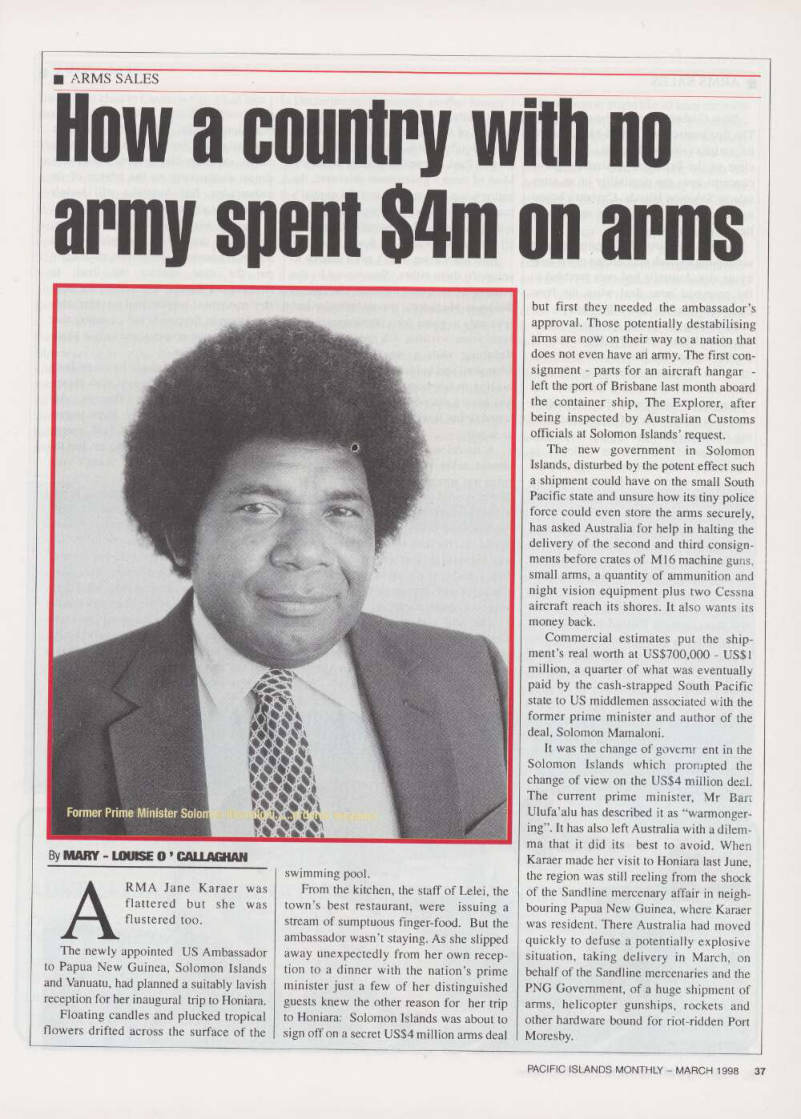
Former Prime Minister Solom[?]llo[?]i... prdered wea[?]s
Now Canberra was on the case again.
The first instructions, in mid-May, were to its embassy in Washington. In making clear to the Pentagon Australia’s grave concerns over the possibility of an arms sale to Solomon Islands, Canberra hoped to pre-empt the granting of any export licences for the weapons.
In fact the Howard Government was scrambling to catch up. Left out of the loop by its ally, Australia had only tumbled to the proposed arms deal when the New Zealanders let on that “the Yanks” had been asking a lot of questions about Solomon Islands recently. The failure of the US to forewarn Australia or even seek its views on such a development in what they were always telling Canberra was “your patch” did little to allay Australia’s unease at the prospect of more arms mak ing their way into the region. But initial soundings of US defence officials in Canberra in May were reassuring; they too appeared not to favour thedeal.
Now Ambassador Karaer had come to town to see for herself.
It was a tough call for the first time ambassador. Although a career diplomat for 30 years, apart from an early posting to Australia, Karaer’s working-life had been spent mostly on the other side of the world, in Africa, Europe, the Middle East and, most recently, Finland. Now, standing , in an archway just above her guests, the Ambassador made an enthusiastic if hasty speech, gushing over her long-desired appointment to the region.
Actually, I’ve wanted to be posted to this part of the world ever since I saw the movie South Pacific, the former journalist from St Paul, Minnesota told her audience.
Most of them - government ministers, the nation’s top bureaucrats and the capital’s business elite - looked nonplussed; bliss
fully ignorant of Hollywood’s all-singing,
all-dancing version of the South Seas.
And Ms Karaer didn’t get a chance to enlighten them either. Summoned by the country’s then prime minister, the elusive Solomon Mamaloni, the ambassador had time only to pause for a photo opportunity with some visiting US marines before departing with a wave, for a dinner Mamaloni had suddenly announced he was hosting in her honour. The short-notice had been a disaster for the Ambassador’s schedule but it was still about as flattering as it gets.
A notorious recluse, Mamaloni was almost never seen at official functions, often not appearing in his office for days.
The eccentric politician seemed to enjoy his reputation for keeping even the most high-ranking foreign visitors on tenter hooks. But the man who once snubbed for mer Australian foreign minister Gareth Evans, had now set out to woo Arma Jane; the Solomons’ eponymous prime minister was on a charm offensive.
The deal with the US arms supplier, Century Arms, had already been struck. All that was needed now was the green light for export from the US State Department.
A positive recommendation from
Ambassador Karaer was pivotal to Mamaloni’s plans. With little corporate knowledge of the small South Pacific nation, the State Department would rely almost exclusively on the advice of its ambassador. But Australia still hadn’t given up the chase.
During her June visit to Honiara, Australia’s then High Commissioner to Solomon Islands, Robert Flynn, once again put the case against the deal, to Ambassador Karaer. For a start, the mili tary equipment represented a remarkable escalation in firepower for a country that had got by with no army and only a hand ful of armed police.
And for a government lurching from one financial crisis to the next, such expen diture was madness. Besides, Mr Mamaloni and his coterie were unpre dictable, unfriendly; and had unsure tenure with an election coming up. But the one-time Fulbright scholar wasn’t con vinced.
Ambassador Karaer knew that Solomon Islands - whose westernmost islands almost touch Bougainville - had long been dealing with the fall-out from PNG’s secessionist crisis, mostly in the form of regular and aggressive border incursions by heavily armed PNG troops. Ms Karaer has said that each of the Solomon Islands government ministers involved had taken the time to meet with her individually, pressing a convincing case for the arms and the ammunition needed to protect the country’s vulnerable water border. By mid-
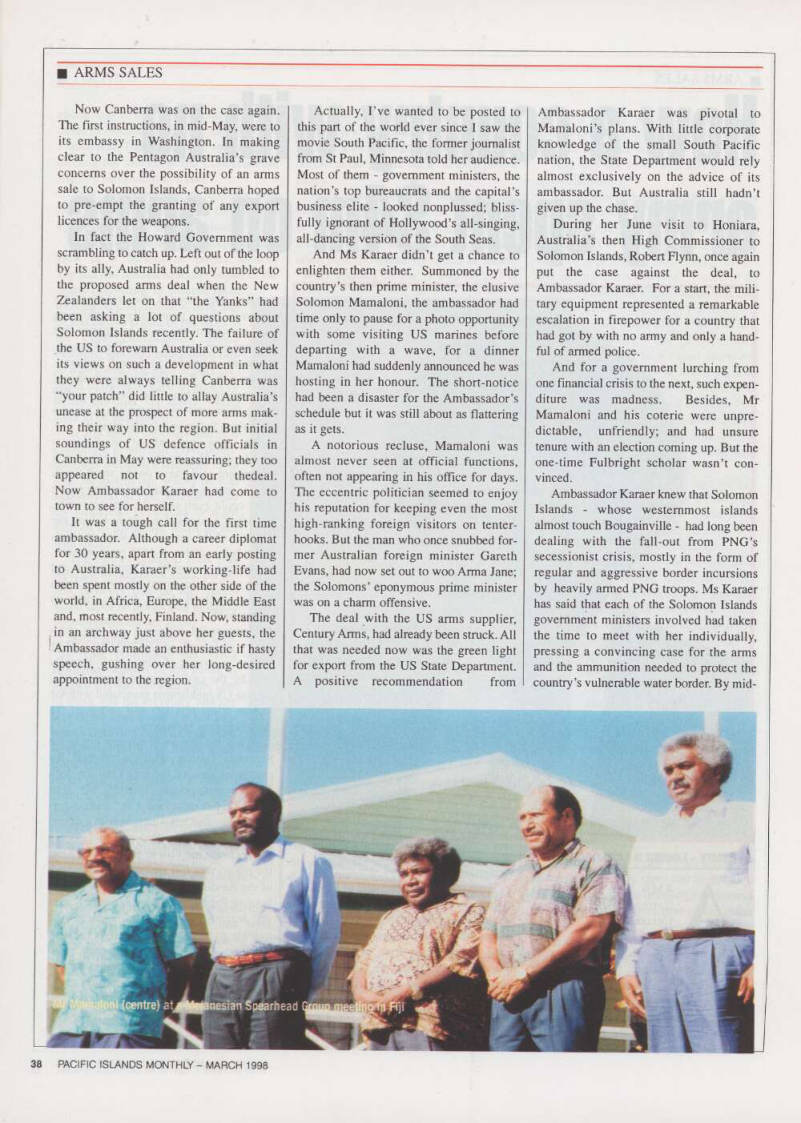
Mr Mamatoni (centre) at a Melanesian Spearhead Group meeting in Fiji
June it was clear to Canberra that it had lost the race.
Three of the four licences were granted.
The State Department only declined, in the end, to facilitate the Solomons’ request for rockets and M 72 anti-armour weapons. But as the rest of arms and aircraft began their slow journey south, Solomons went to the polls, the government changed hands and peace broke out on nearby Bougainville.
The unfriendly border crossings ceased. In time the new prime minister, Bart Ulufa’alu, uncovered evidence of the extraordinary $4 million deal.
According to him there is no sign of a formal contract, simply a letter signed by Mamaloni authorising his long-time friend and associate, an American amateur avia tor, Patrick Murphy, to purchase the arms on behalf of the SI Government.
Anxious to stop delivery of the arms, and recoup the funds, Ulufa’alu wrote immedi ately to the big man: Bill Clinton.
In December he discovered another former Solomons prime minister, Francis Billy Hilly, was on his way to attend a Moonies conference in Washington; Ulufa’alu asked him to hand deliver his letter to the presi dent.
But diplomatic wires became crossed and the envelope came home again. Another copy sent to the US Embassy in Port Moresby also apparently went astray.
Ambassador Karaer has confirmed that a reply was eventually forthcoming from Washington: once the licences were grant ed, the issue became a commercial matter in which the US Government has no power to intervene, it said.
It also pointed out that the amount apparently spent on the arms doesn’t tally with the commercial value of the equip ment listed on the licences. Last month Ulufa’alu met with the Australian Foreign Minister, Alexander Downer, and suggest ed that the Australian
Government might like to keep the arms and pick up the tab. Canberra is consider ing the request as a matter of urgency.
Solomon Mamaloni is incensed. In a four page letter to Ulufa’alu last month he defended the deal describing the prime minister’s decision to stop delivery of the shipment, as “treason”.
“The fact is the Solomon Islands Government successfully pulled this diffi cult deal through with the mightiest power on earth (USA)...unlike some other third world countries it has done the right things, at the very beginning, in presenting its case to Washington.” Mamaloni, makes no men tion of the discrepancy in costs. Perhaps Ambas’sador Karaer would now agree: Hollywood didn’t even get close.
Mary-Louise O’ Callaghan is the South Pacific correspondent of The Australian newspaper where this article first appeared. ■