Democracy and
Editorial
Democracy and the free press
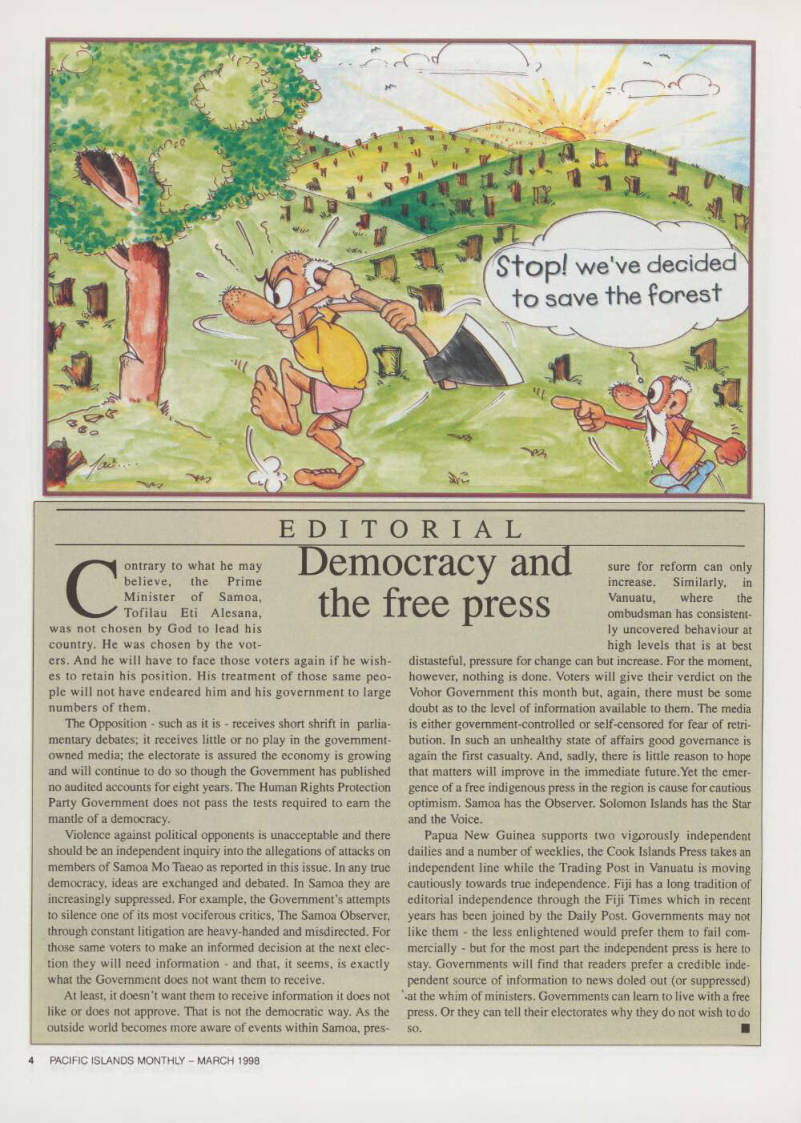
Contrary to what he may believe, the Prime Minister of Samoa, Tofilau Eti Alesana, was not chosen by God to lead his country. He was chosen by the vot
ers. And he will have to face those voters again if he wish es to retain his position. His treatment of those same peo ple will not have endeared him and his government to large numbers of them.
The Opposition - such as it is - receives short shrift in parlia mentary debates; it receives little or no play in the government owned media; the electorate is assured the economy is growing and will continue to do so though the Government has published no audited accounts for eight years. The Human Rights Protection Party Government does not pass the tests required to earn the mantle of a democracy.
Violence against political opponents is unacceptable and there should be an independent inquiry into the allegations of attacks on members of Samoa Mo Taeao as reported in this issue. In any true democracy, ideas are exchanged and debated. In Samoa they are increasingly suppressed. For example, the Government’s attempts to silence one of its most vociferous critics, The Samoa Observer, through constant litigation are heavy-handed and misdirected. For those same voters to make an informed decision at the next elec tion they will need information - and that, it seems, is exactly what the Government does not want them to receive.
At least, it doesn’t want them to receive information it does not like or does not approve. That is not the democratic way. As the outside world becomes more aware of events within Samoa, pres
sure for reform can only increase. Similarly, in Vanuatu, where the ombudsman has consistent ly uncovered behaviour at high levels that is at best
distasteful, pressure for change can but increase. For the moment, however, nothing is done. Voters will give their verdict on the Vohor Government this month but, again, there must be some doubt as to the level of information available to them. The media is either government-controlled or self-censored for fear of retri bution. In such an unhealthy state of affairs good governance is again the first casualty. And, sadly, there is little reason to hope that matters will improve in the immediate future. Yet the emer gence of a free indigenous press in the region is cause for cautious optimism. Samoa has the Observer. Solomon Islands has the Star and the Voice.
Papua New Guinea supports two vigorously independent dailies and a number of weeklies, the Cook Islands Press takes an independent line while the Trading Post in Vanuatu is moving cautiously towards true independence. Fiji has a long tradition of editorial independence through the Fiji Times which in recent years has been joined by the Daily Post. Governments may not like them - the less enlightened would prefer them to fail com mercially - but for the most part the independent press is here to stay. Governments will find that readers prefer a credible inde pendent source of information to news doled out (or suppressed) •at the whim of ministers. Governments can leam to live with a free press. Or they can tell their electorates why they do not wish to do so. ■