Skate on thin ice
pp. 27-28 · Read in the full issue
Corruption
By Sam Vulum
Papua New Guinea’s Prime Minister Bill Skate has stumbled clear of the polit ical gallows recently but his survival after March 13 hinges on his ability to keep his 40-member cab inet intact. He is up against a motion by the opposition, seeking to have parliament remove him, following controversy over the Mujo Sefa videotapes scandal.
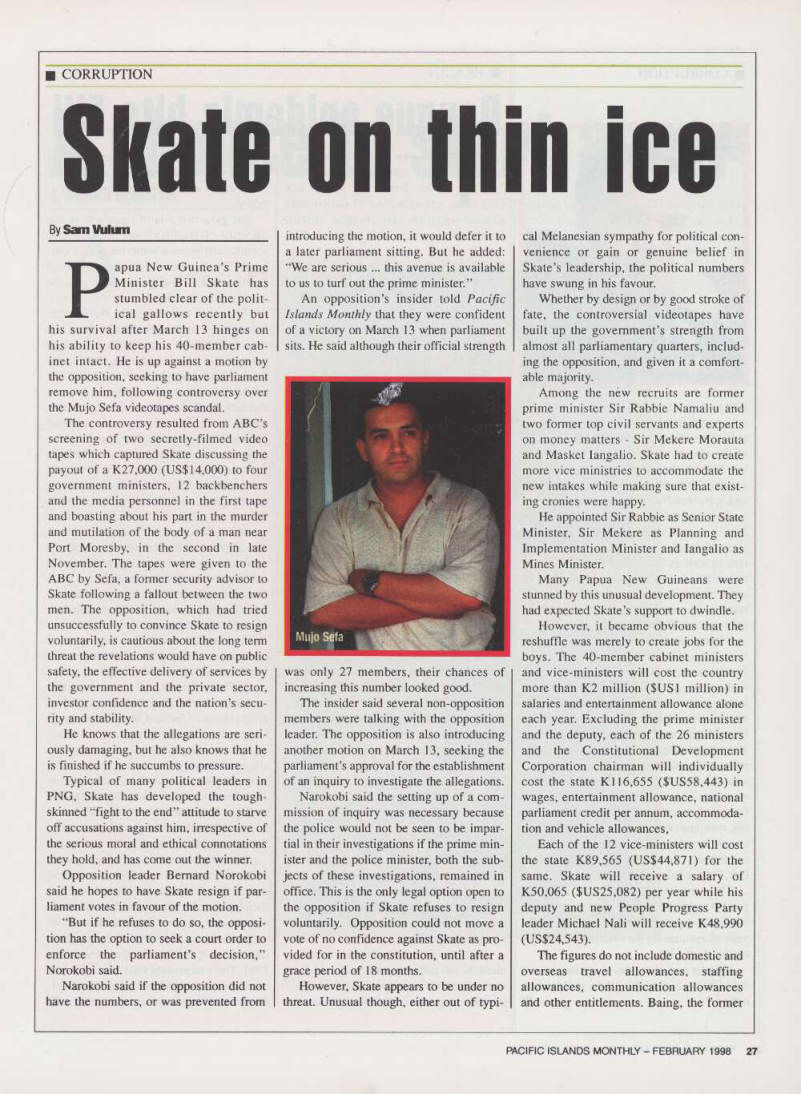
The controversy resulted from ABC’s screening of two secretly-filmed video tapes which captured Skate discussing the payout of a K 27,000 (US$l4,OOO) to four government ministers, 12 backbenchers and the media personnel in the first tape and boasting about his part in the murder and mutilation of the body of a man near Port Moresby, in the second in late November. The tapes were given to the ABC by Sefa, a former security advisor to Skate following a fallout between the two men. The opposition, which had tried unsuccessfully to convince Skate to resign voluntarily, is cautious about the long term threat the revelations would have on public safety, the effective delivery of services by the government and the private sector, investor confidence and the nation’s secu rity and stability.
He knows that the allegations are seri ously damaging, but he also knows that he is finished if he succumbs to pressure.
Typical of many political leaders in PNG, Skate has developed the tough skinned “fight to the end” attitude to starve off accusations against him, irrespective of the serious moral and ethical connotations they hold, and has come out the winner.
Opposition leader Bernard Norokobi said he hopes to have Skate resign if par liament votes in favour of the motion.
“But if he refuses to do so, the opposi tion has the option to seek a court order to enforce the parliament’s decision,”
Norokobi said.
Narokobi said if the opposition did not have the numbers, or was prevented from
introducing the motion, it would defer it to a later parliament sitting. But he added; “We are serious ... this avenue is available to us to turf out the prime minister.”
An opposition’s insider told Pacific Islands Monthly that they were confident of a victory on March 13 when parliament sits. He said although their official strength
was only 27 members, their chances of increasing this number looked good.
The insider said several non-opposition members were talking with the opposition leader. The opposition is also introducing another motion on March 13, seeking the parliament’s approval for the establishment of an inquiry to investigate the allegations.
Narokobi said the setting up of a com mission of inquiry was necessary because the police would not be seen to be impar tial in their investigations if the prime min ister and the police minister, both the sub jects of these investigations, remained in office. This is the only legal option open to the opposition if Skate refuses to resign voluntarily. Opposition could not move a vote of no confidence against Skate as pro vided for in the constitution, until after a grace period of 18 months.
However, Skate appears to be under no threat. Unusual though, either out of typi
cal Melanesian sympathy for political con venience or gain or genuine belief in Skate’s leadership, the political numbers have swung in his favour.
Whether by design or by good stroke of fate, the controversial videotapes have built up the government’s strength from almost all parliamentary quarters, includ ing the opposition, and given it a comfort able majority.
Among the new recruits are former prime minister Sir Rabbie Namaliu and two former top civil servants and experts on money matters - Sir Mekere Morauta and Masket langalio. Skate had to create more vice ministries to accommodate the new intakes while making sure that exist
ing cronies were happy.
He appointed Sir Rabbie as Senior State Minister, Sir Mekere as Planning and Implementation Minister and langalio as Mines Minister.
Many Papua New Guineans were stunned by this unusual development. They had expected Skate’s support to dwindle.
However, it became obvious that the reshuffle was merely to create jobs for the boys. The 40-member cabinet ministers and vice-ministers will cost the country more than K 2 million (SUSI million) in salaries and entertainment allowance alone each year. Excluding the prime minister and the deputy, each of the 26 ministers and the Constitutional Development Corporation chairman will individually cost the state K 116,655 ($U558,443) in wages, entertainment allowance, national parliament credit per annum, accommoda tion and vehicle allowances, Each of the 12 vice-ministers will cost the state K 89,565 (U 5544,871) for the same. Skate will receive a salary of K 50,065 ($U525,082) per year while his
deputy and new People Progress Party
leader Michael Nali will receive K 48,990 (U 5524,543).
The figures do not include domestic and overseas travel allowances, staffing allowances, communication allowances and other entitlements. Baing, the former
Mujo Seta
PPP leader said the nation was in a crisis sit uation with expected losses likely to amount to KlBO million ($U590,179,440) because of the effects of the drought. He failed to lure PPP members to the opposition after his sacking. They decided to remain with Skate and appointed Nali as their leader.
Baing said the government should aim for a lean government instead of a cumber some 28-member cabinet and 12 vice minis ters as well as chairman of parliamentary committees." This is a political marriage of convenience. It indicates that Skate’s gov ernment is pretty shaky because you have got to please all the boys,” he said.
Meanwhile, police have begun investiga tions into allegations of corruption and fraud against certain politicians implicated in the tapes. A special task force started the investigations in late December with the interviewing of Sefa. Police Commissioner Peter Aigilo said the investigations will mean the grilling of certain politicians, min isters and people involved in the alleged scandal. Sefa has so far been questioned extensively by police, the Ombudman’s Commission and the PNG Opposition about his role and who viewed the tape. Sefa invited members of the government’s inde pendent bloc, members like Father Robert Lak, Fabian Pok and Leti Lafanama."
They are young politicians. They are good people and they have allowed them selves to support the prime minister blindly without even seeing the evidence and decid ing for themselves.
If at the end of the day the prime minis ter is held accountable, they will be tar nished.” ■
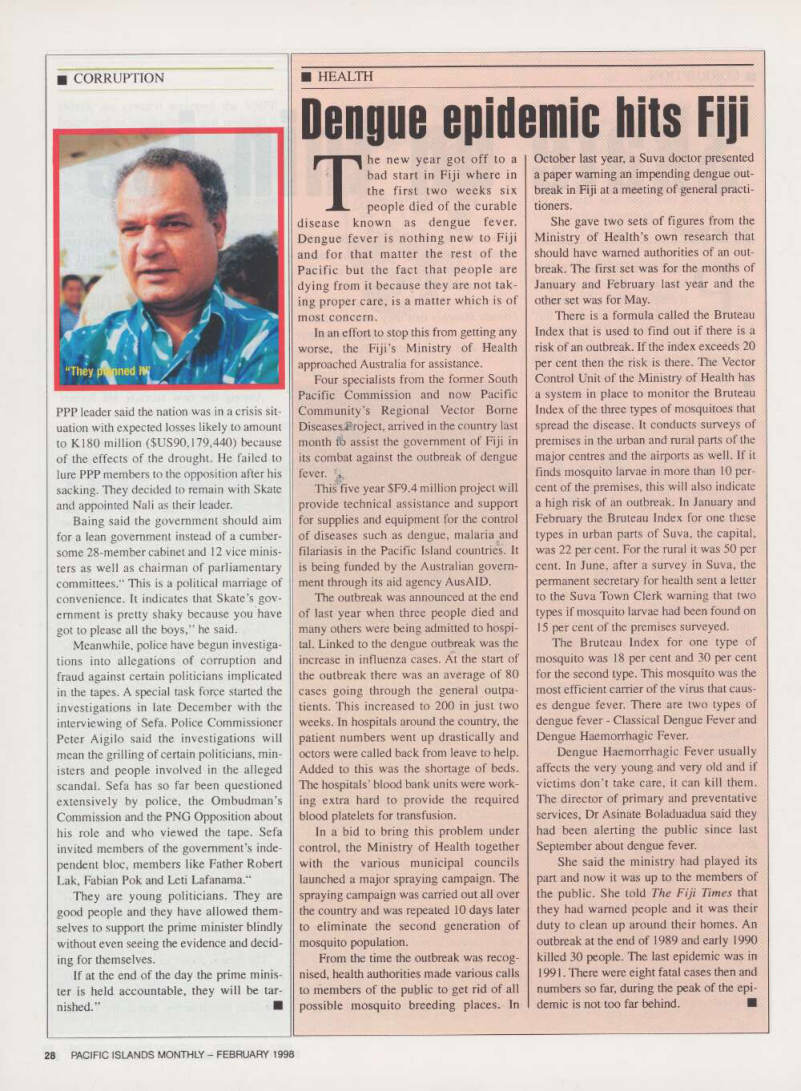
“They mined it"