Uproar in Vanuatu
pp. 24-26 · Read in the full issue
Riot
Reports by PATRICK DECLOITRE
On Monday January 12,
Port Vila was the scene of violence and looting that seemed to have exploded after a long period of wait
ing - buildings and
shops were van dalised, looted by a mob of angry protesters.
Most of them were demanding their money back from Vanuatu’s retirement scheme, the Vanuatu National Provident Fund
(Vnpf).
The demands were triggered by a report published last December by Vanuatu’s ombudsman Marie- Noelle Patterson who accused top politicians of using the VNPF to obtain loans to buy houses (see box).
Since last Christmas,
increasing numbers of protesters gathered in front of the VNPF building, asking for their full contributions (three per cent per month plus another three paid by their bosses) to be paid back.
In return, they were told by the fund they could withdraw up to half of their bal ance, to be repaid within 12 months with a 20 per cent interest under a newly-created “micro-loan” scheme.
But most of the workers refused the proposed conditions and started threaten-
ing to resort to other means if they were not heard.
And this is what happened. On the morning of January 12 - as on previous days, over 500 angry workmen gathered in
front of the VNPF headquarters and started throwing stones at the three-storey build
ing, smashing windows.
Inside, frightened VNPF employees were trapped for over 45 minutes before they could escape after a handful of police men shot tear gas at the crowd.
But the police ranks seemed to be by far out numbered by the crowd.
They were charged by the angry mob, retreated and their truck was turned over. Several of them were injured. ,On the scene, local pho tographers had their cameras smashed.
The crowd then went on toransack the house and office of a former VNPF chairman, Vietnamese born Dinh Van Than.
Other buildings and businesses were also targeted in what seemed to have been a well-set plan.
In the process, several shops were looted,
causing damage not estimated when this issue went to press. National Radio Vanuatu and the television closed down later in the afternoon only to reopen for normal programmes the following day. No
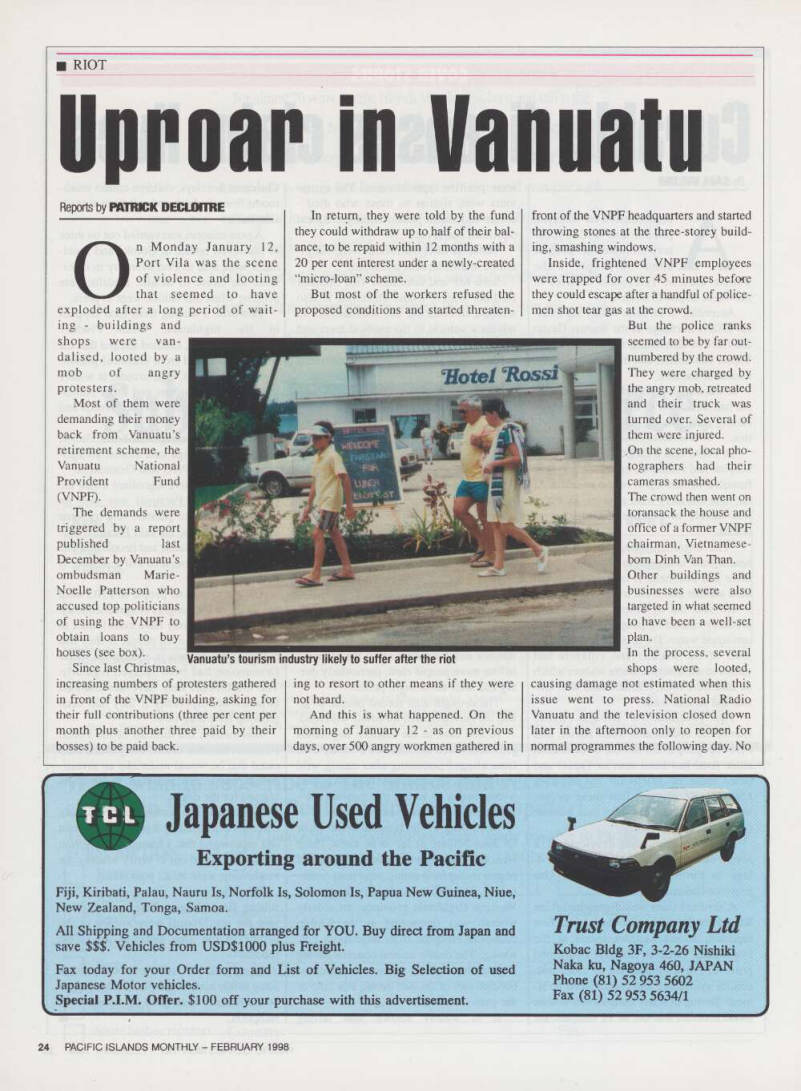
Vanuatu’s tourism industry likely to suffer after the riot
direct allusion to the riot was made, only references to “the current situation” when it was absolutely necessary. They had received threats from some rioters, who feared media reports could lead to their identification.
On the wake of the riot, it seemed Port Vila had been hit by yet another cyclone.
But as opposed to natural disasters, this manmade one had a more devastating psy chological impact. In down town Port Vila, all shops remained closed and boarded up for fear the mob would come back, as the rumour had it.
Two days after the riot, shops in central Port Vila reopened after a call by Prime Minister Serge Vohor. Until early in the afternoon, when it only needed another rumour for all stores and businesses to be boarded up again in five minutes.
An urgent meeting of the council of ministers later resolved to allow everyone to have their contributions back.
On January 13, President Jean-Marie Leye, saying he had acted on Vohor’s request, spoke on national radio to declare a two-week state of emergency, a first for Vanuatu.
“For the last two days, some of have taken the law into their own hands. I’m sorry to see our beautiful town of Port Vila as it is today. I never believed our people could do this,” Leye said in his national address - explaining the emergency state was to “restore peace in our country”.
“Of course, I know what you feel bad about (...) Please take my speech as the speech of a father”.
In a radio address later, Vohor explained that his cabinet took the decision to allow life in Vanuatu to come back to normal and allow a newly-appointed VNPF board of directors to do its work undisturbed.
“There won’t be any more distur bances,” Vohor said.
Under the Vanuatu Constitution, a state of emergency can be declared “in case of natural calamity”, to “prevent a threat” or to restore public order.
It gives extended powers to the council of ministers, which can make regulations for dealing with the public emergency.
This included a ban of all meeting of more than three persons. Weddings were also banned and churches had to apply to the government before holding a religious
service.
Restrictions were also applied to night clubs operations and all meetings were to be dispersed before 10 pm.
Meanwhile, the violence stopped and traditional chiefs in the numerous island communities residing in the capital were given extended powers by police to help restore law and order. They centralised the workers’ demands and were required to keep them quiet until they had been paid.
The chiefs were also commissioned to
encourage their people who had looted the stores to return the stolen good back to the
police.
After the radio station, which was closed down for five hours, went back on air, Vohor said in a special address that every contributor to the fund could now withdraw its full balance and those who could only so far take up to half could now take it fully.
He said after meeting the representa tives of the communities’ traditional
chiefs, the council scrapped the VNPF board and its management and replaced it with a new one.
Appealing to the calm, Vohor said VNPF’s fate would be decided after fresh elections in early March.
“The government thinks this is the right decision to answer the people’s demand, but it also wants those problems created in Port Vila to stop.”
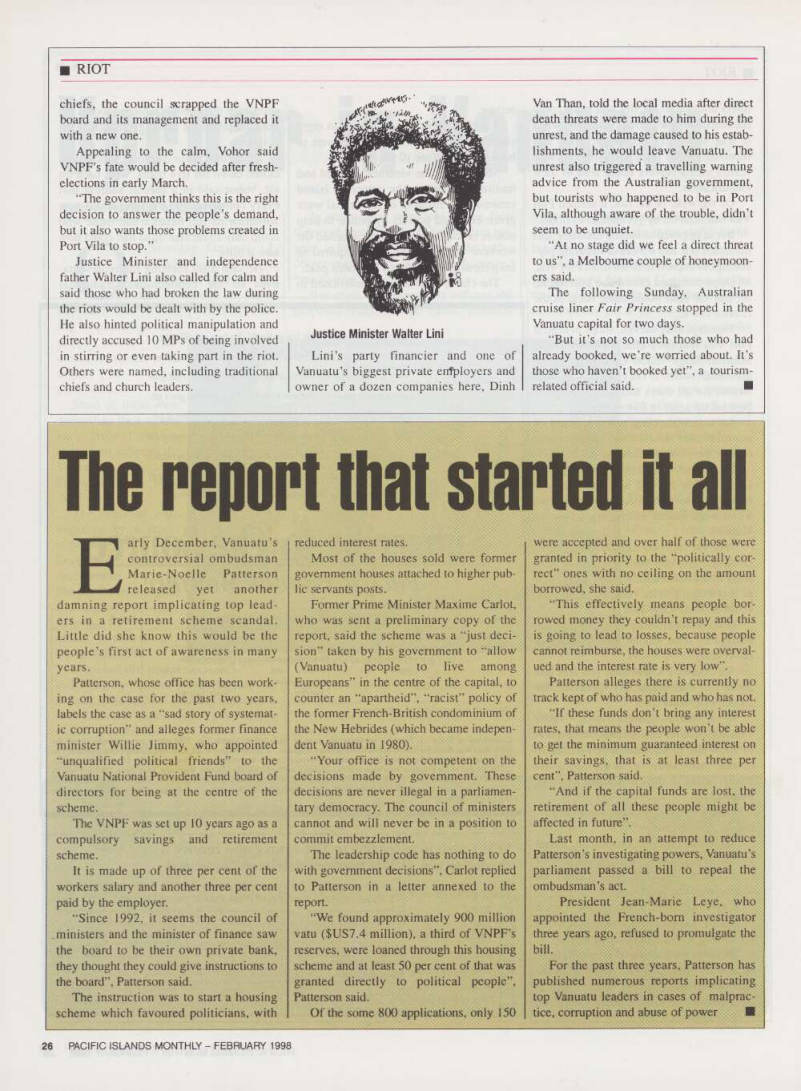
Justice Minister and independence father Walter Lini also called for calm and said those who had broken the law during the riots would be dealt with by the police.
He also hinted political manipulation and directly accused 10 MPs of being involved in stirring or even taking part in the riot.
Others were named, including traditional chiefs and church leaders.
Lini’s party financier and one of Vanuatu’s biggest private enfployers and owner of a dozen companies here, Dinh
Van Than, told the local media after direct death threats were made to him during the unrest, and the damage caused to his estab lishments, he would leave Vanuatu. The unrest also triggered a travelling warning advice from the Australian government, but tourists who happened to be in Port Vila, although aware of the trouble, didn’t seem to be unquiet.
“At no stage did we feel a direct threat to us”, a Melbourne couple of honeymoon ers said.
The following Sunday, Australian cruise liner Fair Princess stopped in the Vanuatu capital for two days.
“But it’s not so much those who had already booked, we’re worried about. It’s those who haven’t booked yet”, a tourism related official said. ■
Justice Minister Walter Lini